Six multilateral development banks and international financial institutions have pledged to develop a coordinated roadmap for stronger fertiliser supply chains.
The agenda spans production, processing, blending, storage, transport, soil diagnostics, digital agriculture and farmer finance.
For African smallholders, its value will depend on whether coordinated finance lowers vulnerability while improving soil health, nutrient efficiency and reliable access.
Global lenders target fertiliser system vulnerabilities
Six multilateral development banks and international financial institutions have declared their readiness to develop a coordinated roadmap for strengthening fertiliser supply chains, responding to repeated shocks that have raised costs and threatened food security.
The signatories are;
- The African Development Bank Group
- Asian Development Bank
- European Bank for Reconstruction and Development
- Inter-American Development Bank Group
- International Fund for Agricultural Development
- World Bank Group
Their joint statement places smallholder farmers and low-income households at the centre of the problem.
- When fertiliser supply is disrupted, farmers can plant less, apply too little or pay prices that destroy margins.
- The consequences travel through harvests, food markets and household budgets, turning a logistics shock into a development emergency.
Roadmap spans factories, farms and corridors
The proposed agenda goes beyond emergency imports.
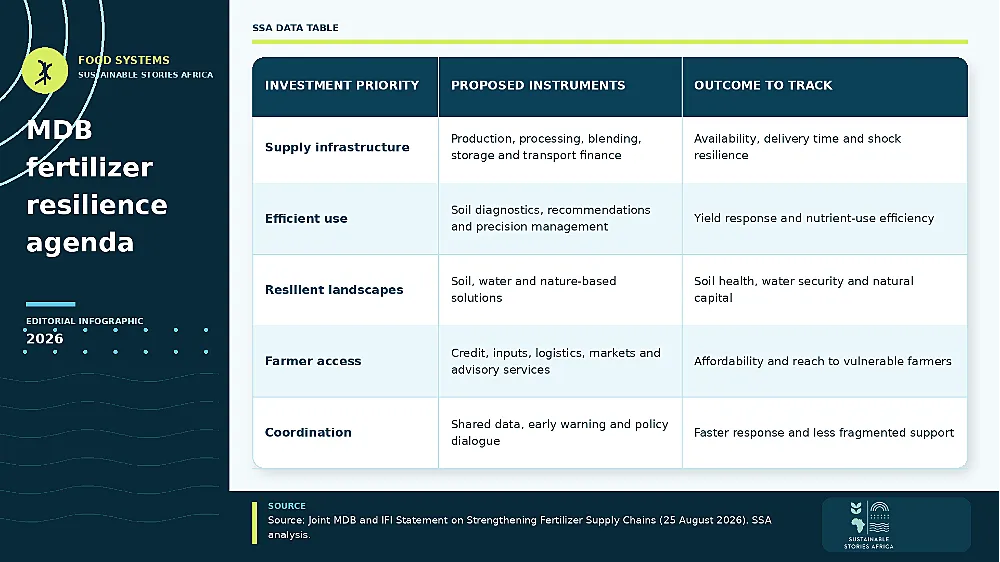
- It calls for finance across upstream production, processing, blending, storage, transport and other critical infrastructure, supported by better market monitoring and timely access.
- Economic corridors are presented as a way to reduce vulnerability to future shocks.
The institutions also want to improve fertiliser-use efficiency through soil diagnostics, tailored recommendations, precision nutrient management, digital agriculture, farmer advisory services, research and innovation.
A third pillar addresses wider food-system resilience through soil and water management, nature-based solutions, technology and private investment.
The roadmap would build on the 2022 international financial institution action plan on food insecurity and emerging G20 and G7 work on monitoring, early warning, coordination and timely finance.
This ambition is to connect policy dialogue, analytical work, technical assistance, public finance and private-sector engagement rather than treat fertiliser access as a single procurement transaction.
Resilience can improve yields and soils
For African agriculture, coordinated investment could reduce exposure to distant production centres, congested ports, foreign-exchange shortages and weak inland logistics
Local or regional blending can match products more closely to crop and soil needs, while storage and market information can reduce seasonal shortages.
Efficiency is equally important.
- More fertiliser is not automatically better.
- Without soil testing, extension and water management, farmers may spend scarce cash on the wrong nutrient mix and contribute to soil degradation or pollution.
- A resilient system should deliver the right input, in the right quantity, at the right time, alongside practices that restore natural capital.
Finance must reach farmers and outcomes
The MDBs should convert the statement into a roadmap with country priorities, financing windows, delivery responsibilities and public indicators.
- Projects should disclose whether finance improves affordability, reduces delivery time, increases storage resilience and raises nutrient-use efficiency.
- Safeguards must address energy use, emissions, water, biodiversity and community impacts across new infrastructure.
Investment choices should begin with a transparent diagnosis of each corridor.
- A country dependent on imports may need port, rail and storage improvements; another may benefit from regional blending, quality laboratories or working capital for distributors.
Public finance should crowd in responsible private investment where market failures are clear, while avoiding stranded assets or concentrated market power.
- Open price, stock and delivery data can help governments intervene earlier and allow farmers to plan.
- Procurement and concessional finance should include performance conditions so disbursement is tied to service improvements, not only construction milestones.
Smallholder access requires more than large assets.
- Credit, aggregation, last-mile distribution, trusted advisory services and transparent pricing must reach women and young farmers as well as established agribusinesses.
Governments should improve customs, standards and competition while avoiding blanket subsidies that obscure those who benefit.
Civil society and farmer organisations need a role in testing whether investments solve real constraints.
Path Forward – Turn Joint Ambition Into Farm Resilience
The signatories should publish a time-bound roadmap that connects infrastructure finance with soil health, farmer services, market monitoring and measurable food-security outcomes. Coordination must be visible at the country level, where farmers experience delays and price shocks.
Africa can benefit if finance strengthens regional value chains without locking agriculture into inefficient input use.
The standard should be resilient harvests, healthier soils and affordable, timely access for vulnerable farmers.