Governments are taking sharply different approaches to artificial intelligence in schools, from Norway’s proposed restrictions to early curriculum integration elsewhere.
The deeper question is not simply when students should use AI, but which capabilities education and work must still develop.
As powerful models become widely available, judgement, critical thinking, creativity and originality may become the real sources of advantage—if automation does not remove the experiences that build them.
Schools test different routes into AI
A widening policy debate over artificial intelligence in education is shifting attention from access to capability.
- Norway has moved close to restricting AI in elementary schools.
- Poland is introducing AI laboratories in primary and secondary education
- The United Arab Emirates is bringing the technology into curricula from kindergarten, according to a World Economic Forum commentary.
The contrast raises a more useful question than whether children should use AI early:
- What should they be able to do by the time they enter the workforce?
- If technology can write, analyse and generate ideas quickly, education systems must decide which human capabilities require protected time, practice and even failure.
Niklas Mortensen, chief design officer at Designit, argues that judgement, critical thinking, creativity, curiosity and the ability to connect unrelated ideas will matter more as powerful models become widely available.
- These are not senior-management traits acquired automatically with promotion.
- They are built through doing difficult work.
Efficiency can weaken tomorrow’s expertise
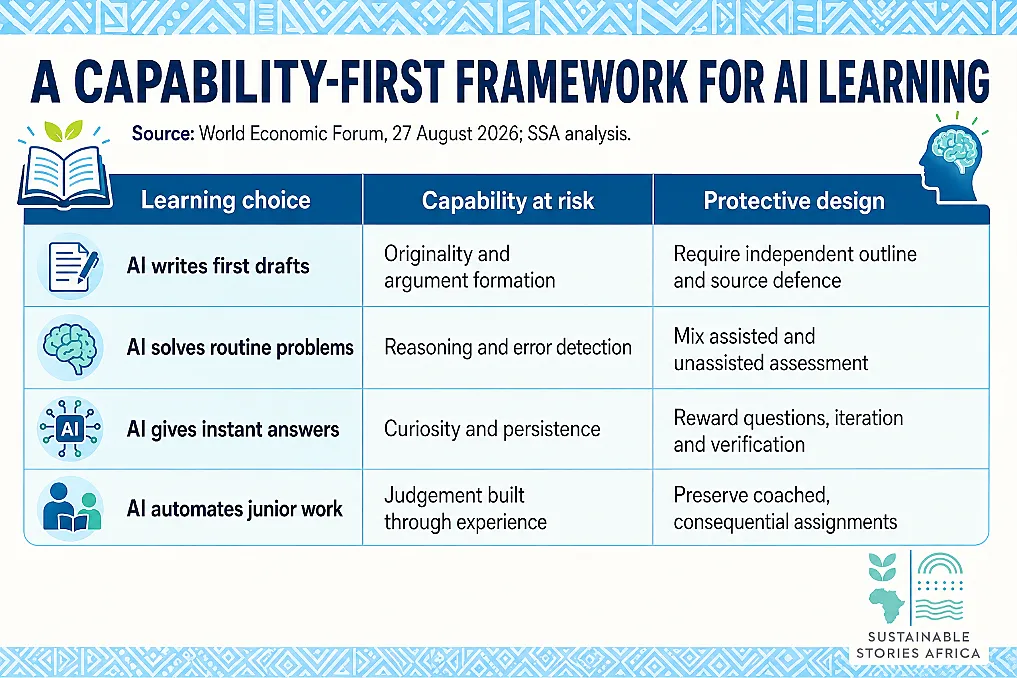
People learn judgement through imperfect decisions, develop critical thinking by wrestling with problems and build creativity through experimentation. AI can remove much of this friction.
- That may make today’s workforce more productive while reducing the opportunities through which tomorrow’s workforce learns to recognise weak reasoning or challenge a plausible but wrong answer.
The same risk appears at work.
- Junior staff once learned through research, flawed first drafts and feedback from experienced colleagues.
- If AI completes all of that work instantly, organisations may produce more output while developing fewer people who can assess its quality.
This is a human-capital version of technical debt.
African systems need deliberate inclusion
For African education systems, a simple ban-versus-adoption frame is especially unhelpful.
- Many learners still face gaps in devices, connectivity, teacher support and foundational literacy.
- Premature dependence on tools can deepen inequality, while excluding students completely can deny them important digital fluency.
A balanced approach would teach how models work, where they fail, how to verify outputs and when original effort is necessary.
- Students should use AI for selected tasks while still researching, calculating, writing and reasoning without it.
- Teachers need training and assessment methods that reward process, evidence and reflection rather than polished output alone.
The policy challenge is not static because models, interfaces and classroom practices will keep changing.
- Standards should focus on durable principles, age-appropriate use, privacy, transparency, verification and human accountability, rather than prescribing one tool.
- Schools also need procurement rules that protect learner data and avoid locking public education into platforms whose costs or terms can change abruptly.
Assessment will have to evolve.
- Oral defence, supervised practical tasks, version histories and reflective notes can help teachers understand how a learner reached an answer.
These approaches are more demanding than checking a finished essay, but they make the learning process visible. They turn AI use into an object of critical inquiry rather than a hidden shortcut.
Protect productive struggle while adopting tools
Businesses should map work according to its developmental value.
- Repetitive administration may be automated, but early-career assignments that build judgement should be redesigned rather than removed.
- Managers can require employees to explain assumptions, test outputs and compare machine recommendations with independent reasoning.
Governments should connect AI policy with teacher development, curriculum standards, child protection and equitable access.
- Success should be assessed through learning and judgement, not the number of licences deployed.
- Organisations will not win because they possess the same tools as everyone else; they will win because their people know when and how to challenge them.
Path Forward – Teach people to challenge intelligent machines
Education leaders should define the human capabilities every learner must develop, then decide where AI supports or weakens that objective. Employers should protect coached work that builds early-career judgement.
Africa needs equitable access, trained teachers and assessments that value reasoning as much as output.
The strongest AI strategy will not automate the most work; it will develop people capable of using powerful tools with originality, evidence and responsibility.