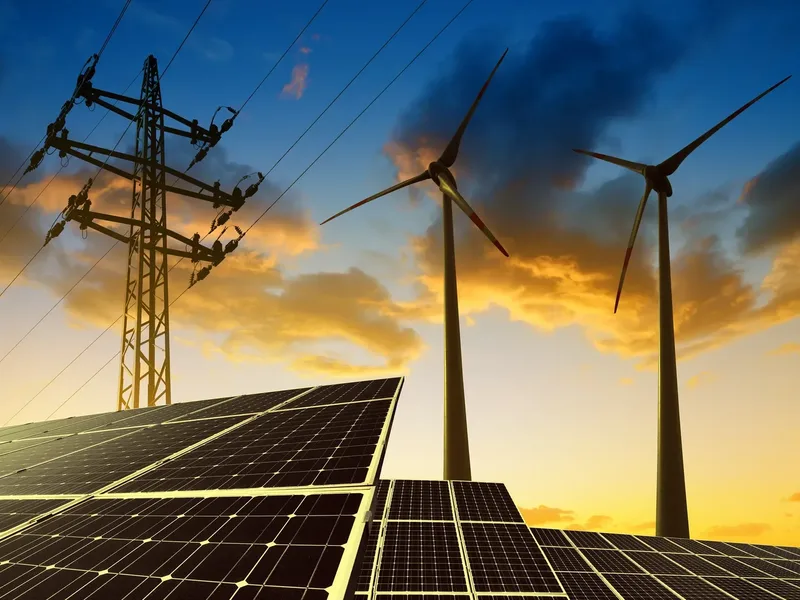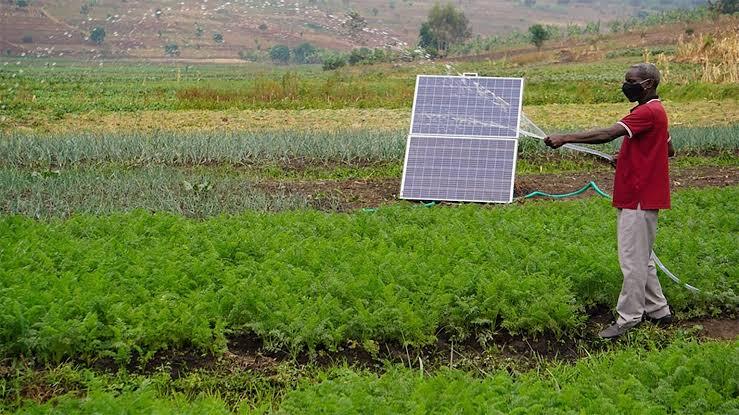
Africa’s food economy is becoming a major frontier for decentralised clean energy as leaders gather at the Africa Food Systems Forum in Rwanda.
Agriculture employs more than 60% of the continent’s workforce but consumes barely 2% of its electricity.
Solar irrigation, cooling and processing could raise productivity, reduce losses and bring reliable power closer to rural communities—but only if finance and service models reach smallholders.
Food systems meet an energy deficit
Africa’s agricultural sector is moving to the centre of the continent’s clean-energy conversation as the 16th Africa Food Systems Forum continues in Rwanda through September 5.
- Discussions are focusing on how reliable, sustainable power can strengthen a sector that Renewables Rising says accounts for about 40% of Africa’s gross domestic product and employs more than 60% of its working population.
The mismatch is stark:
- Agriculture consumes barely 2% of the continent’s electricity and still depends heavily on outdated fossil-fuel technologies.
- A farmer may grow a valuable crop but lose income because irrigation is unreliable, harvests cannot be cooled quickly, or local processing stops when fuel prices rise.
- Energy poverty therefore appears not only as a household problem but also as lower farm productivity and food-system waste.
The forum comes one year after the Agri-Energy Coalition was formed to advance sustainable energy solutions for the sector.
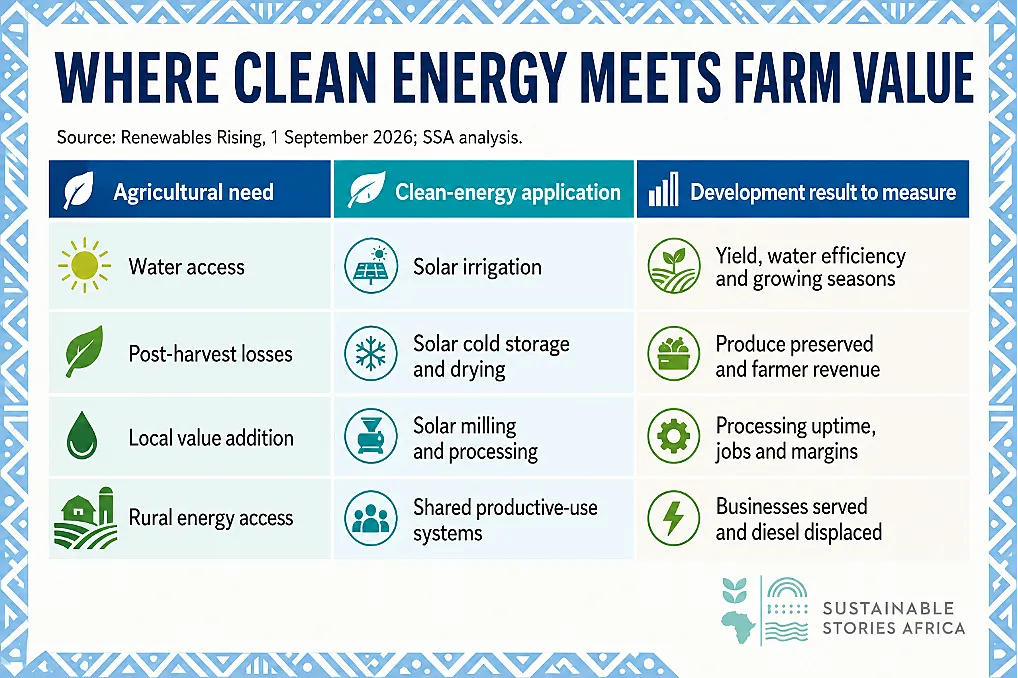
- Its timing matters because decentralised solar technologies are becoming increasingly relevant for irrigation, cold rooms, milling, drying and other productive uses located far from dependable grids.
Productive power can reshape rural economics
Off-grid solar is described as the quickest and most cost-effective electricity option for almost half of Africa’s population that still lacks access.
In agriculture, its development impact can be multiplied:
- The same system that powers a pump or cold store can support nearby businesses, clinics or digital services if projects are planned around local demand.
The commercial case, however, is more demanding than installing panels.
- Agricultural cash flows are seasonal, customers are dispersed, and equipment must survive harsh operating conditions.
- Providers need financing that matches harvest cycles, technicians who can maintain systems and reliable data on how energy use changes yields, losses, income and repayment performance.
From equipment sales to service ecosystems
If those conditions are met, clean energy can help farmers irrigate more consistently, preserve produce longer and sell into higher-value markets.
Local processing can keep more value in rural communities, while reduced diesel dependence can protect margins from fuel-price volatility and cut pollution around workers and food.
The risk is that the market serves only large commercial farms.
- Smallholders may face high upfront costs, uncertain land tenure or limited credit histories. Women farmers can encounter additional barriers to assets and finance.
- Without aggregation, guarantees and inclusive product design, the communities with the greatest energy need may remain the least bankable on paper.
Productive-use energy also offers a route to stronger climate resilience.
- Efficient pumps can help farmers manage rainfall variability, while cooling and drying can protect harvests during increasingly disruptive heat and transport delays.
- The technology must nevertheless be paired with sustainable water management: cheaper pumping without monitoring can accelerate groundwater depletion and create a new environmental problem.
Reliable demand data will be crucial.
- Energy planners often see a village as a household-access target, while agricultural agencies see the same place through crops and yields.
- Combining those datasets can reveal viable clusters for shared infrastructure, allowing developers to size systems around irrigation, storage and processing demand instead of installing assets that are either too small or poorly used.
Build finance around farmers’ real cash flows
Governments and development partners should connect agricultural policy, energy planning and rural finance.
- Results-based subsidies can lower first costs, while cooperatives and value-chain buyers can aggregate demand.
- Local banks and equipment providers should test pay-as-you-grow models tied to credible crop and offtake data rather than standard monthly repayment assumptions.
Investors should also require outcome reporting beyond megawatts installed.
- The stronger measures are hours of reliable service, tonnes of produce preserved, farmer income gained, diesel displaced and the share of women and smallholders reached.
These indicators show whether clean energy is actually strengthening food security.
Path Forward – Power farms, strengthen Africa’s food systems
The next year of the Agri-Energy Coalition should produce investable country pipelines, common impact metrics and financing products matched to agricultural seasons.
Public support should prioritise first-loss risk, market infrastructure and local maintenance capacity.
Clean energy becomes food-system infrastructure when it helps farmers produce, preserve and process more reliably.
Scaling that outcome requires treating rural users as productive customers, not simply as beneficiaries.