
ManpowerGroup chief executive Jonas Prising says AI is increasing recruitment speed but not necessarily improving the accuracy of hiring decisions.
Employers face surging, increasingly uniform applications as candidates use generative and agentic tools to tailor submissions.
For African labour markets, the message is urgent: automate transactions, but preserve interviews, critical assessment, ethical oversight and pathways that recognise potential beyond keywords.
Automation creates a recruitment paradox
Artificial intelligence is making it easier to apply for jobs and faster for employers to screen candidates; however, it is not necessarily producing better matches.
Jonas Prising, chair and chief executive of ManpowerGroup, told the World Economic Forum’s Meet the Leader programme that human judgement has become more important as AI reshapes both sides of recruitment.
Candidates are using large language models and agentic tools to automate applications and optimise CVs against job-advertisement keywords.
- Employers consequently receive more submissions that look increasingly similar.
- The technology can process that volume, but polished uniformity makes it harder to distinguish capability, motivation and fit from optimisation.
Prising said the result is paradoxical: technology may improve speed without improving accuracy.
He argued that recruiters’ conversations and assessments are becoming the most important hiring tools, while final recommendations and decisions at ManpowerGroup remain with people.
Trust now sits inside job design
The issue extends beyond recruitment.
- Prising said technological innovation depends on human adoption, yet many leaders have not clearly explained how AI will support company strategy or improve employees’ working lives.
- Organisations often bolt AI onto individual tasks rather than redesigning complete processes around a deliberate mix of machine capability and human work.
That matters in African markets where digital access, formal credentials and stable work histories are uneven.
- Keyword-led screening can efficiently reproduce the biases contained in historic data or exclude capable applicants whose experience is expressed differently.
- It can also worsen the faceless experience of sending applications without feedback.
Better hiring recognises skills and context
Used carefully;
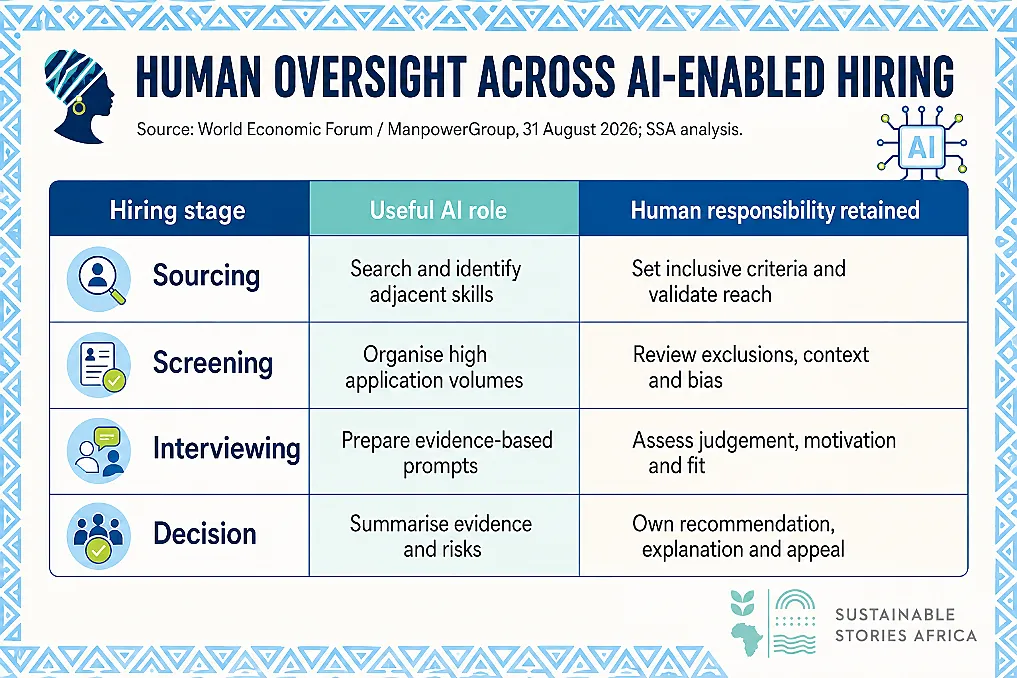
- AI can remove repetitive administration and give recruiters more time for interviews, candidate support and workforce planning.
- It can help identify adjacent skills, widen sourcing and improve communication.
However, these benefits require data quality, testing for disparate impact, accessible channels and clear responsibility when a system is wrong.
Prising’s suggested interview questions focus on judgement:
- How candidates use AI, where it has helped, where it has disappointed and what they understand about its limits.
- This approach tests critical thinking rather than mere familiarity.
- It also recognises that specialists and broad-context generalists can both create value in an AI-enabled workplace.
The volume problem also creates new integrity risks.
- Synthetic profiles, automated applications and identity uncertainty can overwhelm systems built around documents and keywords.
- Employers may respond with more surveillance or blanket filters, but these can punish genuine candidates and exclude those with limited digital footprints.
- Proportionate identity checks, work-sample assessments and direct conversation offer a more credible response than escalating automation alone.
Young applicants are especially exposed when employers hire only people who can become productive immediately.
- Prising linked part of the difficult market to economic uncertainty and low employer confidence rather than declaring broad AI-driven job destruction.
- Organisations still need entry routes, such as apprenticeships, graduate roles and coached project work, through which inexperienced people acquire the judgement firms later say they cannot find.
Job seekers also need disclosure.
- Candidates should know when automated tools materially shape screening, what information is assessed and how to challenge an error.
- Meaningful notice can improve trust and help people present evidence that a rigid digital form might otherwise miss.
Keep people accountable for people decisions
Employers should document which recruitment tasks are automated, test tools across demographic groups and provide candidates with understandable routes to correction or human review.
Recruiters need training in AI literacy, structured interviewing and bias control so that “human judgement” is disciplined rather than arbitrary.
Leadership must also tell workers what technology is intended to change and how it will allocate productivity gains. Without that trust, adoption will lag, and efficiency claims will not translate into durable organisational performance.
Path Forward – Automate tasks, never outsource hiring accountability
Employers should redesign recruitment around transparent task allocation: machines can organise and recommend, while trained people assess evidence, speak with candidates and remain accountable for outcomes.
African institutions can use this moment to expand skills-based hiring and candidate access, but only with bias testing, human review and useful feedback. Faster recruitment is valuable; fair, accurate and trusted recruitment is the actual goal.