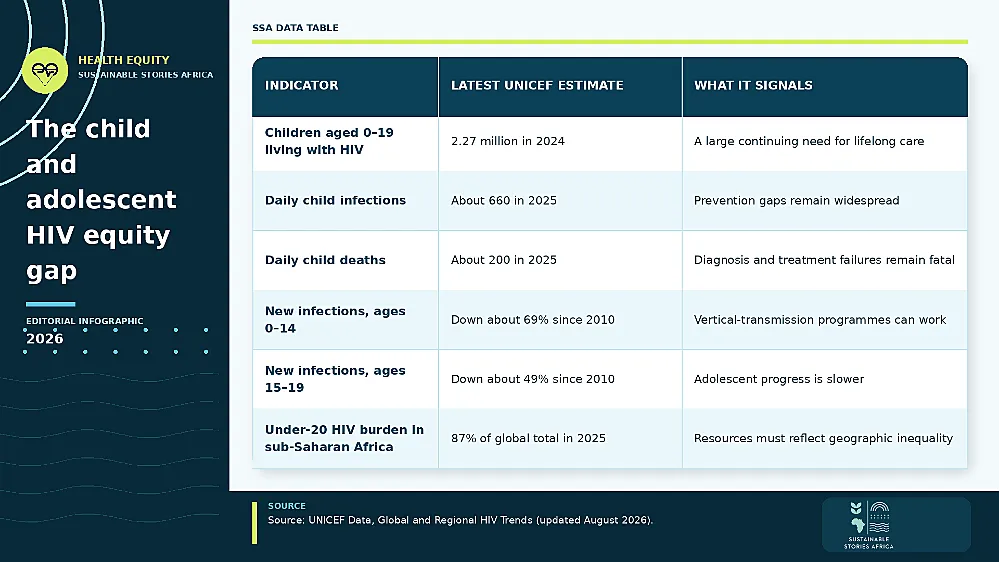
About 660 children became infected with HIV, and roughly 200 died from AIDS-related causes each day in 2025, UNICEF estimates.
New infections among younger children have fallen sharply since 2010, but adolescent progress is slower, and sub-Saharan Africa remains the centre of the burden.
The data points to preventable gaps in diagnosis, treatment, maternal care and adolescent-focused prevention.
Daily infections reveal a preventable emergency
Approximately 660 children became infected with HIV and about 200 died from AIDS-related causes every day in 2025, according to UNICEF’s latest global and regional trends.
The figures show that major scientific and programme advances have yet to translate into equal protection for children and adolescents.
- UNICEF estimates that 2.27 million children aged 0 – 19 were among the 41 million people living with HIV worldwide in 2024.
- In 2025, about 74,000 people under 20 died from AIDS-related illnesses, representing approximately 13% of all AIDS-related deaths.
Most of those deaths were linked to inadequate access to prevention, care and treatment.
Progress divides sharply by age and geography
There is real progress.
- Around 93,000 children aged 0 – 14 acquired HIV in 2025.
- New infections in that age group have fallen by about 69% since 2010, largely because of stronger prevention of vertical transmission.
- Annual AIDS-related deaths among children aged 0 – 14 have declined by about 84% from their 2001 peak.
However, adolescents are being left further behind.
- New infections among 15 – 19-year-olds have fallen by about 49%
- Deaths in that group have declined only 46% from their 2007 peak.
- About 70% of the 74,000 deaths among under-20s in 2025 occurred in children younger than ten.
Geography deepens the inequality.
- Sub-Saharan Africa accounted for about 64% of all people living with HIV.
- 87% of children and adolescents living with HIV in 2025.
The region therefore carries a disproportionate need for maternal treatment continuity, early infant diagnosis, paediatric medicines and adolescent services.
Existing tools could close survival gaps
The encouraging trend among younger children shows what sustained action can achieve.
- When pregnant women know their status, receive effective treatment and remain in care, vertical transmission can be sharply reduced.
- Early diagnosis and child-friendly antiretroviral medicines can turn HIV from a fatal infection into a manageable condition.
Adolescents need services designed around their lives.
- Confidential testing, stigma-free care, comprehensive sexuality education and protection from gender-based violence can reduce missed opportunities.
In southern Africa, prevention must also address relationships between adolescent girls or young women and older men, while protecting agency and avoiding blame.
Health systems must find every child
Governments and partners should use age-, sex- and location-disaggregated data to identify where children are missed between antenatal care, birth testing, treatment initiation and long-term retention.
Procurement systems must maintain paediatric medicine supplies, and community health workers need support to reconnect families to care without breaching confidentiality.
The orphanhood burden also demands attention beyond clinics.
- UNICEF estimates that 13.5 million children under 18 had lost one or both parents to AIDS-related causes by 2025.
- Bereavement can deepen poverty, interrupt schooling and expose children to discrimination or homelessness. Social protection, school support and legal identity services should therefore be connected to HIV programmes.
- When families must choose between transport to a clinic and food, treatment continuity becomes a household economics problem as much as a medical one.
Integrated services can protect both health outcomes and a child’s chance to remain in school.
Funding decisions should protect high-impact services even under fiscal pressure.
- Schools, youth organisations and primary-care facilities can create multiple entry points for prevention and treatment.
Success must be measured not only through national averages, but through viral suppression, avoidable deaths and whether the hardest-to-reach children receive continuous care.
Path Forward – Every Child Must Reach Effective Care
The next phase of the HIV response must close the age and regional gaps hidden by global progress.
Priority actions are maternal treatment continuity, early infant diagnosis, dependable paediatric medicines and adolescent-responsive prevention and care.
Sub-Saharan African governments and partners should target resources using disaggregated data and community evidence.
No decline is sufficient while hundreds of children still acquire HIV or die each day from preventable causes.