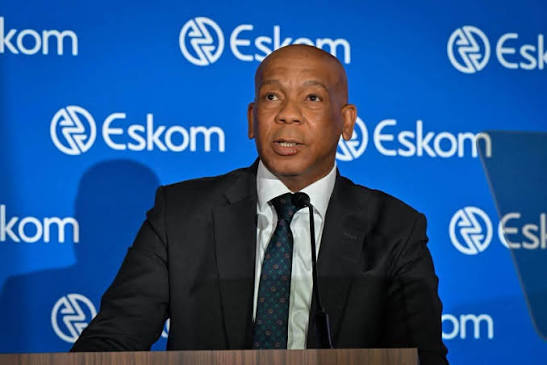
Eskom has reported a second consecutive annual profit, earning about $1.9 billion despite electricity sales falling 6.2%.
Only four days of load-shedding in the 2026 financial year signal a striking operational recovery after years of damaging outages.
However, surplus power, restructuring and the cost of building a cleaner system mean South Africa’s utility crisis has changed shape, not disappeared.
Profit returns as blackouts retreat
South Africa’s Eskom has delivered its second consecutive profitable year, reporting about $1.9 billion in profit even as electricity sales declined by 6.2%.
The result gives the state-owned utility fresh financial breathing room. It marks a notable reversal after years in which debt, unreliable plants and severe load-shedding became symbols of a wider national crisis.
The operational turnaround is as important as the income statement.
- Eskom recorded only four days of load-shedding during its 2026 financial year, according to Renewables Rising.
- For households and firms that had organised daily life around outage schedules, the improvement means fewer interrupted production lines, spoiled goods and costly hours on diesel generators.
However, profitability does not by itself prove that the utility has escaped its structural problems.
- Falling sales have left Eskom with surplus electricity it is struggling to sell.
That creates a new challenge:
- The company must maintain a large network, finance investment and manage legacy obligations while customers with purchasing power increasingly consider private generation and bilateral supply.
Recovery changes the problem, not stakes
The shift from scarcity to surplus is a better problem, but it exposes the commercial tension at the centre of the transition.
- If industrial demand remains weak or high-paying customers reduce grid purchases, revenue can fall even when plants perform better.
- Tariff increases intended to recover costs can then encourage more customers to leave, deepening the pressure on those who remain connected.
Eskom’s unbundling also remains central.
- The utility has positioned Eskom Green, its renewable-energy subsidiary, as part of a future model that will engage customers directly through power-purchase agreements.
- That could help Eskom retain large users seeking cleaner electricity and could turn decarbonisation from a threat to its existing business into a source of new revenue.
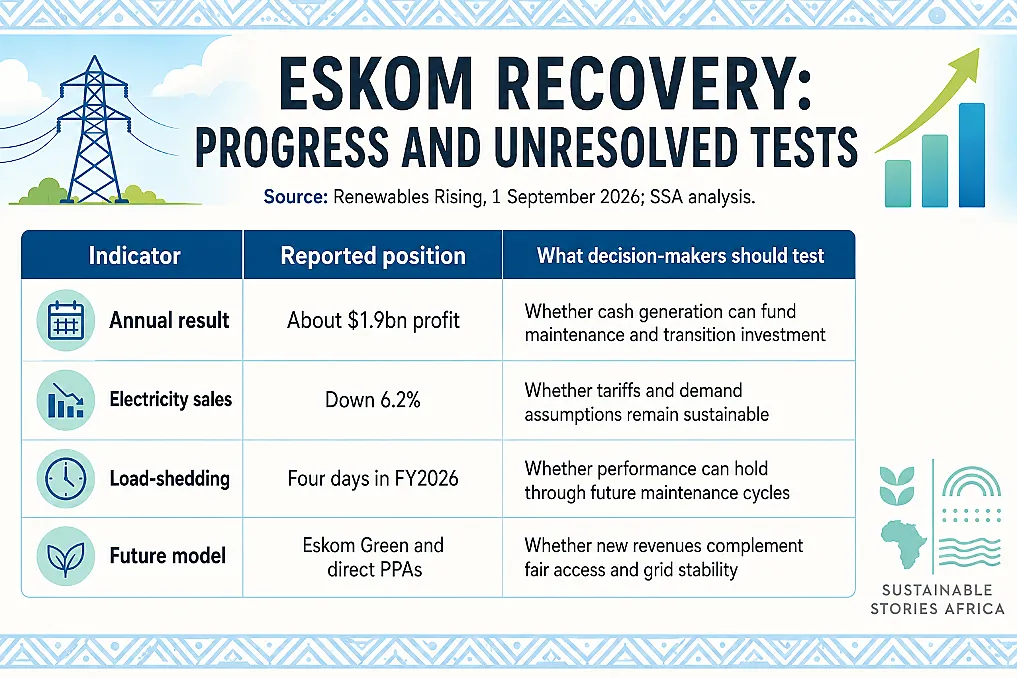
What the turnaround still must prove
The opportunity is substantial.
- A reliable utility can support industrial recovery, reduce the private cost of backup power and create space for renewable generation, storage and transmission investment.
- Eskom’s balance-sheet improvement could also strengthen its ability to plan projects and work with private capital rather than operating in permanent emergency mode.
However, the gains will endure only if maintenance discipline survives, transmission capacity expands, and reforms produce transparent, accountable institutions.
South Africa must also decide how to share system costs as more customers procure power directly.
- A transition that protects reliability but leaves low-income users carrying an unfair share of network costs would exchange one crisis for another.
The wider economy has a direct stake in that durability.
- Years of unreliable electricity suppressed investment, weakened manufacturing schedules and forced smaller firms to divert scarce cash into backup generation.
- A sustained improvement can release some of that money for wages, equipment and expansion.
- It can also improve confidence in public institutions after citizens repeatedly carried the financial and practical costs of utility failure.
Debt relief and state support must therefore be judged against public outcomes, rather than by only accounting recovery.
- If the utility’s finances improve while municipal arrears continue rising or network investment lags, risks will only migrate across the system.
- Transparent treatment of public support, overdue accounts and capital commitments is essential to show who is paying for the turnaround and who benefits from it.
Turn profit into durable public value
Government, regulators and Eskom should use the profitable period to publish a measurable recovery scorecard covering debt, plant performance, transmission delivery, sales, arrears and transition investment.
- Clear data would help the public distinguish temporary relief from durable repair and would give investors a firmer basis for committing capital.
The practical test is no longer whether Eskom can keep the lights on for one improved year.
- It is whether the utility can convert operational stability into affordable, lower-carbon electricity while remaining financially viable in a market with more producers and more customer choice.
Path Forward – Make Eskom’s recovery survive the transition
South Africa should protect maintenance gains, accelerate transmission investment and complete unbundling with transparent governance.
Eskom Green’s contracts should disclose how it manages risks, network costs and public-interest obligations.
A credible recovery will be measured through reliable and affordable electricity, a stronger balance sheet and a transition that keeps vulnerable users connected.
Profit is a platform for reform, not proof that reform is finished.
Culled from: Has Eskom really escaped the utility crisis?