Girls’ education is increasingly being framed as a core development priority for Chad’s long-term future.
Keeping girls in school can strengthen health, income prospects, civic participation and national resilience.
The central task is converting commitment into safe, inclusive and sustained learning opportunities.
Education as National Infrastructure
Chad’s future will be shaped not only by roads, energy systems, and public finances, but by whether girls can enter school, stay there and move into adulthood with the knowledge, confidence and opportunity to participate fully in society.
The African Development Bank has highlighted girls’ education as a building block for Chad’s future, underscoring the connection between learning, gender equality and national development.
This message matters because education is not a stand-alone social service. It is human infrastructure.
- A girl who completes a quality education is more likely to have wider economic choices, better access to information and a stronger capacity to make decisions about her health, work and family.
For Chad, progress in girls’ education can support a more inclusive development model, one that makes human capital a central national asset rather than allowing poverty, distance, insecurity and harmful norms to determine who gets to learn.
Barriers Beyond the Classroom
The barriers facing girls are often interconnected.
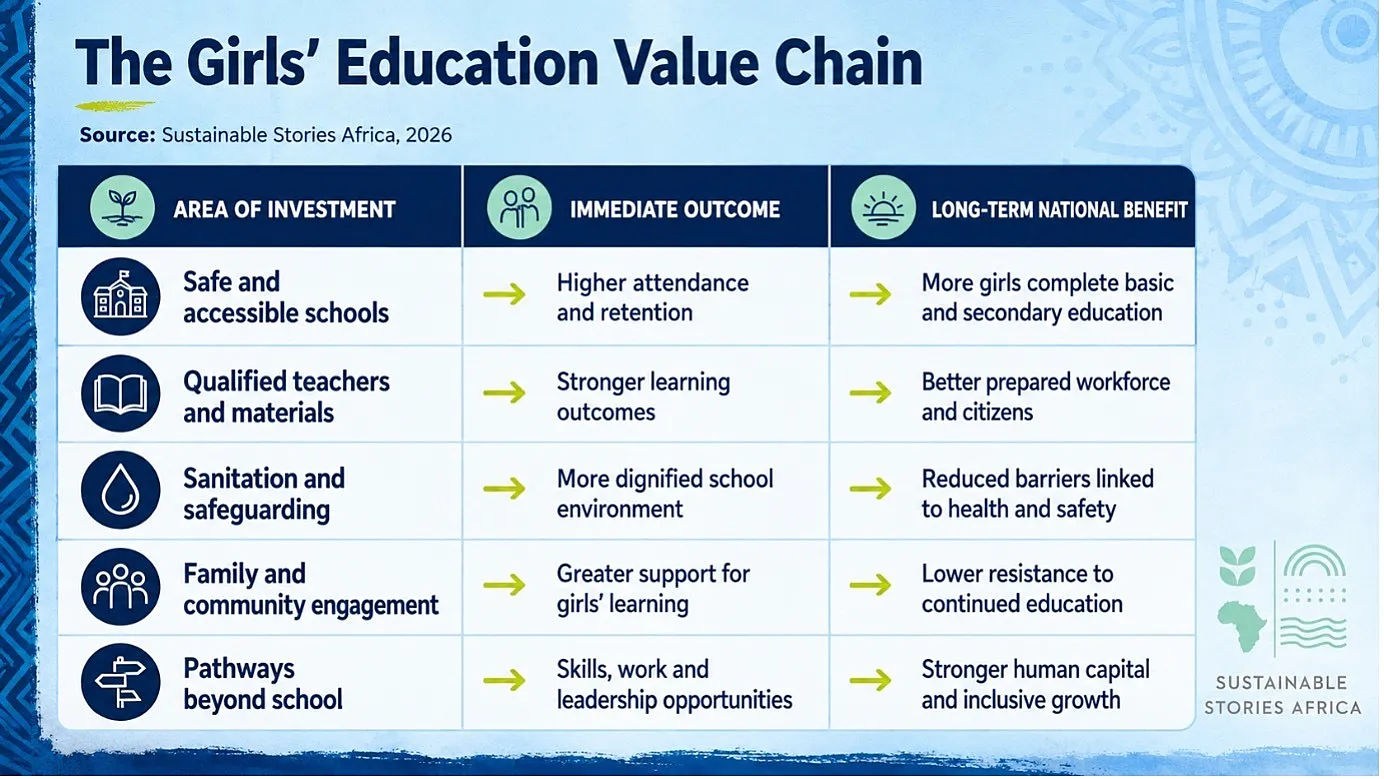
- A school may exist, but distance, safety concerns, inadequate sanitation, unpaid care work, household poverty or early marriage can still make attendance difficult.
- In such circumstances, enrolment figures alone cannot capture whether a child is learning consistently or completing her education.
The quality of the education environment matters as much.
- Girls need trained teachers, safe transport or nearby schools, appropriate sanitation facilities, learning materials and protection from harassment and violence.
- Parents and communities also need confidence that education offers a credible route to improved livelihoods.
A sustained focus on girls’ education can therefore strengthen several Sustainable Development Goal priorities at once: quality education, gender equality, poverty reduction, better health outcomes and reduced inequality.
The gains compound when education systems are designed to support girls through transition points, especially from primary to secondary school.
The Returns Reach Everyone
A meaningful investment in girls’ education would benefit far more than individual learners.
- It can expand the pool of skilled workers, entrepreneurs, professionals and public leaders that Chad will need to diversify its economy and strengthen public institutions.
It can also help households become more resilient.
- Education improves a young person’s ability to understand information, use services, adapt to economic change and pursue income opportunities.
- In communities facing climate, security or livelihood pressures, those capabilities are particularly valuable.
The alternative carries an economic and social cost.
- When girls leave school early, countries lose talent, families lose potential income, and communities lose voices that could contribute to better decision-making.
The issue is therefore not whether Chad can afford to invest in girls’ education; it is whether it can afford not to.
Make Retention the Measure
The practical priority is to move from broad commitments to measurable delivery.
- Government, development partners, civil-society groups and community leaders should track enrolment, attendance, learning outcomes, completion and transition into further education or work, with data broken down by gender and location.
Education financing should prioritise the obstacles most likely to push girls out of school.
- This may include school feeding, scholarships, transport support, menstrual-health facilities, teacher training, safeguarding mechanisms and flexible pathways for girls who have interrupted their schooling.
The private sector also has a role.
- Employers, telecoms firms, banks and technology companies can support mentorship, digital-skills programmes, internships and scholarships that show girls and their families a visible connection between education and economic opportunity.
Path Forward – Keeping Every Girl Learning
Chad’s education agenda should centre on retention, safety and learning quality—not only access.
Sustainable progress requires schools that girls can reach, afford and trust, alongside community engagement that protects their right to continue learning.
Development partners should align financing with nationally owned education priorities and transparent results.
A generation of educated girls can strengthen Chad’s social fabric, labour market and leadership pipeline, making education one of the country’s most consequential long-term investments.
Culled from: Educating girls, building Chad’s future