Recurring US recalls are drawing attention to more severe, drug-resistant foodborne outbreaks.
A Revolving Door Project investigation links the risk to concentrated corporate power and weakened regulatory capacity.
The warning reaches beyond one country: safe food systems depend on traceability, independent oversight and responsible antibiotic use across supply chains.
Routine recalls now carry greater danger
E. coli in blueberries, Salmonella in jalapeño peppers and alfalfa sprouts, and Cyclospora in iceberg lettuce have turned food-safety checks into a recurring task for American consumers.
A September 3 investigation by the Revolving Door Project argues that 2026 is on track to be among the worst recent years for US foodborne illness, even though the number of formal investigations remains below the recent annual average.
The deeper concern is severity.
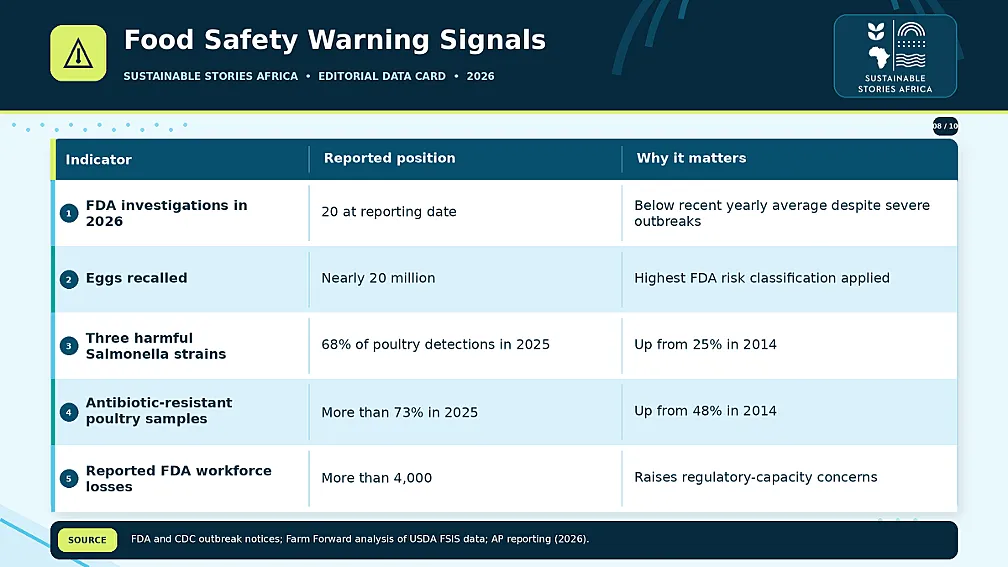
- Nearly 20 million eggs were recalled under the US Food and Drug Administration's highest risk classification, used where exposure carries a reasonable probability of serious harm or death.
- Investigations of jalapeño and sprout outbreaks also found Salmonella infections with resistance to ceftriaxone, a medicine used for severe cases.
Resistance grows while oversight capacity shrinks
The Revolving Door Project reported that the FDA had posted 20 investigations in 2026, five fewer than its 2021 to 2025 annual average, while the agency had lost more than 4,000 employees since the start of the Trump administration.
- Fewer investigations do not necessarily mean safer food, particularly when recalls and hospital outcomes are worsening.
Poultry data illustrates the threat.
- Three Salmonella strains associated with human illness accounted for about 68% of Salmonella detected in the poultry industry in 2025, up from 25% in 2014.
- More than 73% of contaminated poultry samples in 2025 were resistant to at least one antibiotic important for human use, compared with 48% in 2014.
Prevention protects health and market trust
Strong inspection, surveillance and traceability can prevent an isolated contamination event from becoming a national outbreak. They also protect responsible producers.
When buyers cannot identify the source quickly, whole categories of farmers and processors can lose sales, while families carry medical costs and workers lose income.
Antibiotic stewardship in agriculture preserves the effectiveness of medicines for both humans and animals.
The lesson is relevant to African food systems expanding formal retail, processing and cross-border trade.
- Investments in laboratories, cold chains, veterinary surveillance and interoperable recall systems can support both public health and market access.
- Small producers need practical compliance support, so stricter rules do not simply concentrate supply chains further.
Consumers, meanwhile, need clear alerts that reach people beyond websites and smartphones.
Accountability must follow every supply chain
Regulators should restore staffing, enforce traceability requirements and publish outbreak data quickly.
- Agriculture and health agencies need coordinated surveillance for antimicrobial resistance, with routine testing that connects farms, processors, retailers, hospitals and laboratories.
Companies should disclose recall scope promptly, preserve records and fund corrective action without controlling the investigation.
Political spending and regulatory influence also deserve scrutiny where firms benefit from delayed or weakened safeguards.
The Revolving Door Project highlighted Taylor Farms' market position and political donations while questioning whether public protections had been compromised.
- These are allegations and interpretations from an advocacy organisation, but the governance principle is broader: food-safety rules must be evidence-led, independently enforced and insulated from conflicts of interest.
Households still need practical guidance while systemic reforms proceed.
- Consumers should follow official recall notices, separate raw and ready-to-eat foods, cook products to safe temperatures and seek medical advice when severe symptoms appear.
- These steps reduce individual risk but cannot substitute for prevention upstream.
Pathogens move across farms, water, equipment, packaging and distribution networks long before food reaches a kitchen.
- Placing the burden mainly on shoppers obscures where firms and regulators have the greatest ability to detect contamination early, halt distribution and prevent resistant organisms from spreading through the food chain.
Cross-border cooperation is also essential.
- Food travels faster than many notification systems, so regulators need compatible standards, laboratory networks and rapid information exchange.
- Regional economic communities can help align recall protocols while preserving the capacity to respond to local risks.
Path Forward – Build food systems that prevent harm
Governments must strengthen inspection, traceability and antimicrobial-resistance surveillance before the next outbreak.
Companies should disclose risks rapidly and finance prevention throughout their supply chains.
African markets can integrate these safeguards as food processing and trade expand. Effective regulation protects consumers, responsible producers and confidence in the entire food economy.
Culled from: Will The Food Borne Illness Epidemic Ever End?