
Nigeria’s holding-company trend is meeting a tougher tax and governance reality.
A new analysis by Justin C. Chukwudi says the Nigeria Tax Act 2025 changes how owners should assess dividends, disposals and offshore structures.
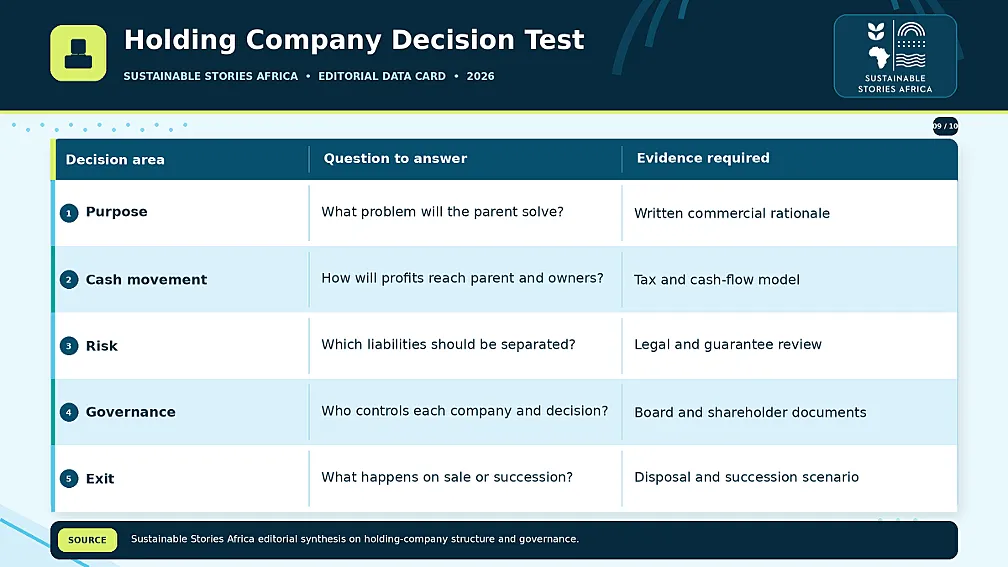
The central test is commercial purpose: a group structure should solve a real risk, ownership, succession or investment problem.
A clean chart is not strategy
Holding companies have become fashionable in Nigerian business circles; however, the Nigeria Tax Act 2025 has made purpose and planning more important than appearance.
In an analysis published September 1, chartered accountant Justin C. Chukwudi warned entrepreneurs that a holding company is neither a magic tax shield nor an automatic wealth-structuring shortcut.
His starting question is simple:
- What problem is the structure meant to solve?
A group may need to separate operating risks, distinguish ownership from control, prepare for succession or centralise governance and investment decisions.
However, adding a parent company without modelling how assets, profits and eventual exits move through the group can create compliance costs and cash-tax exposures without delivering those benefits.
Tax reform changes the group calculus
The Act, which commenced January 1, 2026, changes the assumptions behind common structures.
- Chukwudi notes that dividends between Nigerian resident companies are generally subject to withholding at source and exempt from further tax in the recipient company's hands, subject to correct documentation and conditions.
- That can support profit movement within a group, but it does not make every holding arrangement tax efficient.
His analysis also points to tax on chargeable gains from share disposals at the prevailing company rate, with exemptions linked to proceeds and gain thresholds over a rolling 12-month period.
- Indirect transfers of Nigerian company interests through offshore holding entities are now brought into the tax net.
- Closely held companies may also face deemed-distribution rules in specified circumstances.
Businesses should verify their facts and obtain current professional advice before acting.
Purposeful structures can build resilience
A properly designed holding company can still create long-term value.
- Separating subsidiaries may contain liabilities, while a common parent can provide a clearer strategic view across ventures.
- Different investors or family members can hold interests suited to each business, and succession may be easier when ownership is organised around shares in a parent rather than a web of directly held assets.
Good governance is the difference between a useful structure and an expensive diagram.
- Boards need defined authority, intercompany agreements, transfer-pricing support, reliable accounts and rules for moving cash.
- Lenders and investors will look through the chart to understand guarantees, related-party exposures and decision rights.
For family businesses, the structure should also work alongside wills, trusts, shareholder agreements and dispute-resolution arrangements.
Model the exit before incorporation begins
Founders should decide whether the aim is risk separation, succession, investment consolidation, fundraising or a future sale.
- They should identify which assets belong under the parent and why, then model dividends, management charges, loans, capital injections, share transfers and distributions to individual owners.
- Tax, legal, accounting and regulatory advice should be integrated rather than obtained in isolation.
The exit deserves attention before building the entrance.
- A structure that works while profits remain inside the group may become costly when an owner sells a subsidiary, admits an investor or withdraws wealth.
- Periodic reviews are also essential because ownership, business lines and tax law change.
- The strongest conclusion from Chukwudi's analysis is not that entrepreneurs should reject holding companies, but that sophistication begins with a documented purpose.
Implementation should also match substance.
- A parent that is described as the strategic centre of a group should have appropriate decision-making, records and oversight rather than existing only on incorporation documents.
- Intercompany loans and services need commercial terms, approvals and supporting evidence.
- Beneficial ownership and sector-specific regulatory requirements must be addressed, while minority investors need clear protections.
These disciplines may seem administrative; however, they help a group demonstrate accountability to tax authorities, lenders, employees and future buyers when the structure is tested under pressure.
Smaller businesses should weigh these ongoing obligations against simpler alternatives.
- Separate contracts, insurance, shareholder agreements or a single well-governed operating company may sometimes solve the underlying problem with less cost.
Structure should follow need, scale and evidence.
Path Forward – Build for purpose, governance and exit
Business owners should define the commercial problem first, then model tax, cash flows, control and succession before incorporating a parent company.
Professional advice and periodic review are essential under Nigeria's changed framework. A resilient group is measured by how well it governs risk and value, not by the complexity of its chart.