A UNEP report says the world is likely to cross 1.5°C within years.
Even its most optimistic modelled pathway peaks near 1.8°C before temperatures decline.
The finding shifts attention towards limiting the height and duration of overshoot while accelerating adaptation, emissions cuts and carefully governed carbon removal.
The threshold is becoming a timeline
The world is likely to exceed 1.5°C above pre-industrial temperatures within the next few years, according to reporting on the UN Environment Programme's Limiting Overshoot assessment.
- The most optimistic modelled scenario places peak warming at about 1.8°C, while other pathways rise higher.
The new framing is stark but not fatalistic:
- The size and duration of the overshoot remain shaped by decisions taken now.
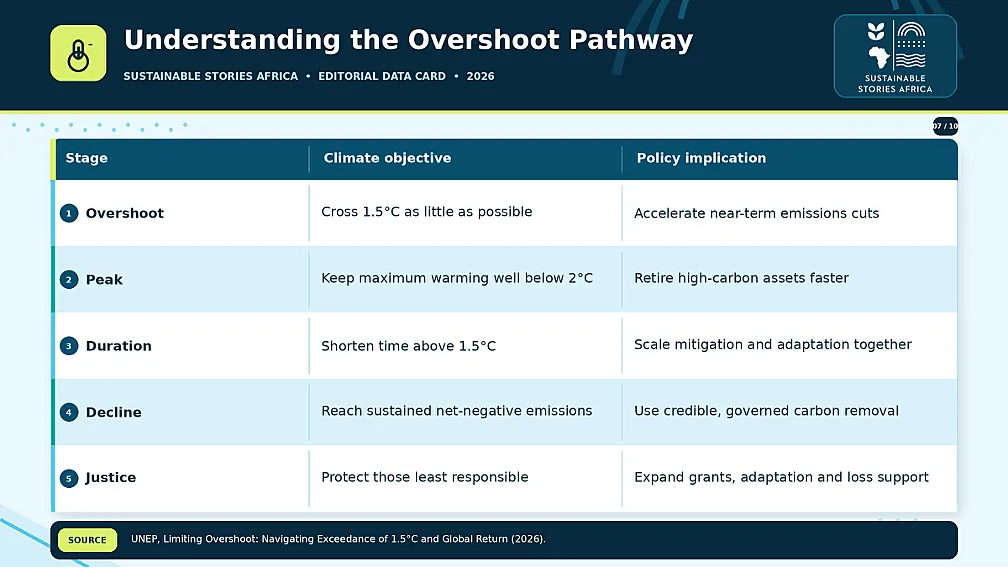
Instead of treating any breach as the end of climate ambition, the report advances an “overshoot, peak and decline” pathway.
- That means cutting emissions fast enough to keep the peak well below 2°C, reducing the time spent above 1.5°C and eventually returning temperatures below the threshold through sustained net-negative emissions.
Higher warming multiplies irreversible climate risks
The distinction between 1.8°C and higher peaks is measured in lives, livelihoods and ecosystems. UNEP identifies destabilisation of major ice sheets, degradation of the Amazon rainforest and disruption of the Atlantic Meridional Overturning Circulation among the tipping risks that become more likely as warming grows higher and lasts longer.
- Some impacts could arrive abruptly; others would accumulate over decades.
For Africa, those global pathways translate into local pressures on food production, water, health, energy systems, coastlines and sovereign finances.
- A shorter, lower overshoot would not remove damage already locked in, but it would make adaptation less difficult and less expensive.
The report says mitigation and adaptation are mutually reinforcing, rather than competing claims on limited climate budgets.
Carbon removal cannot excuse delayed cuts
Carbon dioxide removal can reduce temperatures, but only under strict conditions.
- The report says a return below 1.5°C is possible only if peak warming stays well below 2°C and residual emissions are reduced.
- Net zero should therefore be treated as a milestone on the way to net negative, not as permission to continue avoidable emissions while relying on future technology.
This creates an investment opportunity in credible removal, ecosystem restoration and industrial decarbonisation, but also a governance test.
- Measurement, permanence, additionality, land rights and community consent will determine whether removal delivers climate value.
- Nature-based cooling can support mitigation and adaptation together, provided it does not displace people or turn biodiversity into an accounting shortcut.
Governments must plan for overshoot realities
Governments should update national climate plans, infrastructure standards and fiscal risk assessments for an overshoot world.
- That includes earlier warning systems, heat-resilient health services, climate-smart agriculture, water security and protection for people who may be forced to relocate or change livelihoods.
Companies and financiers must stress-test assets against higher temperatures and disclose transition and physical risks clearly.
Equity must shape the response.
- Countries with greater historical responsibility and financial capacity should move fastest on emissions and provide more predictable finance, technology and support to vulnerable states.
For African negotiators, the overshoot framing strengthens the case for grants, loss-and-damage support and locally led adaptation.
- It also reinforces a difficult truth: avoiding one threshold does not determine success; limiting every additional fraction of warming does.
Businesses should treat the report as a planning signal rather than a distant environmental forecast.
- Capital expenditure approved today may operate through decades of higher heat, water stress and extreme weather.
- Boards therefore need credible transition plans, location-specific physical-risk analysis and clear responsibility for delivery.
Banks and insurers should examine whether pricing and coverage support adaptation or withdraw from vulnerable markets.
- Public disclosure will matter, but disclosure alone is insufficient unless it changes investment, procurement, design standards and the protection offered to workers and communities on the front line.
Cities and local governments will be central to delivery because heat, flooding and service disruption are experienced locally.
- National plans should give them finance, data and authority to act, with transparent criteria that prioritise vulnerable neighbourhoods rather than only high-value assets.
Path Forward – Limit the peak and protect people
Immediate priorities are deeper emissions cuts, faster resilience investment and strict governance for carbon removal. Plans must minimise both the height and duration of overshoot.
Climate justice requires wealthier, higher-emitting countries to act first and finance vulnerable regions.
Success now means preventing avoidable warming while protecting communities from losses that can no longer be prevented.
Culled from: UNEP Report Finds World Likely to Cross 1.5°C, Best Case Peaks at 1.8°C