


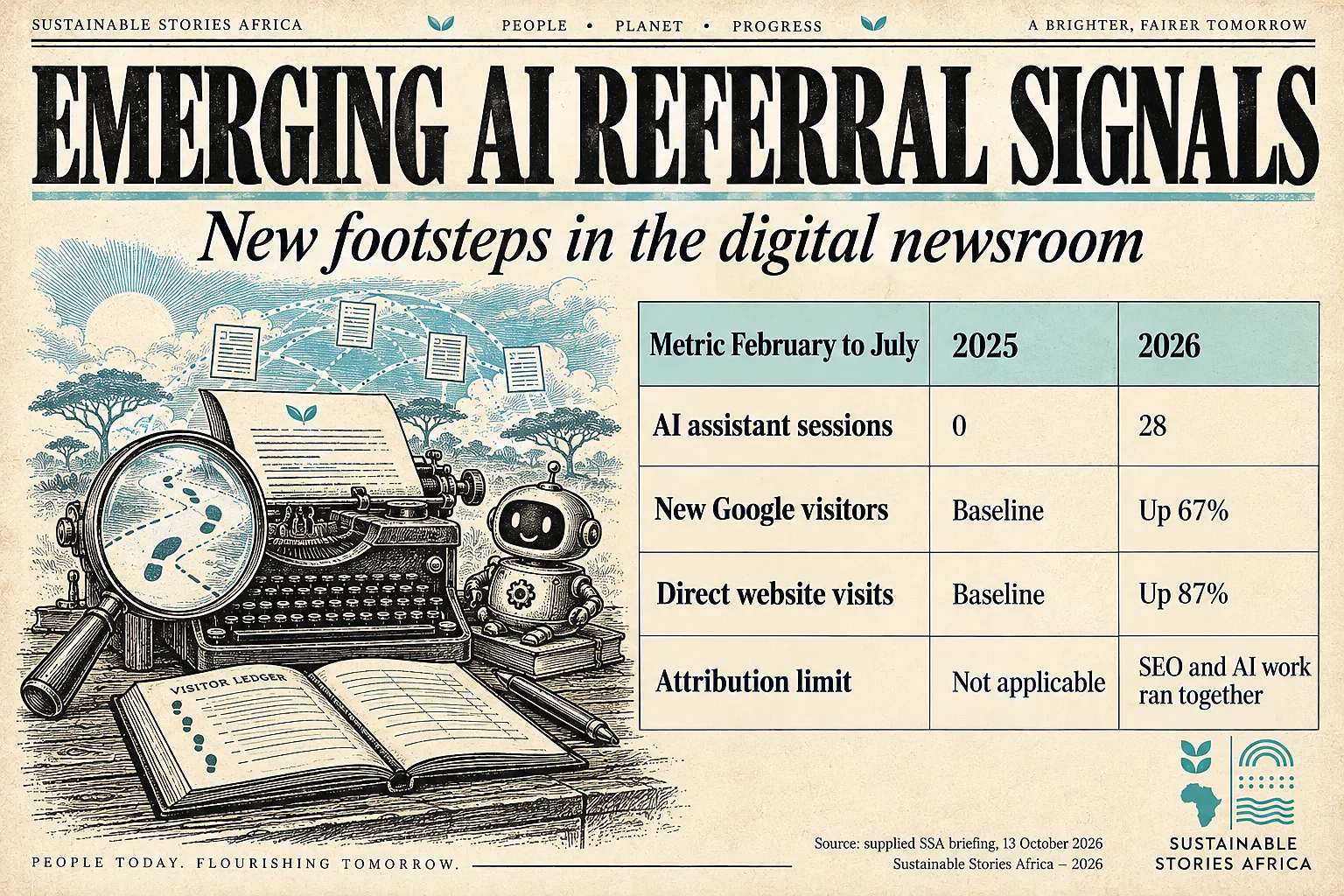
A South African case study recorded 28 website sessions from AI assistants between February and July 2026, compared with none a year earlier.
The numbers are small, but they show AI recommendations becoming a measurable route to business websites.
For logistics companies, accurate routes, licences, capacity and service information may now influence both buyers and the tools advising them.
AI Referrals Begin Influencing Business Discovery
Artificial intelligence assistants are beginning to send measurable traffic to South African business websites, creating a new visibility question for logistics and supply chain companies.
A case study by digital agency IMS found that Big Talk Entertainment received 28 website sessions from ChatGPT, Gemini and Perplexity between February and July 2026, compared with none in the same period of 2025.
Big Talk is not a logistics operator, but the behaviour is relevant because corporate buyers increasingly ask AI tools to shortlist suppliers before requesting a quotation.
Early Traffic Signals a New Channel
Over the same six-month review;
- Big Talk recorded a 67% increase in new visitors from Google search and an 87% rise in direct visits.
- IMS improved technical foundations, rewrote pages around customer questions and kept business information consistent across the web.
- The case study calls the AI-focused practice generative engine optimisation, or GEO.
For a freight or warehousing company, useful information includes current routes, coverage areas, fleet capabilities, licences, certifications, safety records and clear answers about transit times.
AI systems are more likely to cite information they can find, interpret and corroborate.
Visibility Rewards Accuracy but Amplifies Errors
AI discovery also changes the communication burden on companies.
Traditional websites are often brochures, with broad claims and limited operational detail.
- An AI assistant answering a specific buyer question needs structured facts and may combine information from several sources.
- Businesses that publish precise service boundaries and evidence may be easier to recommend, but they also become easier to hold accountable.
- This can reward transparency if buyers verify the answer.
- It can create harm if generated summaries omit conditions or confuse businesses with similar names.
Companies should monitor how major tools describe them and correct source information rather than attempting to manipulate outputs.
Buyers should still confirm availability and compliance directly before awarding work.
Structured Information Can Improve Buyer Matching
Better structured information could help smaller African operators compete on evidence rather than advertising budgets.
- A specialist carrier that clearly documents its routes, cold-chain controls or cross-border experience may become easier for both search engines and AI tools to surface. Buyers could also compare providers faster.
However, the channel carries a risk: an outdated page or exaggerated service claim can be repeated at scale.
Visibility without accuracy could lead to missed deliveries, compliance failures or damaged stock, especially where buyers treat an AI answer as due diligence.
Businesses Must Measure Referrals and Outcomes
Logistics businesses should audit the facts published on their websites and business listings, then assign owners to keep routes, licences, contacts and service limits current.
- Pages should answer real buyer questions in plain language and link important claims to verifiable evidence.
- Companies should track AI referral traffic separately, while continuing established search, sales and relationship channels.
The case study does not prove that GEO alone caused the wider traffic gains because traditional search and AI-focused work ran together.
Measurement should therefore stay cautious and focus on qualified leads, not novelty.
Path Forward – What Businesses Should Measure From Here
Companies should treat AI referrals as an emerging channel and test them against lead quality, conversion and customer value.
Accurate, current and verifiable information is the foundation of visibility.
Industry associations can help by promoting common digital descriptions for routes, certifications and service capabilities.
Clearer data would make supplier discovery more reliable for buyers and reduce the chance that AI systems recommend businesses using incomplete or misleading information.