
Bolaji Balogun urged Nigeria to bring more state assets and private companies to its stock market at the 30th Annual Stockbrokers’ Conference in Lagos.
He said faster settlement and recent reforms had laid the groundwork for a deeper market.
His proposals would give households more ways to invest and businesses more options to raise long-term capital.
The case for more domestic listings
Capital market executive Bolaji Balogun called on Nigeria to use privatisation and domestic listings to expand its pool of long-term investment capital. Speaking on 4 November at the 30th Annual Stockbrokers’ Conference “Themed From Capital Mobilised to Prosperity Financed: Financing Nigeria’s Next Era of Growth and Global Competitiveness” at Harbour Point in Victoria Island, Lagos, he said the government should bring more assets to the equity market and make an eventual listing part of the terms for companies that receive public licences or concessions.

Balogun said the government already uses the debt market extensively.
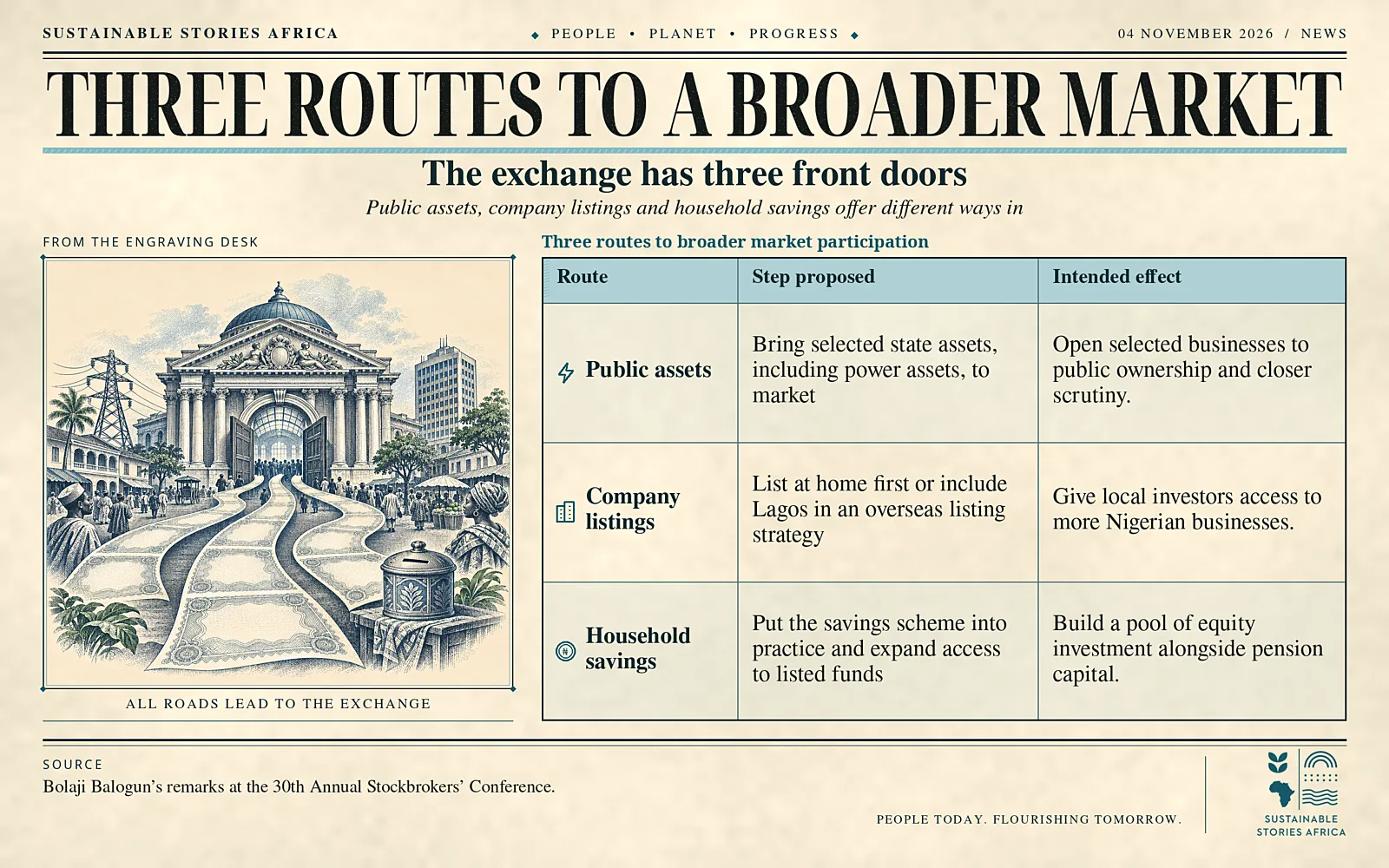
- Selling shares in selected public assets would let investors own a stake in those businesses and subject the companies to greater disclosure and scrutiny.
- He said the government had identified more than 91 federal assets for sale.
- He singled out power assets as near-term candidates and warned that going another 24 months without significant privatisation offers would be a missed opportunity.
Faster settlement leaves a deeper challenge
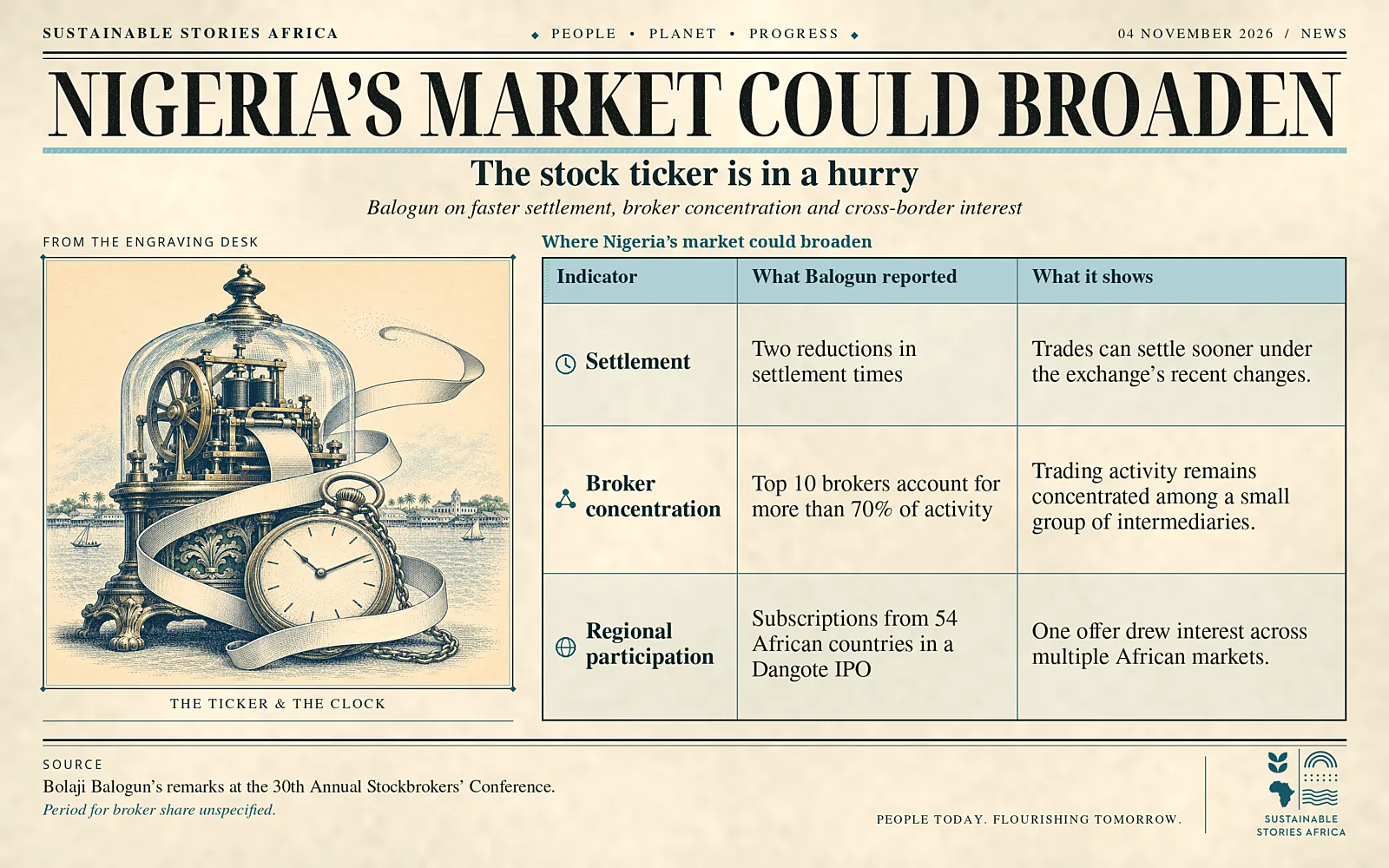
Balogun cited the Investments and Securities Act 2025 and two reductions in settlement times as evidence that Nigeria had improved how its market operates.
- He said the next challenge was attracting more companies to raise funds and more investors to buy and sell their securities.
- He told the conference that the 10 most active brokers accounted for more than 70% of market activity.
Nigeria already has a range of financing instruments, including project bonds, green bonds, sukuk and listed closed-end funds, Balogun said.
- The question is whether more issuers can use those instruments to finance ports, power, agriculture and housing, where projects typically need funding over longer periods than short-term bank lending provides.
Balogun pointed to a recent Dangote initial public offering, which he said drew subscriptions from 54 African countries.
- He used the offer to argue that Lagos could serve as a regional market.
“Fast settlement of a thin market is still a thin market,” he said.
He noted that technology can make participation easier, and regulation can strengthen trust.
However, Broader participation also depends on having enough issuers and investable securities to attract and retain investors.
Household savings could widen ownership
Balogun urged founders, family businesses and company sponsors to consider the Nigerian Exchange as their first market.
- He said domestic listings could give local investors a stake in businesses whose products and services they already know.
- For companies that also want to raise money abroad, he called for links between exchanges that would keep Lagos in their listing plans.
He also urged market operators to develop Nigeria’s savings scheme, citing tax-free investment accounts in countries such as the United Kingdom and the United States as examples.
- Balogun envisaged households building equity exposure by buying shares directly or through listed funds.
A wider pool of household investors could supplement pension capital and give companies another source of funding for expansion.
What government and market operators can do
Balogun proposed that companies receiving public licences or concessions should work towards investment-grade credit ratings and eventual listings.
- A rating would help investors assess the company’s creditworthiness.
- A listing could make shares available to the public and increase the number available for trading, depending on the size and terms of the offer.
He urged regulators and market operators to turn the savings initiative into a way for households to invest and to develop a broader range of listed funds.
- He also noted that few capital market firms were themselves listed, putting part of the responsibility for broadening the issuer base on the industry represented at the conference.
Balogun also saw scope for pension funds to invest in infrastructure, real estate, private equity and private credit.
- He argued that household investment would serve a separate purpose by bringing additional risk capital into the market and spreading share ownership.
For prospective investors, the terms of any privatisation offer will matter as much as the choice of asset.
- The portion offered to the public, and the disclosures accompanying it, would shape who can participate and what they can learn before buying shares.
Path Forward – A wider market needs more issuers
Balogun’s near-term priorities were to bring credible privatisation offers to market and give households practical access to equity investments.
Power assets were among the opportunities he identified.
To attract both domestic and regional investors, the proposals would have to translate into investable offers.
Public disclosure and share availability for trading would help determine how widely ownership could spread.