Researchers have built regional fair shares into climate pathway generation and found multiple ways to reach the same global temperature outcome.
The model changes the balance between domestic emissions cuts and financial support across world regions.
For African negotiators, it provides a clearer basis for discussing responsibility and finance, and prescribing national payments.
Fair shares change the route to climate goals
A study led by the International Institute for Applied Systems Analysis (IIASA), published in Environmental Research Letters, finds that accounting for fairness while constructing emissions pathways changes who cuts faster and who finances mitigation, while preserving the modelled global climate objective.
Released ahead of further national climate planning, it turns an abstract argument about responsibility into comparable regional scenarios.
The authors allocated a global emissions budget among world regions using different principles, including historical responsibility and economic capability.
- Regions above their allocated share incur what the researchers call a carbon debt.
- They can address it through faster domestic cuts, carbon removal or support for mitigation elsewhere.
These are modelled options, not a binding formula for governments.
Transfers and domestic cuts create different paths
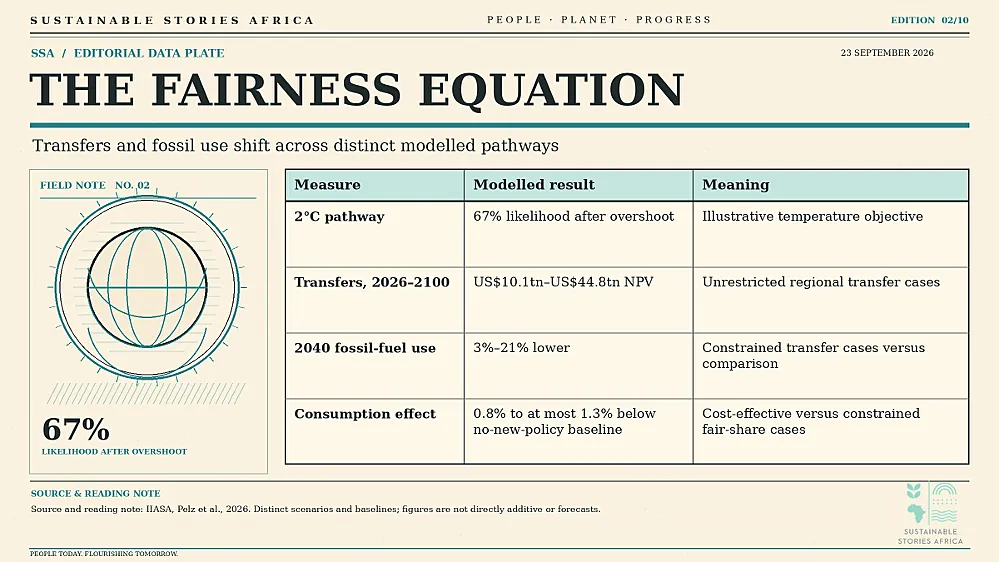
For a scenario consistent with limiting warming to about 2°C with a 67% likelihood, after a temporary overshoot, unrestricted interregional transfers range from $10.1 trillion to $44.8 trillion in net present value over 2026 – 2100, depending on the fairness principle.
In that case, the physical transition resembles the original cost-effective pathway.
When transfers are pushed toward the lowest feasible level, they fall by more than half and regions with higher responsibility cut more at home.
- Modelled global fossil-fuel use in 2040 is 3% to 21% lower than in the comparison pathway.
- Cumulative emissions and the global temperature objective remain unchanged.
These ranges are scenario results, not forecasts of agreed transfers or actual spending.
The researchers also examined a pathway to return to 1.5°C by century’s end, with a 50% likelihood after overshoot.
- Physical effort has less room to move between regions, making finance more important: in one comparison, required transfers roughly double relative to the 2°C case.
- Limiting cooperation to geological carbon removal alone costs around ten times as much per transferred tonne as allowing a broader set of mitigation options, excluding land use.
Fairer modelling can support stronger climate bargains
For African economies seeking electricity access, industrial growth and resilience, the design of a global pathway affects the pace of domestic transition and the support available to make it feasible.
- The study does not assign an Africa-wide bill or entitlement.
- It does show that a global target can conceal materially different regional burdens.
IIASA says lower-responsibility and lower-capability regions see net consumption gains relative to the purely cost-effective pathway across the fairness cases studied.
- That result is conditional on the model assumptions and transfer arrangements.
- It strengthens the case for testing distributive consequences before policymakers describe a pathway as equitable.
Responsibility principles are contestable, and regions are broad aggregates that hide differences between countries and households.
- The model does not calculate which African state should pay or receive a specified sum.
- Negotiators would still need to decide how private and public flows are counted, whether support is additional to existing promises, and how projects avoid harming land rights or energy access.
Transparent accounting would make the fair-share debate more useful to citizens.
Put fair shares inside national climate planning
Governments and climate institutions should publish the fairness principles, regional assumptions and financing mechanisms behind proposed mitigation pathways.
Negotiators can use multiple scenarios to discuss how higher-responsibility countries combine domestic cuts with dependable support for others.
- They should also test the feasibility and governance of finance rather than treating modelled aggregate transfers as promised public funding.
This is relevant as countries update nationally determined contributions and prepare for the second Global Stocktake.
A pathway that adds up globally will be easier to implement if its regional obligations are visible, contestable and matched to credible finance.
Path Forward – Translate fair shares into accountable finance
The next step is to compare national plans against explicit fairness benchmarks and identify the grants, concessional capital and domestic measures needed to deliver them. IIASA’s scenarios widen the policy choices; political negotiation must determine which allocation is accepted and how support reaches communities.