McKinsey advisers identify five recurring behaviour patterns that can slow organisational transformation before results deteriorate.
They say chief executives have a direct role in aligning incentives, sharing information and increasing participation.
The lesson for African businesses is practical: a change programme needs broader capability and lasting management routines, not just a launch.
Five habits can stop change before results fall
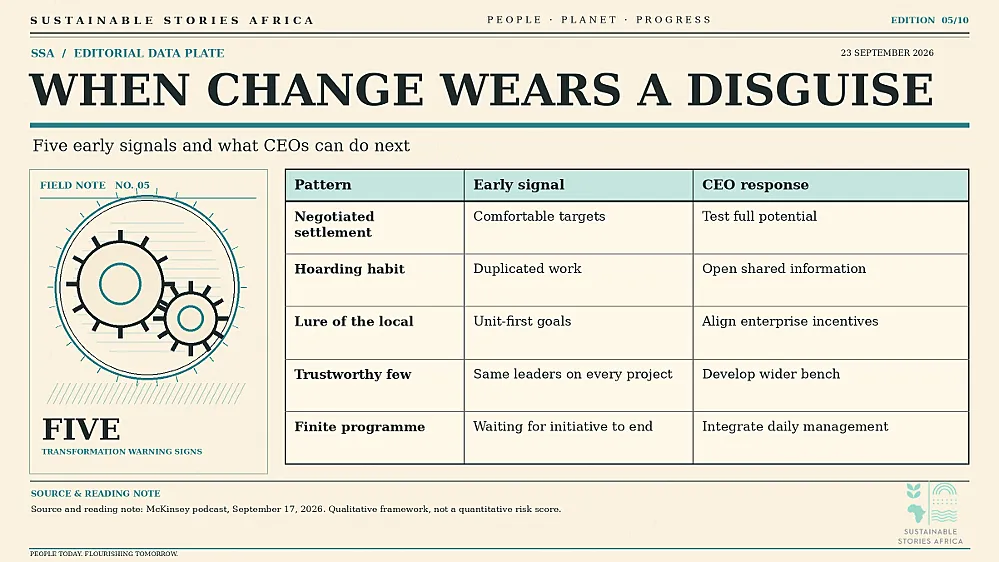
Company transformations can stall because teams choose safe targets, withhold information, defend their own unit, depend on a small circle of trusted people or treat change as a temporary programme.
McKinsey senior partner Kurt Strovink and partner Mathew Lee set out those five collective-action problems in a podcast published September 17, arguing that chief executives have a distinctive responsibility to align incentives across the enterprise.
The account is a practitioner discussion, not a measured failure rate for all transformations.
- It is relevant to organisations pursuing technology, operational or sustainability changes because the first signs often appear in meetings, staffing and information flows before financial indicators move.
Early signals emerge in targets and teams
Lee called the first pattern a “negotiated settlement”:
- Managers bargain ambitions down to what feels safe.
Strovink recommended comparing realistic bottom-up plans with a fact-based view of full potential.
- He suggested that targets include both steps already understood and room for learning how to reach a more demanding result.
Information hoarding appears when teams duplicate work or pull in opposite directions.
- Local optimisation sounds like “my budget” and “my team” at the expense of shared outcomes.
- The “trustworthy few” pattern routes every consequential project through familiar high performers, creating bottlenecks and denying others a chance to develop.
- Finally, a finite programme invites people to wait for the initiative to end and return to old routines.
The advisers said CEOs can demand a shared, regularly accessible view of performance and run meetings to solve problems rather than debate whose data is right.
They also urged rewards for asking for help and incentives that connect middle managers and senior leaders to enterprise results.
Broader participation builds lasting execution capacity
Strovink said transformations involving only 5% to 7% of staff tend to do worse, while those engaging about 20% to 25% or more reach a point at which they take off.
- This is an observation described in the interview, not a guaranteed threshold or a causal estimate.
- It implies that concentrated responsibility limits both delivery and the next generation of leaders.
In an African bank, manufacturer, or utility, the principle could apply when a climate target sits with a sustainability team, but lending, procurement or operations still reward old behaviour.
- A broader operating change would give those teams shared metrics, authority and training.
- This is an illustrative application of McKinsey’s framework, not a case study reported in the podcast.
For sustainability strategies, management incentives need to connect long-term targets with ordinary commercial choices.
- A firm could publish a climate goal yet continue to reward managers only for short-term volume, leaving operations to absorb the contradiction.
- The interview's framework suggests checking this misalignment early and giving staff across functions authority to propose fixes.
The advisers do not claim that any one meeting format or participation percentage guarantees environmental performance.
CEOs should redesign incentives and daily routines
Boards and chief executives can check whether targets are evidence-based, information is visible, project leaders come from more than a familiar circle, and managers are rewarded for shared results.
- They should transform work into part of ordinary budgeting, staffing and performance reviews.
- A dashboard alone cannot create trust; leaders must use it to solve problems without punishing honest escalation.
The strongest claim is about responsibility:
- A chief executive can delegate work but remains responsible for the conditions under which teams cooperate.
Testing that claim means tracking participation, decisions, skills and outcomes over time, including after the original programme timetable ends.
Path Forward – Build shared incentives into company decisions
Leaders should broaden participation, make performance data usable and integrate change into regular management.
They can audit the five warning signs before financial results weaken and publish progress against concrete operational and sustainability goals.
McKinsey’s categories offer a diagnostic; each organisation still needs evidence that its chosen interventions work.