Agricultural credit in Nigeria reached N11.38 trillion in the first quarter of 2026, up 23% from a year earlier.
The increase came as reported credit to oil and gas and manufacturing fell, raising questions about where banks see growth.
For farmers and food businesses, the test is whether larger loan books translate into affordable, resilient finance beyond established borrowers.
More credit reaches farms as old sectors retreat
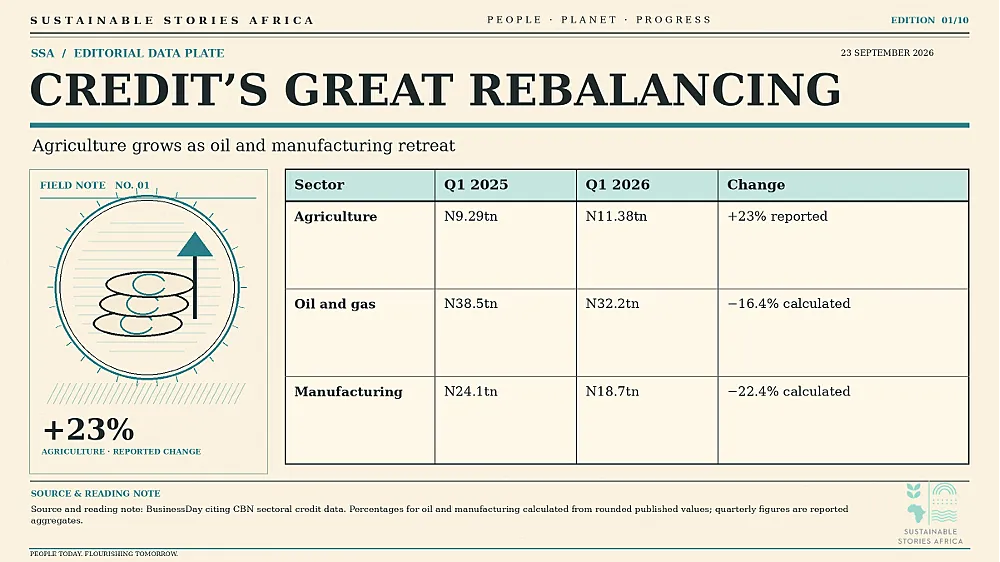
Nigeria’s banks expanded agricultural credit by 23% year on year to N11.38 trillion in the first quarter of 2026, from N9.29 trillion a year earlier, according to Central Bank of Nigeria sectoral data reported by BusinessDay.
Over the same period, oil and gas credit fell to N32.2 trillion from N38.5 trillion, and manufacturing credit dropped to N18.7 trillion from N24.1 trillion.
- The divergent figures show a changing mix of reported lending; they do not establish that every naira leaving one sector was redirected to farms.
The figures matter to a country where agriculture contributes roughly 23% of gross domestic product and employs more than 30% of the workforce, according to analysts cited by BusinessDay.
However, a higher sector balance says little about which farmers receive funds, at what cost, or what protection against weather and market shocks.
Lending growth meets uneven farm finance needs
BusinessDay reported that the monthly agricultural credit figure rose from N3.71 trillion in January to N3.86 trillion in March.
- Its quarterly aggregate is the sum of reported monthly sector figures, so it should not be read as a single end-of-quarter loan stock or as proof that 23% more farmers obtained credit.
- The year-on-year comparison is nonetheless a clear signal of stronger reported agricultural exposure.
Abiodun Ogunniyi of GTI Investment Group pointed to improved agricultural output, food demand and a persistent financing gap.
Kehinde Jones of Anchoria Capital Group also cited policy interest and portfolio diversification.
- Their interpretations are plausible explanations for the pattern, though the sector data cannot isolate the contribution of each driver.
Intervention facilities remain part of the picture.
- BusinessDay cited first-quarter disclosures by FCMB, Fidelity and Sterling describing participation in agricultural lending schemes.
- Concessionary funding can ease borrowing costs, but its presence also makes it important to distinguish commercially sustainable lending from growth that depends on public support.
Better lending can strengthen food system resilience
- A processor able to finance produce purchases and cold storage can reduce losses between harvest and market.
- A farmer group with timely working capital can buy inputs before planting rather than after prices rise.
These are practical possibilities, not measured outcomes of the first-quarter credit increase.
- Climate resilience should be built into the credit decision.
- Drought, flooding, transport disruptions and insecurity can turn a viable seasonal loan into a default.
- Insurance that pays reliably, verified off-take agreements, storage and risk-sharing can help banks reach productive enterprises without shifting all risk to farmers.
Ogunniyi specifically identified insurance, off-take, storage, security and value-chain finance as conditions for durable growth.
The lending data also require care in comparison.
- Published sector totals can move with new lending, repayments, reclassification and price effects, so they should not be treated as a direct measure of new investment on farms.
A useful follow-up would compare disbursements, outstanding balances and actual borrowing terms, alongside agricultural output and food prices.
- It would identify whether a financing change reaches producers, aggregators and processors in proportion to their needs.
Banks and policymakers must test real access
Banks should disclose agricultural loan reach by borrower size, geography, value-chain activity, tenor and repayment performance, while protecting customer privacy.
Regulators can track whether growing balances bring new borrowers into formal finance or enlarge existing corporate exposures.
Policymakers should address roads, storage, security and climate information alongside loan supply.
The first-quarter numbers are encouraging, but the more consequential measure will be whether agricultural financing stays affordable and productive as public schemes change and shocks arrive.
A stronger food system requires credit whose terms match the harvest cycle and whose risks to lenders and borrowers are understood.
Path Forward – Make farm credit reach resilient producers
The next reporting cycle should connect agricultural loan growth with access, pricing, defaults and investment in storage and climate protection. That evidence would show whether the shift supports farmers and food security or primarily expands bank exposure to a narrow set of established borrowers.
Culled from: Agriculture credit rises by 23% as banks shift lending from oil, manufacturing - Businessday NG