
Deloitte has outlined how corporate controllership functions can strengthen the reliability, consistency and governance of sustainability disclosures.
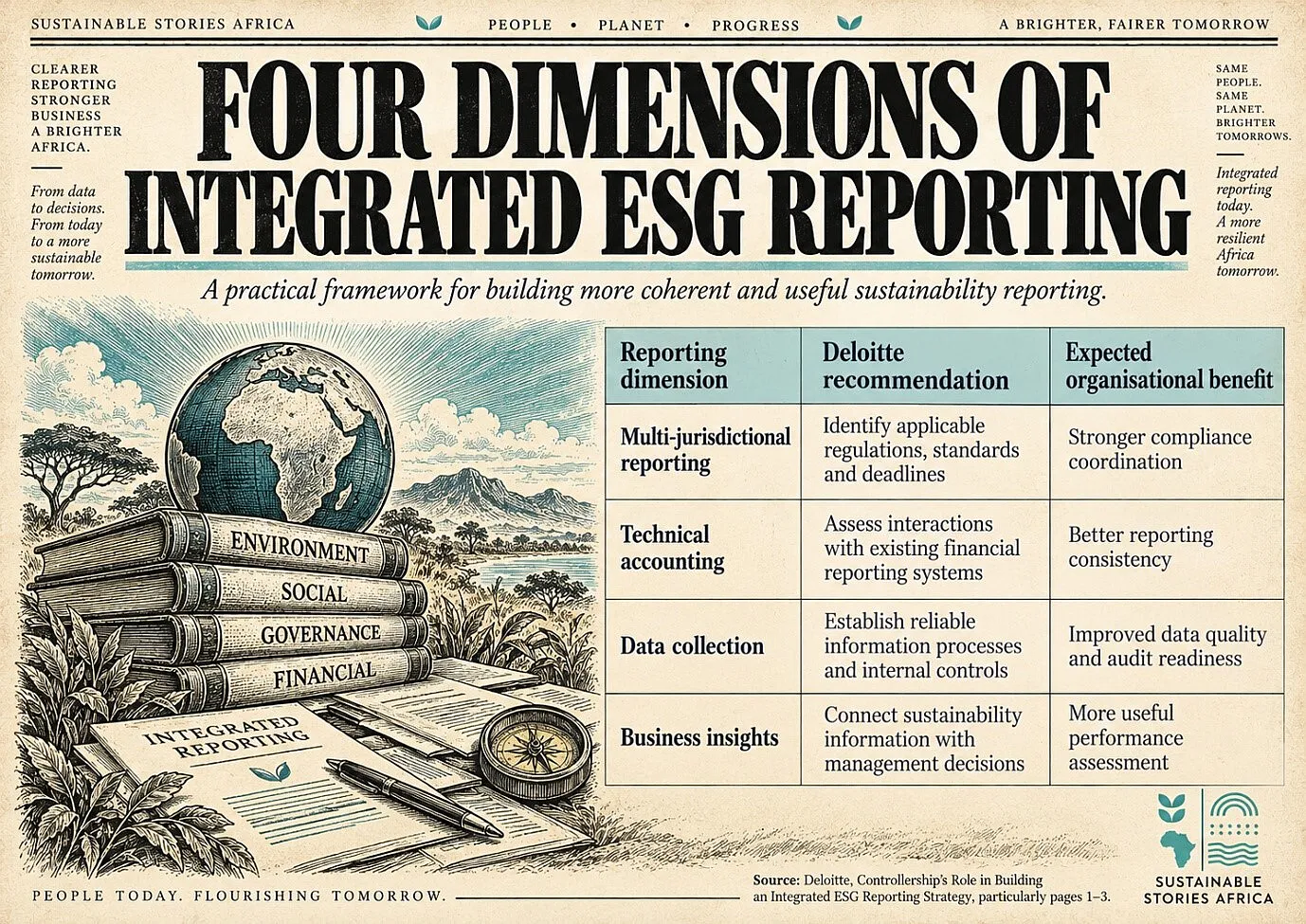
Its analysis identifies regulatory complexity, technical accounting, data collection and business insights as four critical dimensions of an integrated ESG reporting strategy.
The recommendations are relevant to African companies seeking stronger investor confidence, credible sustainability information and greater alignment between financial and non-financial reporting.
Financial Controllers Face Expanding ESG Responsibilities
Corporate finance and controllership functions should take on greater responsibility for sustainability reporting as environmental, social and governance disclosure requirements become increasingly complex, according to a Deloitte report.
In Controllership's Role in Building an Integrated ESG Reporting Strategy, the professional services firm argues that ESG reporting requires the same attention to accountability, documentation, internal controls and information quality traditionally associated with financial reporting.
The report identifies changing international disclosure requirements as a major challenge for multinational businesses.
- Companies operating across several jurisdictions may face different reporting standards, implementation deadlines, information requests and assurance expectations.
- Deloitte maintains that controllership teams are well positioned to coordinate these requirements because of their existing experience in financial reporting, internal controls and regulatory compliance.
Reporting Complexity Demands Integrated Corporate Systems
Sustainability reporting increasingly depends on information originating across departments rather than a single central function.
- Environmental indicators may require data from production facilities, procurement departments and energy suppliers.
- Social indicators may involve human resources, workplace safety, community relations and supply-chain management.
- Governance disclosures may depend on board structures, compliance procedures and risk management arrangements.
Without clear responsibilities, organisations may have inconsistent information, duplicated reporting activities and weak documentation.
Deloitte identifies four dimensions that companies should address when developing integrated ESG reporting arrangements.
These include;
- Understanding multi-jurisdictional disclosure requirements
- Linking ESG matters with technical accounting
- Improving data collection
- Translating sustainability information into business insights
The report also highlights the need to determine which departments are responsible and accountable for particular activities.
This may require formal responsibility matrices, coordination across operating subsidiaries and closer collaboration among controllership, sustainability, legal and risk management teams.
Integrated Reporting Can Improve Corporate Credibility
The implications extend beyond regulatory compliance.
By consistently measuring energy consumption, occupational safety, resource efficiency and governance performance, organisations can potentially use this information to improve operational decision-making.
- For example, reliable energy data can help management understand the financial implications of energy efficiency investments.
- Similarly, workforce safety indicators can support risk assessment and investment in safer working conditions.
These benefits are difficult to achieve when sustainability information gathering relates to annual publication.
- Deloitte's approach suggests that reporting systems should form part of routine organisational management.
For African businesses, especially those seeking international financing or operating across regional markets, stronger ESG information systems may improve engagement with investors, lenders and commercial partners.
- However, reporting frameworks should match organisational size, operational complexity and applicable regulatory obligations.
An integrated system should improve transparency without imposing unnecessary administrative demands that undermine smaller enterprises' capacities.
Business Leaders Must Clarify Reporting Accountability
Corporate boards should assess how responsibilities for sustainability disclosures are distributed across their organisations.
Financial controllers, sustainability professionals, legal teams and operational managers should establish consistent reporting definitions, documentation requirements and review procedures.
Companies should also maintain a register of applicable disclosure obligations, particularly where operations extend into multiple jurisdictions.
Technology can support information management and reporting efficiency, but effective systems require clearly defined data ownership and adequate internal controls.
Organisations should periodically review their reporting arrangements as standards, operations and stakeholder expectations evolve.
Path Forward – Stronger Governance Can Deliver Credible Disclosures
Deloitte's analysis reinforces the importance of integrating sustainability reporting with established corporate governance and financial control systems.
For African organisations, clearer accountability, dependable data and coordinated reporting can strengthen disclosure credibility, support better decisions and improve preparedness for evolving sustainability requirements.