Developed economies account for approximately 70% of global greenfield investment in strategic sectors, according to UNCTAD's 2026 trade and development analysis.
The report warns that intensifying geopolitical competition is reshaping traditional pathways to industrialisation and technological upgrading.
For African economies, the findings underline the urgency of stronger industrial policies, regional integration and investment frameworks that deliver domestic economic value.
Strategic Investments Increasingly Favour Wealthy Economies
Developing countries face growing risks of exclusion from the industries shaping the next generation of global economic growth, according to the United Nations Conference on Trade and Development.
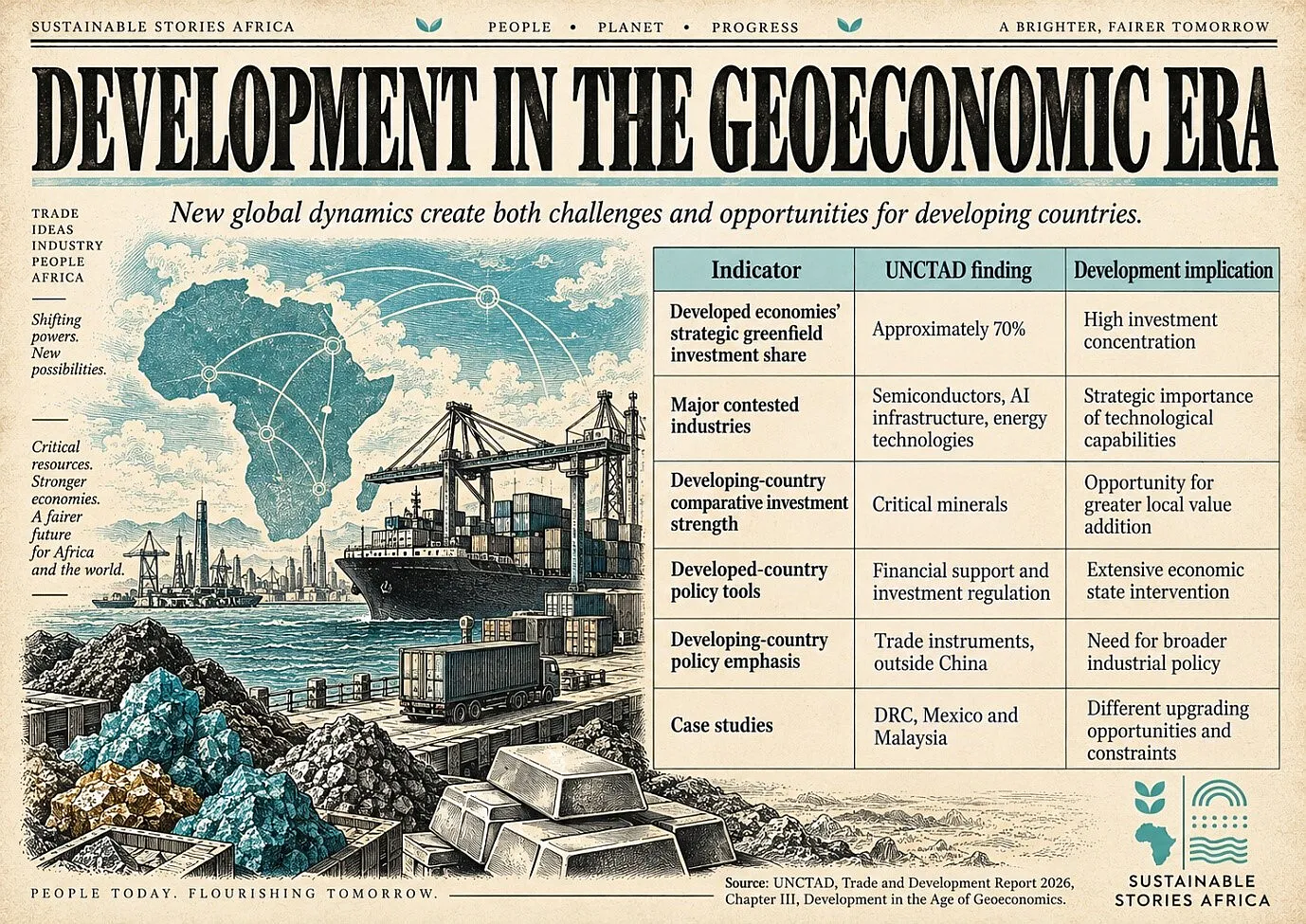
Chapter III of UNCTAD's Trade and Development Report 2026, titled Development in the Age of Geoeconomics, finds that developed economies capture approximately 70% of global greenfield investment in strategic sectors.
- These industries include semiconductors, artificial intelligence infrastructure and energy-transition technologies.
- The report identifies critical minerals as a notable area in which developing countries maintain a comparatively stronger investment position.
However, controlling mineral resources does not necessarily mean that countries capture the manufacturing, technological and commercial benefits associated with finished products.
UNCTAD warns that competition among major economic powers is destabilising traditional routes to development through industrialisation, merchandise trade and participation in global value chains.
Global Competition Reshapes Industrial Development Prospects
For decades, developing economies have sought economic transformation by attracting foreign manufacturing investment, increasing exports and gradually upgrading industrial capabilities.
- This strategy is becoming more challenging as major powers increasingly view advanced technologies, energy systems and critical materials through the lens of national security.
- Government subsidies, investment restrictions, domestic production incentives and technology policies are reshaping where companies establish production facilities.
The report identifies a difference in policy approaches.
- Developed economies frequently employ financial instruments, including grants, state-backed loans and investment regulations.
- Developing countries outside China rely more heavily on trade-policy measures.
UNCTAD examines the Democratic Republic of the Congo, Mexico and Malaysia to illustrate how geopolitical competition affects countries occupying different positions in global production networks.
- The analysis identifies ownership structures and market concentration as substantial barriers to industrial upgrading.
For resource-rich African countries, this presents a critical challenge:
- Increased global demand for strategic minerals may generate export revenue without necessarily delivering domestic processing capacity, technological learning or diversified employment.
Regional Industrial Cooperation Could Improve Outcomes
UNCTAD argues that successful industrial policy must be assessed over a longer horizon rather than judged solely by immediate commercial returns.
- Countries may need to support emerging industries through early development stages before firms become internationally competitive.
The report also emphasises that joining global value chains does not automatically produce sustainable development.
- Foreign investment needs to create opportunities for local suppliers, workforce development, technology transfer and progressively higher-value production.
For African economies, regional integration offers a potentially important response.
- The African Continental Free Trade Area could provide a platform for coordinating regional production, industrial standards, trade facilitation and payment systems.
Cross-border cooperation could also help countries pool demand, strengthen regional supply chains and attract investment into manufacturing and processing facilities.
Nevertheless, effective implementation requires addressing infrastructure gaps, inconsistent regulations, financing constraints and barriers to market access.
Policymakers Must Strengthen Industrial Bargaining Power
African governments should develop strategic sector policies linked to realistic market opportunities and domestic capabilities.
- Investment agreements can be designed to encourage local procurement, workforce development and technology partnerships, while remaining commercially credible and consistent with applicable obligations.
Public financing institutions should examine how patient capital can support industrial projects that require longer development horizons.
Governments should also assess whether regional cooperation offers greater economic value than isolated national investment strategies.
Path Forward – Strategic Cooperation Can Strengthen African Industrialisation
The new geoeconomic environment presents serious development challenges, but it also creates opportunities for coordinated industrial transformation.
African countries can improve their position by strengthening regional markets, developing productive capabilities and negotiating investments that generate long-term domestic value rather than concentrating exclusively on raw-material exports.