
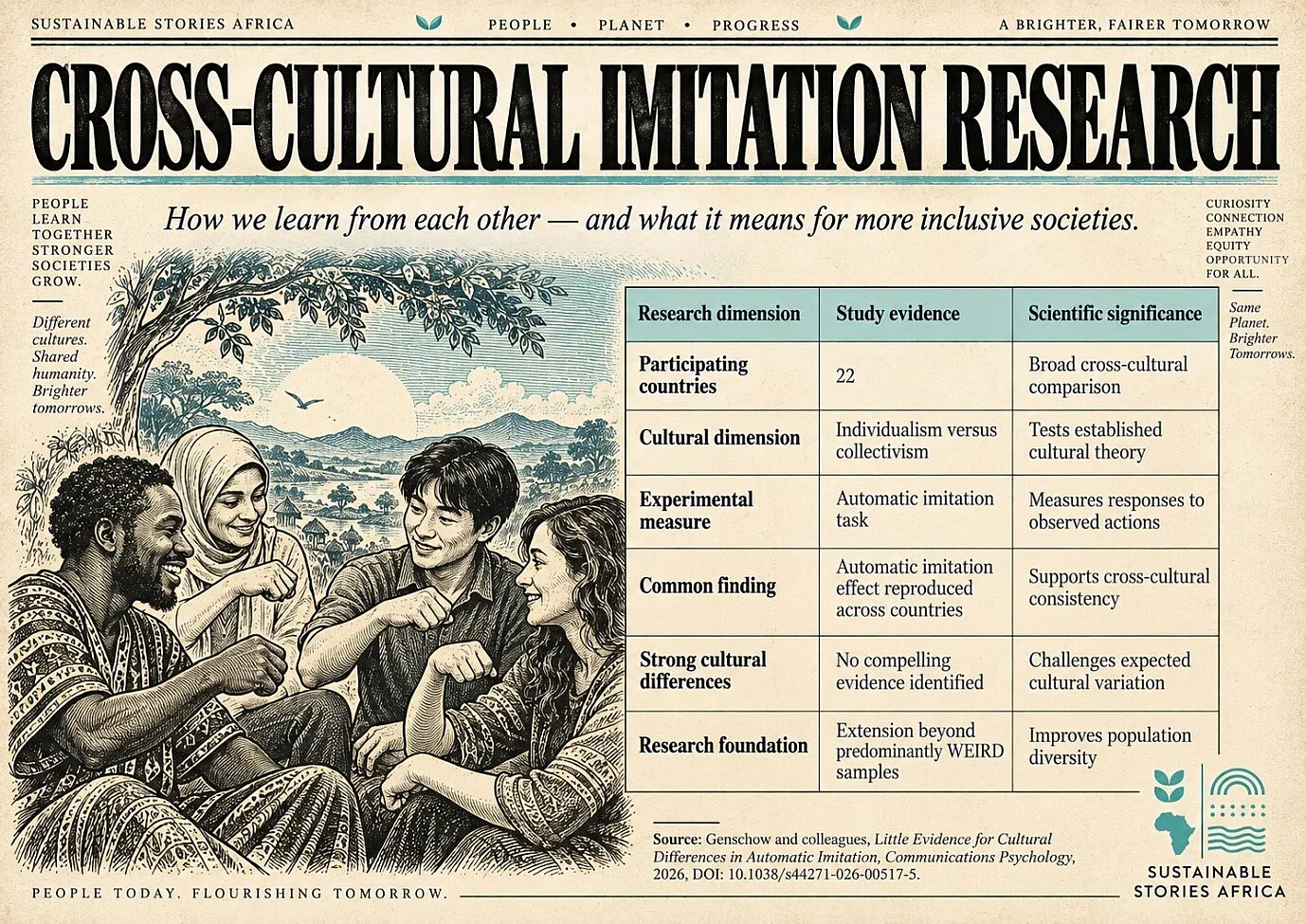
An international psychology study spanning 22 culturally diverse countries has found little convincing evidence that automatic imitation differs substantially between collectivist and individualist societies.
The findings challenge longstanding assumptions about the influence of cultural identity on basic social behaviour.
The research also highlights the importance of expanding behavioural science beyond Western populations to produce more representative knowledge of human behaviour.
Researchers Challenge Cultural Assumptions About Imitation
A major international study has found that people from culturally diverse countries demonstrate broadly similar patterns of automatic imitation, despite differences in social values and cultural identity.
Published in Communications Psychology in 2026, the research examined whether cultural differences in individualism and collectivism influence how automatically people reproduce actions they observe in others.
The researchers, including Oliver Genschow, Mareike Westfal, Angela R. Dorrough, Emiel Cracco, Tobias Wingen and Jan Crusius, examined automatic imitation using samples from 22 countries.
- Their findings replicated the established automatic imitation effect across participating countries but found no compelling evidence of substantial cultural variation.
The results challenge theories suggesting that people from collectivist societies would necessarily show stronger automatic imitation than individuals from more individualist cultures.
Human Social Behaviour Shows Shared Patterns
Automatic imitation refers to a tendency for observing another person's movement to facilitate the performance of a similar movement.
- Researchers commonly investigate this effect through experimental tasks requiring participants to respond to instructions while simultaneously observing another person's actions.
- When the observed action corresponds with the required response, people typically respond more quickly than when the observed action conflicts with the instruction.
This difference, known as a compatibility or congruency effect, provides a measure of automatic imitation.
- Earlier psychological research frequently relied on participants from Western, educated, industrialised, rich and democratic societies, commonly described as WEIRD populations.
- Such research practices created uncertainty about whether observed psychological effects applied equally across different cultural environments.
The new study sought to address this limitation through a broader international research design.
Its findings suggest that automatic imitation may reflect a relatively stable feature of human information processing rather than a behaviour strongly determined by national cultural orientation.
Broader Scientific Representation Strengthens Global Knowledge
The findings contribute to a broader discussion about how researchers distinguish universal psychological processes from behaviours shaped by culture and social experience.
- They also demonstrate the importance of including diverse populations in behavioural research.
For African academic institutions, participation in international psychological studies can help improve the representation of non-Western populations in scientific evidence.
- Cross-cultural research may also provide valuable perspectives for education, behavioural policy, communication and social development.
However, the findings must not be interpreted as evidence that cultural differences are unimportant in human behaviour generally.
- The study investigates a specific laboratory measure of automatic imitation, not every form of social learning, cooperation, communication or cultural expression.
- Cultural norms can still influence when people choose to imitate others, how they interpret behaviour and the social meanings attached to different actions.
The absence of compelling differences in one experimentally measured process does not eliminate these broader influences.
Researchers Should Expand Cross-Cultural Evidence
Psychological researchers should continue examining behavioural processes across diverse societies while maintaining consistent experimental methods.
Future studies could explore whether the findings apply to additional types of imitation, more natural social interactions and populations not adequately represented in existing research.
African universities and research institutions can contribute through collaborative studies, locally relevant research questions and greater investment in behavioural science.
Scientific communication should also avoid turning limited experimental findings into sweeping claims about cultural similarities or differences.
Path Forward – Global Research Must Reflect Human Diversity
The study provides evidence that automatic imitation may be more consistent across cultures than some theories anticipated.
Expanding research participation and testing findings across diverse social settings will improve scientific understanding while helping ensure that global behavioural knowledge reflects humanity's full cultural diversity.