Australian scientists have identified Pacific Ocean conditions that could improve predictions of some El Niño and La Niña events up to 12 months ahead.
The discovery is based on the analysis of thousands of historical climate forecasts, revealing major differences in prediction reliability.
Earlier warnings could help vulnerable communities prepare for climate-related disruptions affecting agriculture, water security and disaster management.
Pacific Ocean Conditions Reveal Forecasting Breakthrough
Scientists from Australia's Commonwealth Scientific and Industrial Research Organisation (CSIRO) and the University of Melbourne found that the Pacific Ocean’s starting conditions strongly influence the reliability of El Niño and La Niña predictions.
The findings, published on October 23, 2026, in Science Advances, could eventually help forecasting agencies to identify which long-range climate predictions deserve greater confidence.
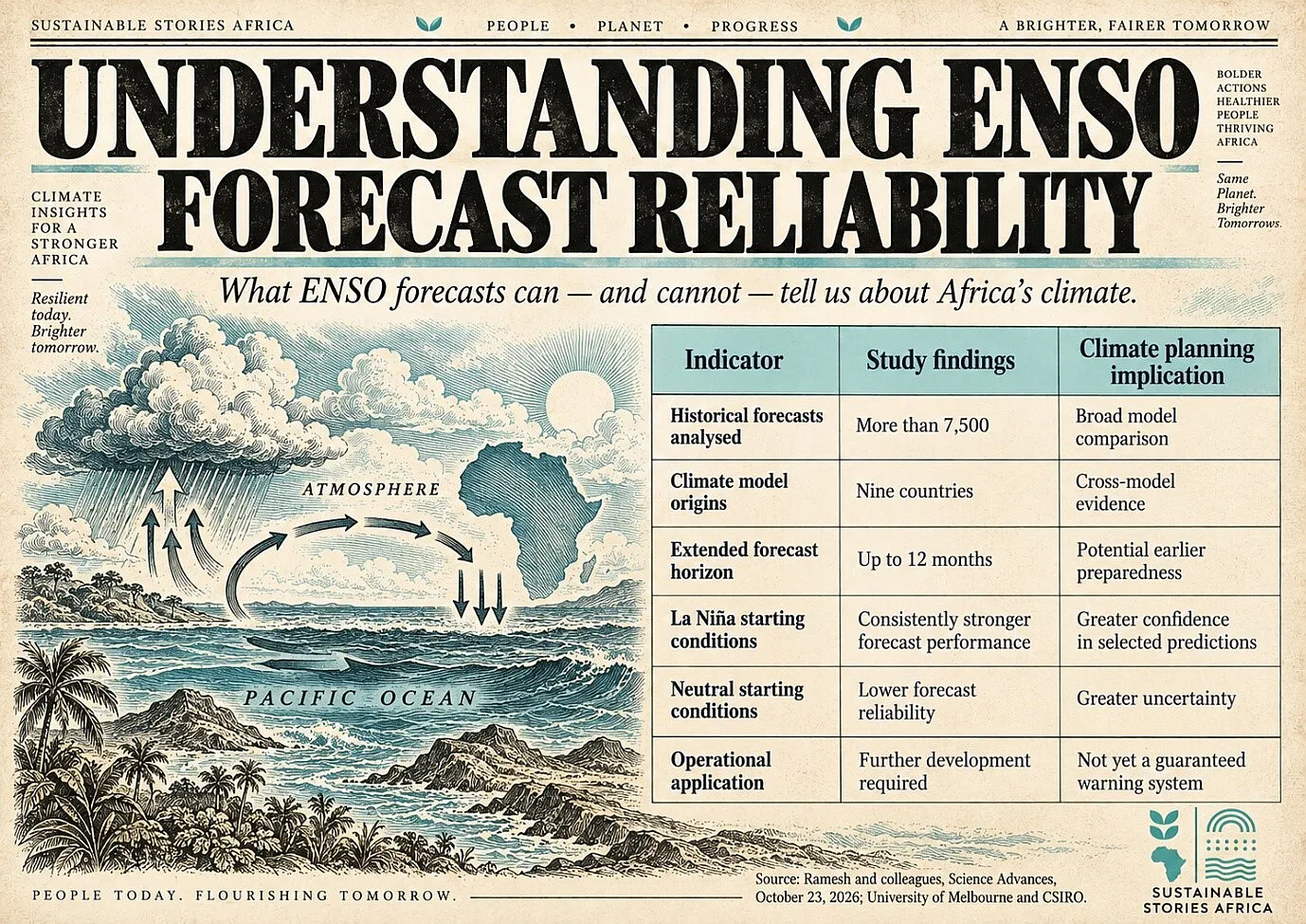
Researchers examined more than 7,500 historical forecasts produced by climate models developed in nine countries.
- Their analysis found that predictions beginning during La Niña conditions performed consistently well when forecasting El Niño–Southern Oscillation (ENSO) behaviour up to one year ahead.
Forecasts beginning under neutral Pacific conditions were considerably less reliable.
Climate Forecast Reliability Depends On Conditions
ENSO is a major driver of global climate variability, influencing rainfall, temperature and atmospheric circulation across multiple regions.
El Niño generally refers to unusually warm conditions in the central and eastern tropical Pacific Ocean, while La Niña represents the cooler phase.
These shifts can alter drought, flooding, heat and agricultural productivity patterns worldwide.
ENSO events typically reach their strongest expression toward the end of the calendar year.
- Forecasting them confidently more than six months ahead has historically been difficult.
The latest study suggests that this forecasting limitation is not uniform.
- Instead, the predictability of future conditions depends substantially on the ocean-atmosphere system's initial state.
The discovery has practical relevance for Africa, where climate-sensitive agriculture, limited irrigation infrastructure and constrained disaster-response resources can magnify the consequences of extreme weather.
Improved long-range forecasts could give authorities more time to prepare, although the study does not establish that every African weather event can be predicted 12 months.
Earlier Climate Warnings Could Protect Livelihoods
For climate-vulnerable economies, reliable early warnings create opportunities to move from emergency response toward anticipatory action.
- Agricultural ministries could use sufficiently reliable forecasts to inform seasonal planning, seed distribution and water-management decisions.
- Disaster-management authorities could review flood preparedness, emergency supplies and vulnerable infrastructure before climate hazards intensify.
- Financial institutions and insurers may also benefit from improved understanding of climate-related risks, particularly in agriculture and infrastructure.
Nevertheless, the research highlights an important scientific distinction between predicting large-scale Pacific climate conditions and forecasting the exact timing or severity of local disasters.
- Dr Nandini Ramesh, the study's lead author, noted that more research is needed and that further steps are required before the findings can be integrated into operational forecasting systems.
The researchers also observed that statistical and machine-learning methods could complement physics-based models under particularly difficult starting conditions.
Governments Should Strengthen Climate Warning Infrastructure
African governments and regional meteorological organisations should continue investing in observation networks, climate modelling, forecasting expertise and last-mile communication systems.
- Early forecasts protect communities when scientific information is translated into understandable and actionable guidance.
This requires coordination among weather agencies, agricultural institutions, water authorities, humanitarian organisations and local government.
Climate information should also communicate uncertainty clearly, ensuring that decision-makers understand the difference between a promising forecast and a confirmed weather outcome.
Path Forward – Better Forecasting Can Strengthen Climate Resilience
The findings demonstrate how improvements in climate science could support more anticipatory risk management.
For African countries, the priority is to connect emerging forecasting capabilities with reliable local observations, effective public communication and practical adaptation measures that protect communities and livelihoods.
Culled from: Scientists find key to predicting some El Niño events 12 months ahead