
The United Nations Conference on Trade and Development has warned that the expansion of services employment does not automatically deliver higher productivity or sustainable economic growth in least developed countries.
Its Least Developed Countries Report 2025 identifies weaknesses in traditional services, limited technological upgrading and insufficient connections with productive industries.
The findings call for policies that combine modern services development with industrialisation, skills improvement and stronger domestic economic linkages.
Services Expansion Has Not Guaranteed Transformation
Least developed countries need a fundamental upgrade in service-sector productivity and economic linkages if expanding employment is to translate into sustainable development, according to the United Nations Conference on Trade and Development (UNCTAD).
Chapter V of The Least Developed Countries Report 2025, titled Conclusions and Policy Discussion, examines whether services can provide an alternative pathway to the economic transformation historically associated with industrialisation.
The report concludes that services can contribute positively to development, particularly when they complement manufacturing and other productive activities.
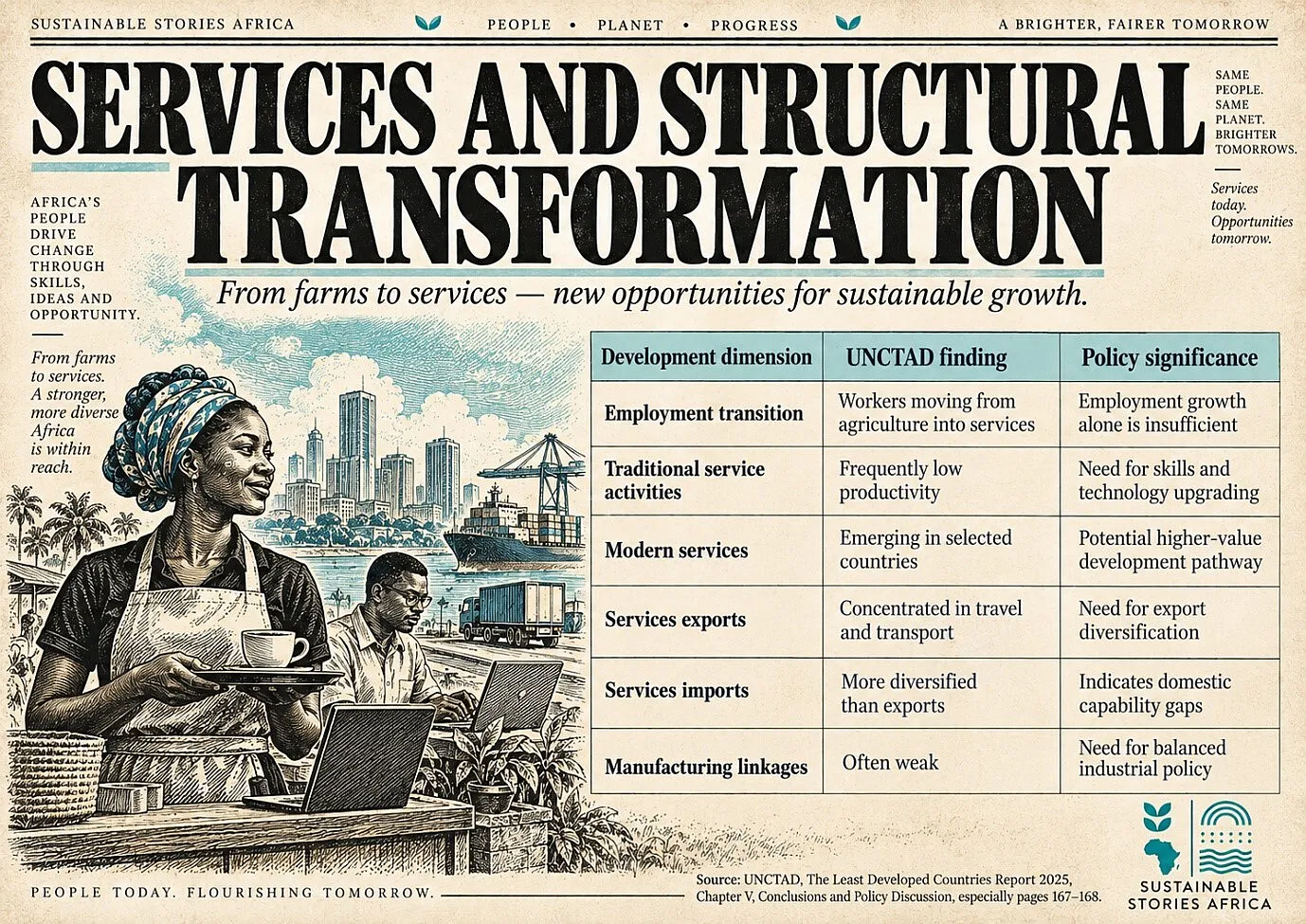
However, much of the employment growth occurring in the sector remains concentrated in low-productivity occupations and small businesses with limited opportunities for technological upgrading.
As a result, movement from agriculture into services has often failed to generate the substantial productivity improvements achieved through earlier industrial development experiences.
Traditional Services Remain Structurally Constrained Today
Structural transformation occurs when workers and economic resources shift from lower-productivity activities into sectors capable of generating greater value, higher earnings and improved living standards.
- In many least developed countries, services are absorbing workers leaving rural and agricultural activities.
- However, many of these jobs remain informal, poorly capitalised or dependent on modest domestic purchasing power.
The report identifies a dual structure in which large traditional service industries coexist with smaller, more sophisticated activities.
Examples of emerging modern services include commercial air transport in Ethiopia, port activities in Djibouti and Togo, financial services in Rwanda, and tourism in Cambodia and The Gambia.
- These examples demonstrate the potential for higher-value services, but also expose the uneven distribution of productive capabilities.
UNCTAD further observes that least developed countries' services exports remain concentrated in travel and transport, while their imports are considerably more diversified.
This pattern reflects continued dependence on external suppliers for specialised services and limited domestic capacity in some knowledge-intensive activities.
Productive Services Could Accelerate Inclusive Growth
UNCTAD's findings suggest that governments should avoid treating services and manufacturing as mutually exclusive development options.
- Modern logistics, finance, information technology, transport and professional services can increase productivity across agriculture, manufacturing and trade.
- An efficient logistics sector, for example, can reduce the cost of moving agricultural produce to processing facilities and domestic markets.
Similarly, accessible financial services can help enterprises acquire productive equipment, while digital technologies can improve business administration and market access.
- These linkages become more valuable when local workers and enterprises develop the capabilities to provide higher-value services.
For African economies with rapidly expanding urban populations, the challenge is to ensure that service-sector job creation leads to meaningful improvements in productivity, earnings and working conditions.
Without stronger linkages to productive industries, service-sector expansion risks reinforcing existing patterns of low-income employment.
Governments Should Prioritise Productive Sector Linkages
Policymakers should invest in vocational education, digital infrastructure, efficient transport systems and reliable energy supplies.
Development strategies should support firms capable of upgrading from basic service provision into higher-value commercial and knowledge-intensive activities.
Regional trade agreements and development partnerships can also create opportunities for cross-border service provision, technology transfer and enterprise development.
However, industrial policy should remain grounded in local capabilities and avoid assuming that approaches successful in one country will automatically produce comparable results elsewhere.
Path Forward – Balanced Development Strategies Can Unlock Growth
The report reinforces the importance of combining modern services, industrial development and agricultural productivity within coherent national strategies.
For African least developed economies, stronger skills, domestic enterprise capabilities and regional trade linkages can help convert expanding service employment into sustained productivity growth and improved living standards.