
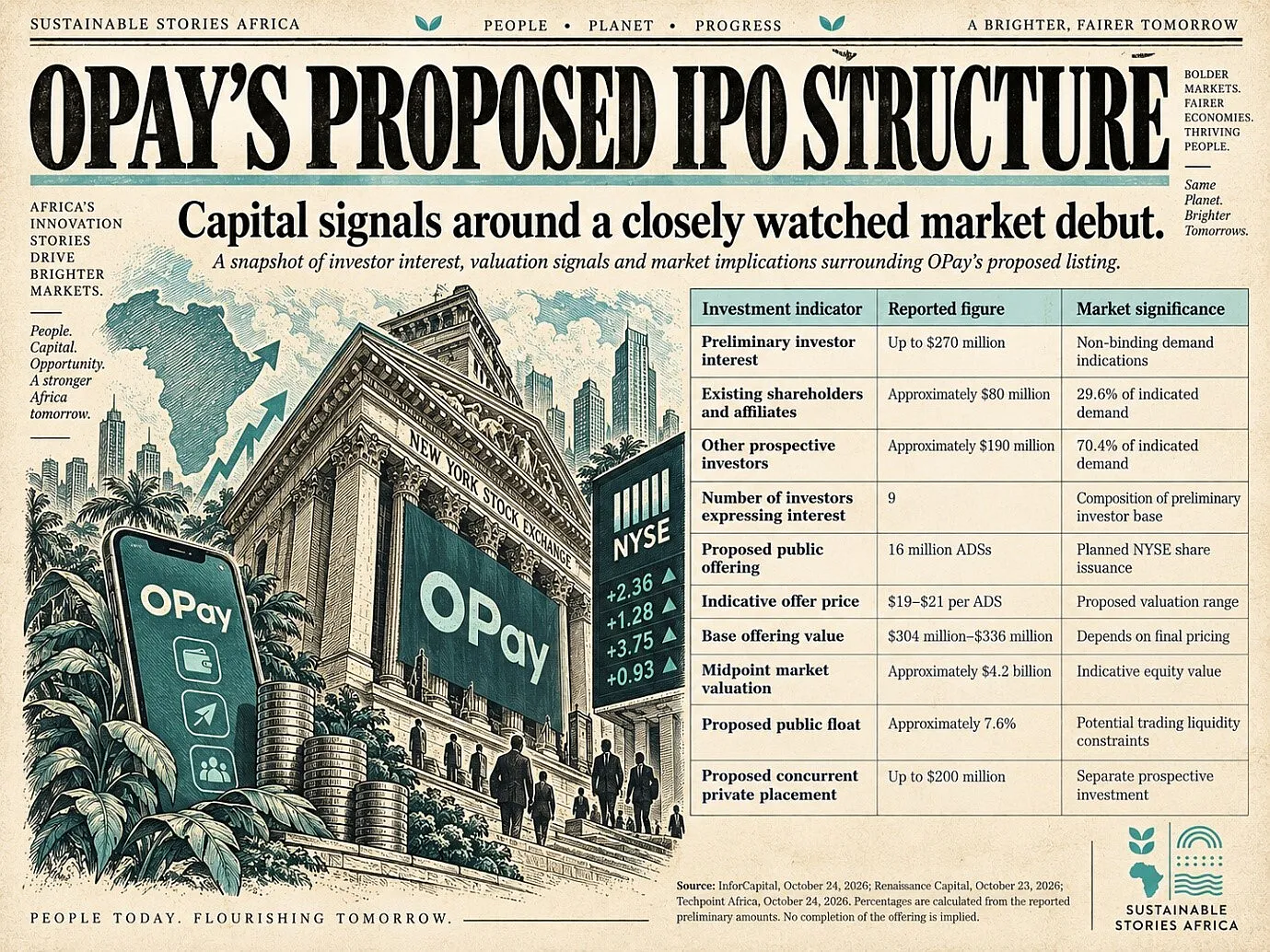
OPay has attracted up to $270 million in preliminary investor interest ahead of its proposed New York Stock Exchange initial public offering.
Approximately $80 million of the indicated demand comes from existing shareholders or affiliated investors, raising concerns about ownership concentration and trading liquidity.
The proposed listing matters to global capital-market confidence in African fintech businesses and their capacity to sustain transparent, inclusive financial growth.
OPay Attracts Significant Global Investor Interest
Nigeria-focused financial technology company OPay has attracted up to $270 million in preliminary investor interest ahead of its proposed New York Stock Exchange listing, with almost 30% of the indicated demand linked to existing shareholders and affiliated investment entities.
The development follows an amended registration statement filed with the United States Securities and Exchange Commission on October 23, 2026.
According to an October 24 report by InforCapital, nine institutional investors and investment vehicles have expressed interest in purchasing shares in the proposed initial public offering.
About $80 million of that interest comes from parties with existing financial relationships with OPay, while the remaining $190 million represents demand from other prospective investors.
The company intends to offer 16 million American Depositary Shares at an indicative price range of $19 to $21 each.
At the midpoint of the proposed range, OPay would raise approximately $320 million and achieve an indicative market valuation of about $4.2 billion.
The shares are expected to trade on the New York Stock Exchange under the ticker OPAY.
Importantly, the $270 million represents preliminary, non-binding expressions of interest. It does not mean that OPay has completed the offering or received that amount in IPO proceeds.
Existing Shareholders Shape Early Market Demand
The composition of OPay's prospective investor base provides insight into how established relationships influence major technology fundraising transactions.
- InforCapital identifies SCC Foresight Ventures, 3W Fund Management and SBVA, formerly SoftBank Ventures Asia, among the investors with existing exposure or related financial interests.
- Together, existing investors and affiliated entities account for approximately $80 million in indicated demand.
- Their participation could demonstrate continued confidence in OPay's business prospects.
However, it also raises questions about whether the offering is attracting independent institutional investors entering the company for the first time.
- Other prospective participants include international investment institutions and family offices.
- The transaction therefore combines established shareholder support with potential additional investment from outside OPay's existing ownership structure.
Another consideration is the relatively limited proportion of shares expected to become publicly available.
The proposed offering represents about 7.6% of the company's post-transaction equity on a reported share basis.
- A comparatively small public float can reduce trading liquidity, particularly when investors acquire significant allocations for a holding position for extended periods.
- This could result in sharper price movements when trading demand changes.
Investor interest is substantial relative to the proposed offer size, representing approximately 84% of the $320 million midpoint transaction.
These figures suggest potential support for the offering, but final demand will only become clear when the bookbuilding and allocation processes are completed.
International Capital Could Accelerate Financial Inclusion
OPay's proposed listing reflects the growing commercial importance of digital financial services in African economies.
- The company provides payment and related financial technology services in Nigeria and other emerging markets, supporting electronic transactions among individuals, merchants and businesses.
Digital payment systems have become increasingly important for small enterprises that require convenient transaction processing and alternatives to cash-based operations.
- For example, a market trader may benefit from reliable electronic payments that reduce the need to handle substantial amounts of physical cash.
- Small businesses may also use transaction histories to improve financial recordkeeping and demonstrate commercial activity.
According to Renaissance Capital, OPay generated approximately $806 million in revenue during the 12 months ended June 30, 2026.
- The company also operates in Indonesia, Egypt and Pakistan, demonstrating ambitions beyond its original Nigerian market.
Access to international public capital could provide financial resources for product development, technology investment and further market expansion.
- However, commercial expansion and financial inclusion are not necessarily the same achievement.
- Sustainable financial inclusion requires affordable services, transparent fees, responsible financial products, effective consumer protection and reliable access to digital infrastructure.
The ultimate development contribution of a successful IPO would therefore depend partly on how additional investment translates into better services and stronger economic participation.
Corporate Governance Must Support Market Confidence
OPay's proposed listing underscores the importance of disclosure quality, financial controls and effective investor oversight.
Companies seeking international capital must clearly communicate their financial information, ownership structures and commercial risk exposures to prospective shareholders.
- Investors should examine the company's revenue performance, profitability, competitive position and regulatory exposure alongside its growth prospects.
- They must also distinguish between preliminary subscription interest and confirmed share purchases.
Market regulators and corporate boards have an important role in promoting transparent disclosures and sound governance.
For African technology firms considering future public offerings, the OPay transaction illustrates the potential benefits of strong financial reporting and institutional credibility.
Equally important is customers’ protection as fintech businesses scale their operations.
Data privacy, cybersecurity, responsible lending practices and effective dispute resolution should remain central to long-term business sustainability.
Path Forward – Demands Financial Accountability
OPay's proposed listing could strengthen international recognition of African financial technology businesses and broaden access to global investment capital.
However, sustained success will require transparent reporting, credible governance, diversified investor participation and adequate market liquidity.
For Africa's fintech sector, the priority is to translate capital-market growth into resilient businesses, responsible innovation and financial services that deliver measurable benefits to individuals and enterprises.