Employers increasingly rank resilience as a defining workplace skill, yet many offer little support to develop or sustain it.
Researcher Laura Chamberlain argues that organisations often mistake endurance under dysfunction for genuine resilience.
The distinction matters across African workplaces, where economic volatility and lean staffing can turn structural strain into an unfair test of individual toughness.
Resilience Becomes a Management Test
Employers say resilience is among the qualities most likely to determine whether a recruit succeeds.
However, many organisations still treat it as something a candidate either possesses or lacks, rather than a capacity that leadership, resources and relationships can strengthen.
- That contradiction is turning a valued future-of-work skill into a convenient label for surviving preventable pressure.
Laura Chamberlain, whose work examines positive resilience, argues that waiting for a crisis and watching who survives is a gamble, not a strategy.
- A worker who is already exhausted cannot reasonably be asked to build resilience at the same moment.
Burnout prevention and resilience development are connected, but they are not interchangeable.
Toughness Is Not Organisational Capacity
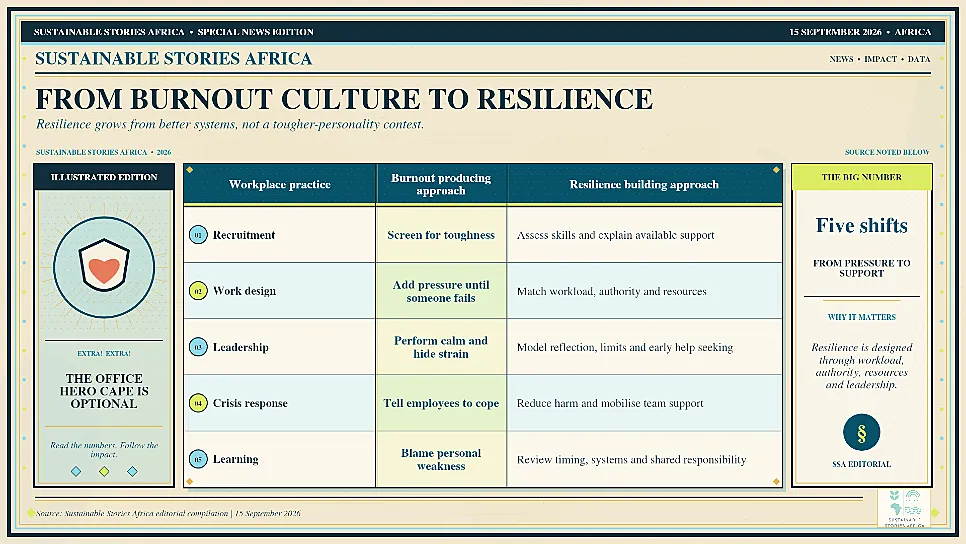
The common hiring approach starts with the desired outcome and works backwards: resilient staff remain effective when plans change, clients become difficult, or resources shrink.
When somebody struggles, managers can diagnose an attitude problem without examining timing, workload, authority or support.
Chamberlain proposes a different question.
- An apparent “cannot” may mean “not yet,” revealing a missing resource, an untested case or an unrealistic deadline.
Her research also challenges the image of resilience as lone-wolf self-reliance.
- People build it through colleagues who notice distress, leaders who model vulnerability and teams where asking for help is treated as responsible conduct.
- Men and women may give different reasons for avoiding resilience programmes, but both can internalise the idea that participation signals personal weakness.
Healthy Teams Recover and Learn
Properly understood, resilience is a process of preparation, adaptation and recovery.
- Organisations that build it during calm periods are better placed to respond to shocks without sacrificing health, institutional knowledge or trust.
- They also improve retention because employees see that performance expectations are matched by realistic support.
For African companies navigating currency shocks, unreliable infrastructure and fast-changing markets, resilient operations are particularly valuable.
However, transferring every external pressure to workers is not resilience.
- Cross-training, predictable escalation channels, psychological safety and well-designed leave arrangements help teams absorb disruption without normalising exhaustion.
The gain is not only wellbeing; it is continuity, better judgement and lower replacement costs.
Redesign Work Before Testing Workers
Boards and executives should treat burnout indicators as governance data rather than private employee problems.
- Regular workload reviews, manager training, confidential support and team-level recovery plans should sit beside performance metrics.
- Leaders should also examine whether incentives reward permanent urgency, silence or unpaid emotional labour.
Human-resources teams can replace vague resilience language in job descriptions with observable behaviours and the conditions that enable them.
Managers should ask what employees need before a crisis, then rehearse response plans through manageable simulations.
- The objective is not a workforce that absorbs dysfunction without complaint.
- It is an organisation that can recognise strain, adapt intelligently and recover together.
Path Forward – Builds Resilience Through Better Work
Employers should move from selecting supposedly tough individuals to creating teams with resources, trust and permission to seek help early.
When leaders measure workload, model healthy limits and learn from pressure, resilience becomes a shared organisational capability.
That shift protects people while strengthening operational continuity and long-term performance.