The October TIGER update points to a more resilient global economy, alongside persistent vulnerabilities.
For African markets, stronger activity abroad offers opportunities but does not guarantee affordable finance or stable demand.
The priority is to convert external momentum into productive investment without weakening public finances.
Global momentum carries important fiscal warnings
The global economy has regained momentum despite policy and geopolitical disruption, according to the October 11 Brookings–Financial Times TIGER update.
Authors Eswar Prasad and Thomas Riveros describe positive activity across advanced and emerging economies while warning about debt, inflation and trade tensions.
For African policymakers, the immediate relevance is the external environment in which exporters sell, governments borrow, and households buy imported necessities.
Improving global activity can support opportunity, but its benefits depend on which markets expand and how financing conditions evolve.
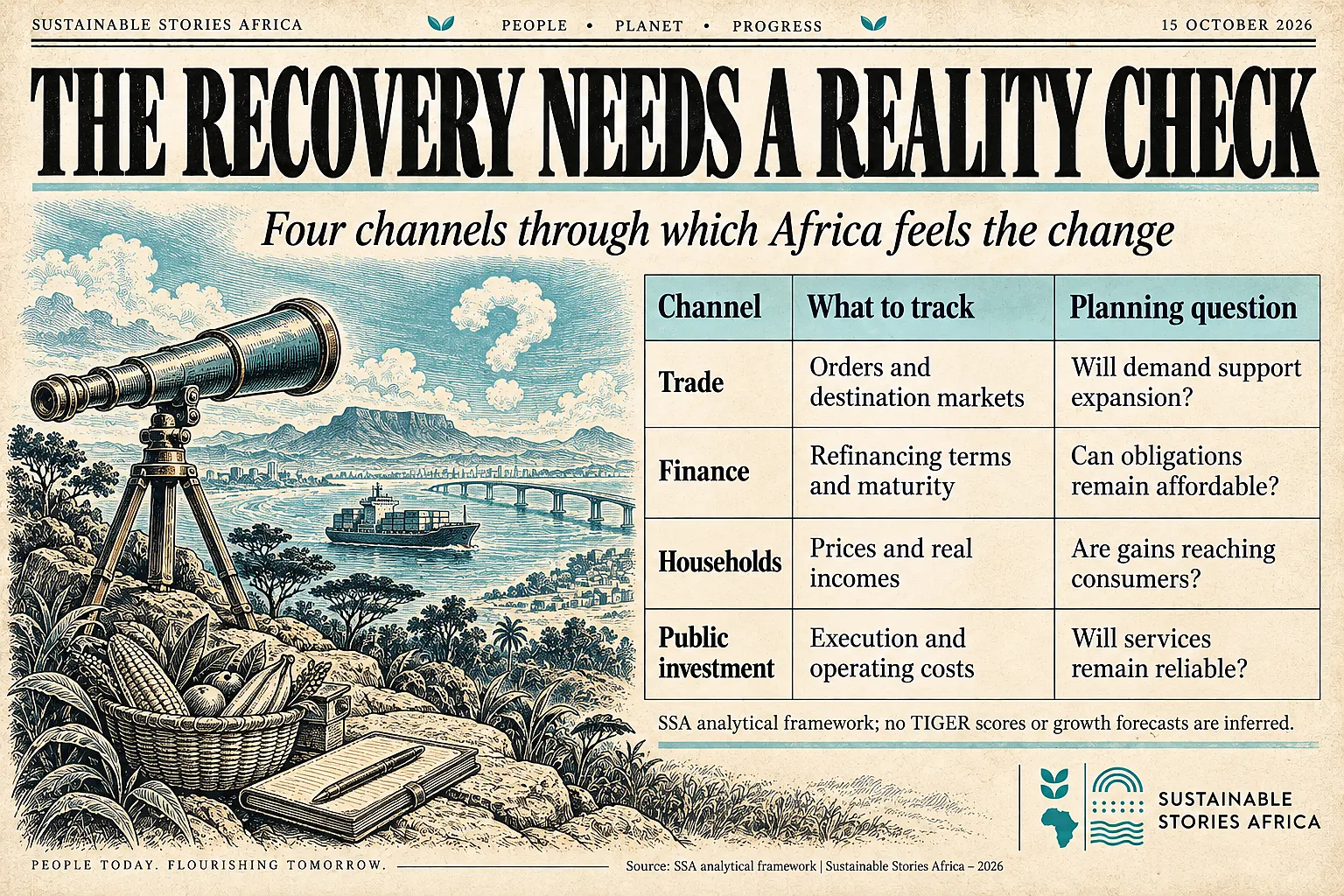
SSA’s analysis is to assess resilience through these transmission channels.
- A stronger international headline works locally when it supports sustainable orders, manageable input costs and investment that creates reliable work.
Recovery indicators tell different economic stories
TIGER brings together indicators of real activity, financial conditions and confidence.
- The update highlights a divergence between business optimism and weaker household sentiment in some advanced economies, while describing uneven regional performance.
The recovery index is not a promise about the next quarter, and it should not be read as a direct forecast for countries outside its coverage.
- African planning requires country evidence alongside international signals.
Relevant regional context comes from IMF analysis of budget credibility in sub-Saharan Africa.
- It links weak execution of spending plans to fiscal vulnerabilities, including arrears and unexpected financing needs.
The linkage is practical:
- External opportunities are harder to use when public investment plans cannot be implemented predictably, or suppliers cannot rely on timely payment.
Household gains require productive domestic investment
Consider an exporter deciding whether to expand capacity after renewed interest from overseas buyers.
- Stronger demand creates an opening, but the firm must still judge the reliability of electricity, transport and working capital.
- The international recovery cannot resolve those constraints on its own.
This is an illustrative decision, rather than a company case reported by Brookings.
The same distinction applies to employment.
- A capital spending boom can lift production without creating equivalent opportunities for every group of workers.
- Training, competition and access to finance for smaller businesses influence how widely the gains spread.
For governments, sustainable growth also requires attention to the quality of spending.
- A project that improves the reliability of existing services may offer more public value than an ambitious expansion with no maintenance budget.
- The test should be the service delivered over time, with a clear account of operating costs and who will pay them.
Policy credibility must accompany growth ambitions
SSA assesses that governments should use an improving external environment to strengthen resilience rather than assume it will continue.
- This means testing budgets against less favourable export earnings, financing conditions and import bills.
- Assumptions should be published clearly enough for legislatures and citizens to understand the trade-offs.
Businesses can apply similar discipline by reviewing exposure to a small number of customers or suppliers.
- They should distinguish confirmed orders from encouraging enquiries and assess whether expansion remains viable if payment takes longer than expected.
Development financiers can support investment that removes identifiable constraints, with procurement and performance reporting designed around actual delivery.
- General optimism is a weak substitute for a credible implementation plan.
These priorities give sustainability a concrete economic meaning.
- Fiscal transparency protects the resources available for essential services; productive infrastructure supports livelihoods; and sensible risk management reduces the likelihood that an external setback will force abrupt cuts to social or climate spending.
A clear distinction between temporary gains and durable improvements would help citizens judge whether recovery is strengthening everyday economic security.
Path Forward – Turn stronger growth into lasting resilience
African decision-makers should pair international recovery signals with domestic evidence on jobs, costs and public finances.
The aim is to strengthen productive capacity while preserving room to respond to shocks.
Credible budgets, practical reforms and accountable investment can help turn temporary momentum into lasting economic resilience.
Culled from: October 2026 update to TIGER: A modest recovery built on shaky foundations | Brookings