Rising precious metal prices have renewed interest in the debasement trade, a bet against weakening currency purchasing power.
Brookings economist Robin Brooks says fiscal concerns warrant attention, while acknowledging conflicting market evidence.
For African economies, the debate highlights the importance of credible budgets and careful management of commodity exposure.
Precious metals raise questions about confidence
A sharp rise in precious metal prices has intensified debate about whether investors are seeking protection against policies that could erode the value of money.
In an October 2 Brookings commentary, economist Robin Brooks examines this so-called debasement trade and the unresolved questions surrounding it.
For Africa, the significance goes beyond investment terminology.
- Confidence in public finances, the cost of borrowing and earnings from mineral exports all shape the resources available for development.
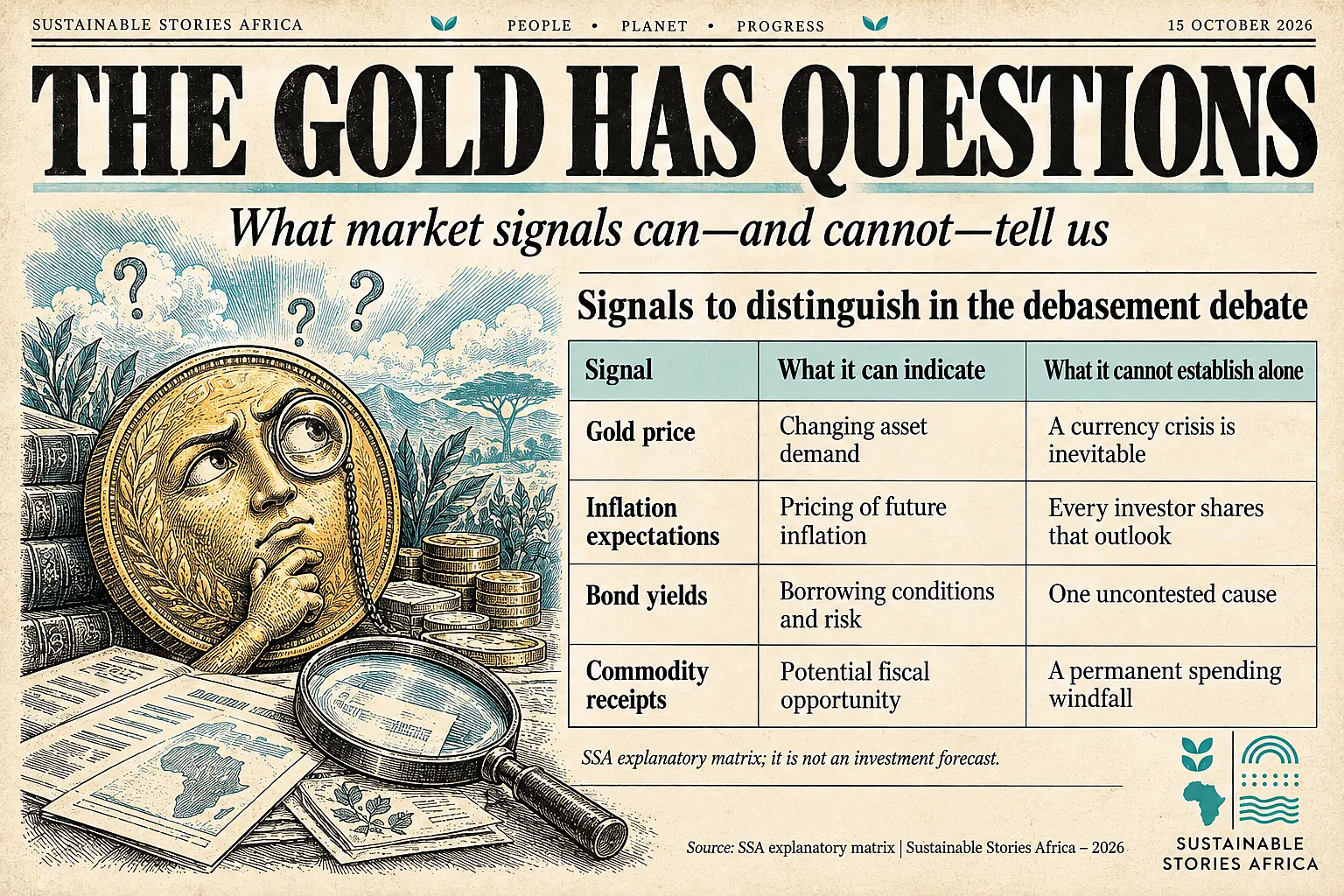
However, a rally in gold does not, by itself, establish that monetary instability is inevitable.
SSA assesses that the debate should encourage stronger scrutiny of fiscal decisions.
It should also discourage sweeping conclusions based on a single asset price, especially when markets are sending different signals.
Market evidence leaves the explanation contested
Brooks describes the trade as a move towards assets such as gold when investors fear that fiscal and monetary policy will weaken fiat currencies.
- It links movements in precious metals and policy events.
- It also discusses stable market measures of expected inflation as a challenge to a simple explanation.
A separate IMF analysis of African debt highlights the growing importance of domestic borrowing and the links between sovereign finances and banks.
- This provides a regional reason to take fiscal confidence seriously without assuming that the drivers of international gold prices explain local financial conditions.
The distinction matters because a government’s ability to fund services depends on its own revenues, liabilities and institutions as well as the international environment.
- Local evidence is indispensable.
THE GOLD HAS QUESTIONS
Commodity earnings need careful public stewardship
For a gold-producing economy, higher export prices could strengthen public finances.
- The scale of any gain depends on production, costs, ownership and the tax system.
- A change in the market price doesn’t necessarily mean that money is available for public spending.
SSA’s analysis is that temporary commodity strength is best assessed alongside longer-term obligations.
- If a government commits to recurrent expenditure that can be financed only at unusually favourable prices, a later reversal could threaten essential services.
- Transparent revenue assumptions make that exposure easier to identify.
Environmental and social performance also remain relevant when prices rise.
- Public authorities and companies should be able to explain how production affects land, water, workers and nearby communities.
- Higher earnings should create room for better oversight and rehabilitation, rather than weaken the discipline applied to those responsibilities.
These are policy implications, not findings of a new mining study.
Fiscal transparency offers a practical response
Governments cannot control every movement in global markets, but they can improve the information lenders and citizens use to assess their decisions.
- Clear debt reporting, realistic budgets and explanation of contingent obligations help make fiscal choices more meaningful.
Public debate should also distinguish inflation, exchange-rate changes and investor demand for particular assets.
- They can interact, but they are not interchangeable measures.
- Treating every rise in gold as proof that the currency is failing would obscure other drivers and make policy discussion less useful.
For businesses, the immediate task is to understand exposures in their own accounts:
- The currency of income and debt, payment timing and sensitivity to input costs.
This article does not recommend buying or selling any asset.
- It emphasises the governance implications of the market debate.
- A credible response should prioritise institutions that can withstand unfavourable conditions.
Sustainable public finances depend on consistent implementation and trustworthy disclosure, not a reassuring label attached to a budget or an assumption that a commodity windfall will last.
Path Forward – Build fiscal trust beyond commodity cycles
African governments should explain debt and revenue risks plainly and resist building permanent obligations on temporary commodity gains.
Investors and citizens need evidence they can test.
The debasement debate remains unsettled.
Its practical lesson is to strengthen fiscal credibility while assessing market signals in their full context.
Culled from: What is the debasement trade? | Brookings