KenGen plans to sell electricity directly to industries at its Green Energy Park in Olkaria, Naivasha.
The move follows Kenya’s new open-access electricity regulations, which allow power producers to serve large consumers directly.
For manufacturers, it could mean cheaper, cleaner and more reliable power, and a test of Kenya’s industrial energy reforms.
Attention: Kenya’s Power Market Begins Opening
Kenya’s state-owned electricity producer, KenGen, is preparing to sell power directly to industries at its Green Energy Park in Olkaria, marking one of the clearest signs yet that the country’s electricity market is moving beyond the traditional single-buyer model.
The company is expected to apply to the Energy and Petroleum Regulatory Authority for transmission and distribution licences on June 2, 2026, allowing it to supply companies setting up inside the Naivasha-based park.
The plan follows the gazettement of the Energy (Electricity Market, Bulk Supply and Open Access) Regulations, 2026, which opened a route for generators to sell electricity directly to large consumers.
For Kenya’s manufacturers, the issue is practical. Power is not just a utility bill; it is a question of competitiveness.
A factory that loses production hours to unreliable supply or pays high tariffs passes those costs to workers, consumers and export markets.
KenGen’s proposal is therefore more than a corporate expansion. It is a test of whether Kenya can use clean electricity to attract industry, reduce production costs and build a greener manufacturing base.
Olkaria Becomes Industrial Test Case
At the heart of KenGen's industrial strategy is the Green Energy Park in Olkaria, a special economic zone designed to host energy-intensive industries powered by geothermal electricity. The model is deliberately straightforward: position industries close to clean baseload power, reduce energy supply friction, and transform electricity from a business constraint into a competitive investment incentive.
KenGen is targeting manufacturers, data centres, logistics companies and high-consumption businesses, leveraging lower electricity costs and reliable supply as key attractions. The park has already drawn investor interest, including industrial activity linked to steel logistics and fabrication.
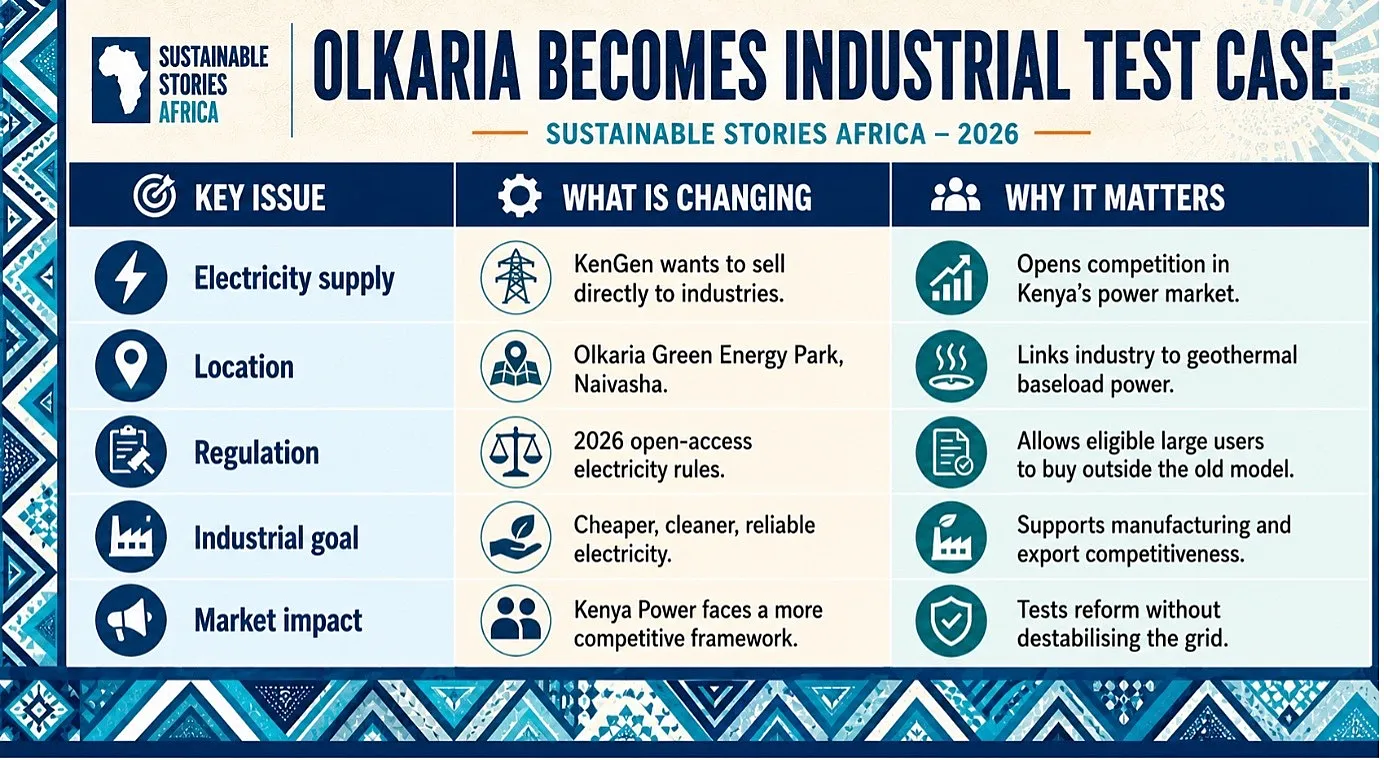
The initiative arrives at a structurally significant moment. Kenya Power has traditionally dominated electricity procurement and distribution, while KenGen supplied power into the national grid. Open access reforms are reshaping this arrangement, enabling direct engagement between qualified consumers and generators through wheeling arrangements. For industries such as flower processors, cold-chain operators and steel fabricators in Naivasha, reliable and competitively priced geothermal power could establish Olkaria as a compelling proof point for green industrialisation in Africa.
Desire: Clean Power Can Drive Jobs
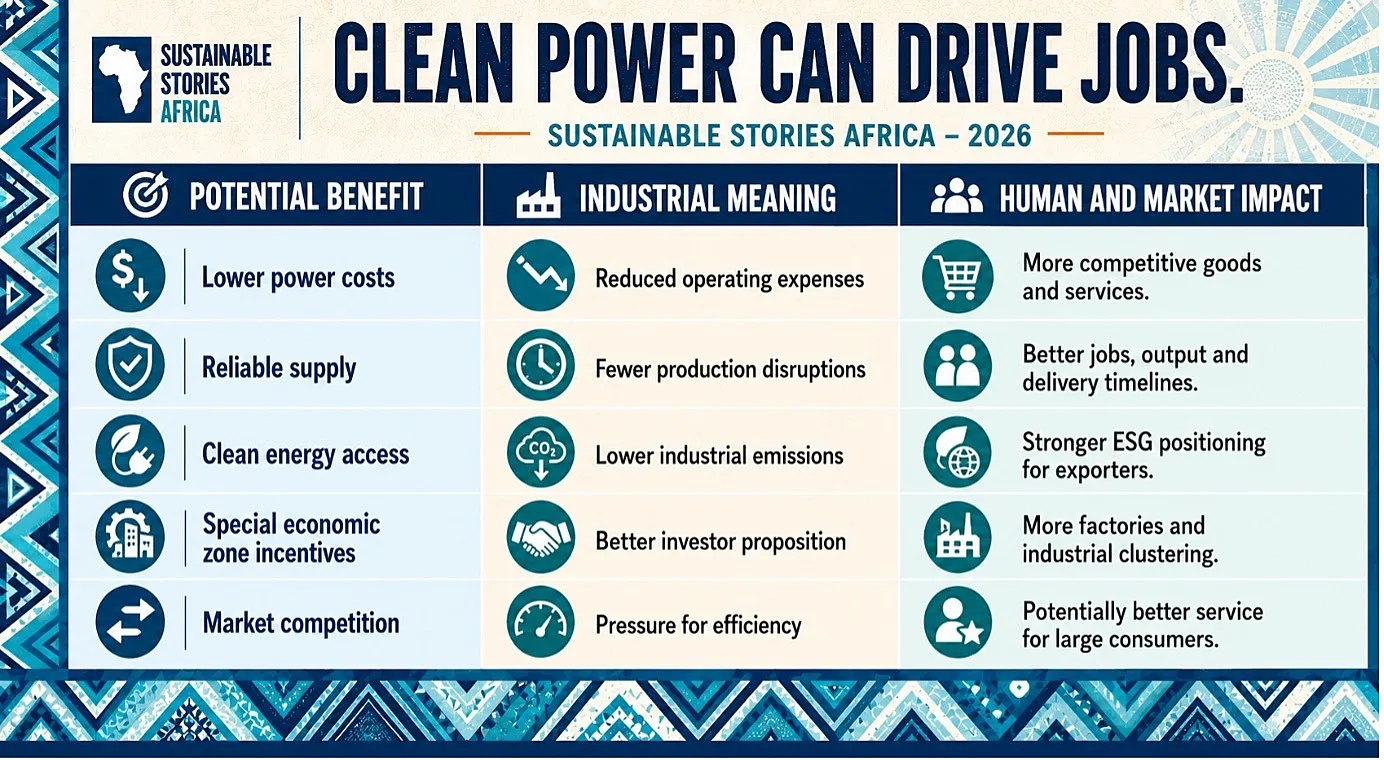
Kenya’s opportunity is not only to lower power bills. It is to show how renewable energy can become an industrial infrastructure.
Geothermal power gives Kenya an advantage many African economies are still trying to build: a renewable resource that can run day and night.
Unlike solar and wind, geothermal can provide stable baseload electricity, making it attractive for factories that cannot afford frequent interruptions.
If the direct supply model works, it could support new jobs, deepen local value chains and improve the appeal of cleaner production hubs by investors in Kenya.
It could also help companies reduce carbon exposure as global buyers increasingly scrutinise emissions across supply chains.
The risk is that reform without careful design could create new tensions. If the best-paying industrial customers move into direct supply arrangements, Kenya Power’s revenue base could weaken unless tariffs, wheeling charges and market rules are managed transparently.
That is why the reform must balance competition with system stability. The goal should not be to weaken public utilities, but to make the electricity market more efficient, bankable and responsive to industrial demand.
Build Rules That Protect Growth
Kenya now needs a disciplined implementation framework. Regulators must ensure that direct supply licences, wheeling charges, grid access rules and consumer eligibility criteria are clear, fair and enforceable.
KenGen must also prove that the Green Energy Park can deliver what investors need: reliable electricity, serviced land, access to water, transparent pricing and fast approvals.
Without these, cheaper power alone will not be enough.
For policymakers, the wider lesson is that clean energy should be tied to production. Africa’s energy transition will gain public support when it powers factories, preserves jobs, reduces business costs and improves household livelihoods.
Kenya’s experiment could become a model for other African markets seeking to connect renewable energy with industrial policy.
However, the model will only work if reform is transparent, financially sound and inclusive enough to serve national development, rather than a handful of large consumers.
Path Forward – Make Clean Power Industrial Policy
Kenya should use KenGen’s direct supply plan to test a fair, competitive and investment-ready electricity market.
Clear wheeling charges, strong regulation and transparent pricing will be essential.
The bigger promise is green industrialisation. If Olkaria works, clean power can become a platform for jobs, exports, lower emissions and stronger ESG performance across African markets.
Culled From: KenGen eyes direct power supply to industries