
Meta has agreed to pay up to $18 billion and change how teenagers use Facebook and Instagram in the United States.
The settlement introduces time limits, overnight restrictions and stronger safeguards, but researchers question whether the measures address the platforms’ most harmful design features.
For African regulators and families, the case offers a warning: child safety cannot depend on corporate promises alone.
A costly deal meets scientific doubt
Meta Platforms will pay up to $18 billion over ten years and impose new restrictions on teenage use of Facebook and Instagram after settling claims brought by nearly all US states.
The agreement, approved in August 2026, ends a federal trial alleging that Meta designed addictive products, harmed children and misled the public about platform safety. Meta denied wrongdoing.
The settlement is financially large and operationally significant.
- However, the central public-interest question is not whether Meta has accepted new rules, but whether those rules will measurably reduce harm.
- Researchers interviewed by Nature were doubtful that the available evidence supports treating the package as a complete solution.
New controls leave core systems untouched
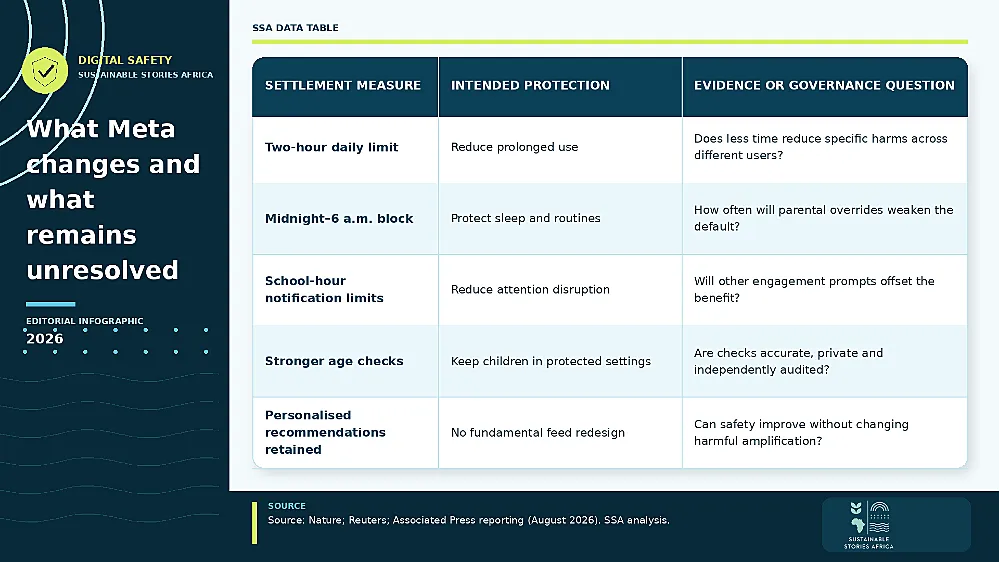
Under the agreement, users under 18 will generally face a two-hour daily limit and a midnight-to-6 a.m. block unless parents consent.
- Meta will curb most school-hour push notifications, strengthen age checks, hide some engagement signals and provide additional parental controls.
- Independent audits are expected to test parts of implementation.
However, the settlement does not require Meta to abandon personalised recommendations or targeted advertising.
- It also leaves unresolved how platforms should respond to content linked to body-image distress and other harms.
That gap matters because time online is only one exposure measure; the content encountered, ways it is ranked and the social feedback it triggers can shape outcomes.
Researchers have also warned against assuming that one intervention will affect all teenagers in the same way.
- A time cap may help some families create boundaries, while doing little for a young person repeatedly directed towards harmful content.
- Evidence must therefore examine different ages, vulnerabilities and patterns of use, not only average screen time.
Safer design could reset digital norms
If properly enforced and independently evaluated, the settlement could establish a useful baseline for youth-centred product design.
- Defaults matter: protections that apply automatically are more likely to reach children than settings hidden behind menus.
- Clear age assurance, night-time quiet periods and reduced attention prompts could also help parents without making them sole safety officers for complex platforms.
The wider prize is market-wide change.
- Meta’s payment includes a contingent amount linked to whether rival platforms adopt comparable protections.
- That structure could push safety expectations beyond one company.
However, competition over safeguards should raise standards, not produce a checklist that companies can satisfy while keeping high-risk recommendation systems unchanged.
Africa needs enforceable child protections now
African regulators should study the settlement and not just copy it.
- Children across the continent use the same global platforms, often in markets with thinner research capacity, fewer specialist mental-health services and uneven enforcement.
- Governments, schools, researchers and child-rights groups need locally grounded evidence on exposure, language, culture, gender and access patterns.
That evidence should extend beyond self-reported wellbeing surveys.
- Researchers need privacy-protecting access to test what young people are shown, how quickly harmful material appears, whether reporting tools work and which interventions change behaviour over time.
- Public agencies should also track unintended effects, including children moving to less visible accounts or platforms.
- A credible evaluation framework would define baseline risks before changes begin, publish methods and report both benefits and failures.
Without that discipline, governments may confuse compliance with impact, and companies may promote measures whose protective value remains uncertain.
- Platforms should publish age-disaggregated safety metrics, open systems to qualified independent researchers and explain how recommendation changes affect harmful-content exposure.
- Regulators should require risk assessments, accessible complaints channels and remedies that work across low-bandwidth environments.
Parents deserve usable tools, but the burden of correcting platform design must remain with the companies that build and profit from it.
Path Forward – Evidence Must Guide Youth Safety Rules
The settlement is a meaningful intervention, not proof of safety. Its value will depend on transparent implementation, credible audits and evidence showing that young users experience less harm rather than simply spend fewer minutes online.
African policymakers can use this moment to demand child-centred design, independent access to platform data and protections suited to local realities. The next standard should measure outcomes, not announcements.
Culled from: Will Meta’s deal make social media safe for kids? Researchers are dubious | Nature