A new generation of nature carbon projects seeks to rebuild confidence through stronger accounting, monitoring and finance.
For African developers, the opportunity depends on proving benefits while protecting communities and land rights.
Buyers must distinguish credible project improvements from promises that have yet to withstand scrutiny.
Stronger standards reshape the market debate
Nature carbon markets are changing, with more conservative accounting, better management of storage risks, longer purchase agreements and improved monitoring emerging as priorities.
This is according to a September World Economic Forum 28 commentary published.
Julia Strong of the Symbiosis Coalition and Susan Cook-Patton of The Nature Conservancy argue that purchasing and policy decisions should reflect these developments.
The argument matters for Africa because restoration projects need patient finance, while buyers need confidence that their money supports measurable climate benefits.
SSA’s analysis is that the opportunity lies in linking these needs through transparent contracts.
A project should explain what it will deliver, how delivery will be assessed and who bears the cost if performance falls short.
Four changes demand closer buyer scrutiny
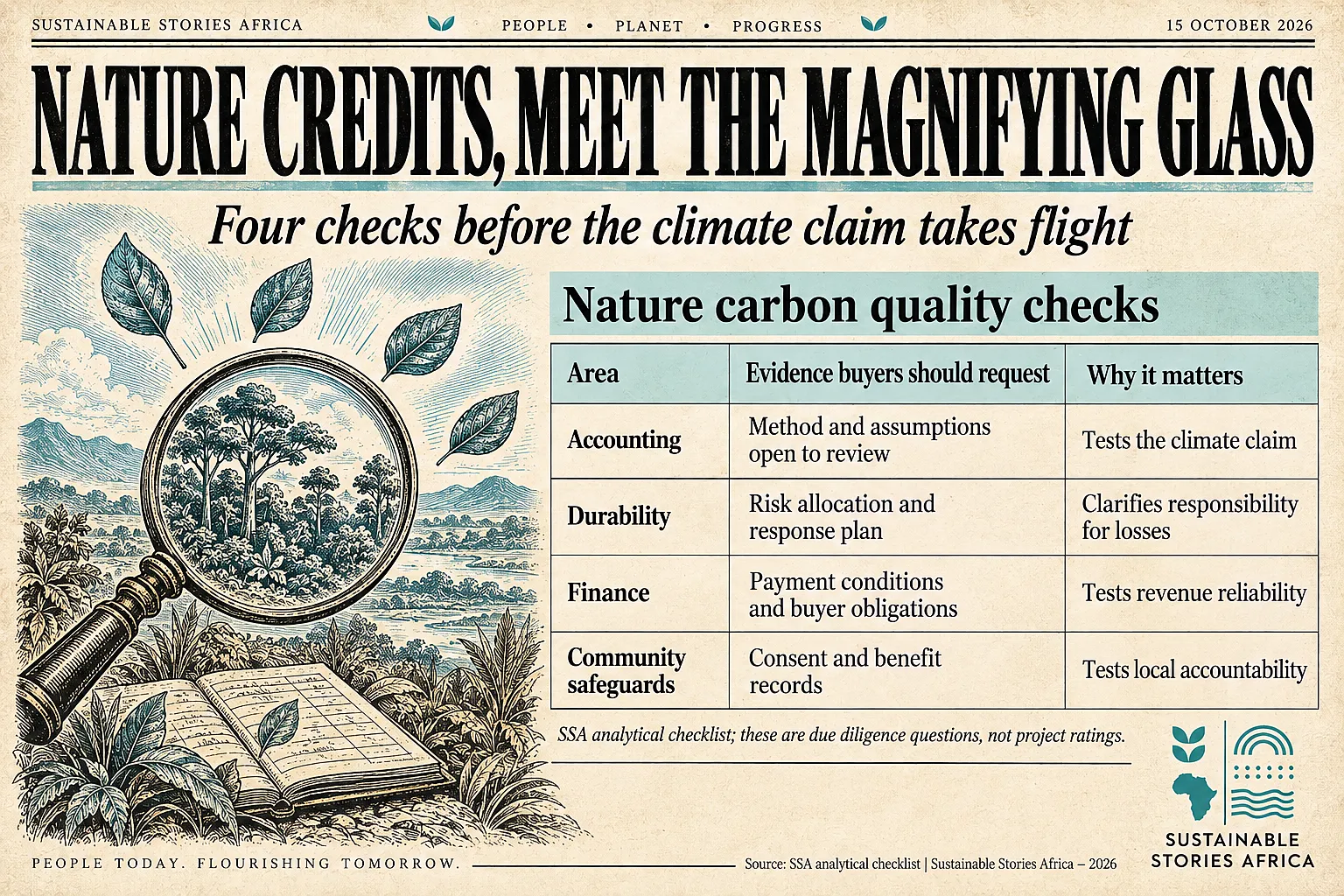
The authors identify four areas of progress:
- Scientific rigour
- Durability
- Financing
- Technology.
Their case is an expert assessment of market developments, rather than proof that every credit now meets a common quality threshold.
The Integrity Council for the Voluntary Carbon Market provides a separate benchmark.
- Its Core Carbon Principles cover issues including additionality, robust quantification, permanence, independent verification and social safeguards.
- These requirements help translate broad assurances into questions that a purchaser can investigate.
For example, a restoration proposal should explain why the activity needs carbon finance and how its emissions estimate would change if the underlying assumptions proved optimistic.
A monitoring platform can support this work; it cannot settle an unresolved land claim or establish community consent by itself.
Community benefits must survive market uncertainty
For an African landholder considering a restoration agreement, the practical question extends beyond how many credits might be issued.
- The agreement may influence access to land, income expectations and decisions about farming or grazing.
- People should understand these consequences before making commitments.
SSA assesses that credible project design should make the distribution of benefits understandable to people who do not trade carbon.
- Payment schedules, deductions, responsibilities and complaints procedures should be available in accessible language.
- Communities also need to know what happens when a buyer withdraws, or a project generates fewer credits than expected.
A commercially attractive agreement could support local nurseries, restoration work and monitoring skills.
- These are potential outcomes, however, and should be reported as results only after delivery is documented.
Counting projected employment as achieved employment would weaken the very confidence that improved carbon accounting seeks to restore.
Investment decisions need independently testable evidence
Buyers should request a clear evidence trail linking the project boundary, methodology, monitoring period and issued credits.
- They should also ask whether local institutions have the resources to challenge inaccurate information.
- Independent assessment becomes more useful when communities can raise concerns without losing access to promised benefits.
Developers, in turn, need procurement processes that recognise the cost of credible measurement.
- Demanding stronger evidence while refusing to finance its collection can leave smaller projects unable to participate.
- A proportionate approach could support shared technical services while keeping project accountability intact.
Governments should make authorisation processes predictable and explain how national climate objectives interact with private projects.
- These are SSA recommendations, rather than measures announced in the WEF commentary.
- Their purpose is to reduce avoidable uncertainty without treating carbon revenue as guaranteed.
- Reduction of corporate emissions should remain central to climate plans; credit purchases require their own honest explanation of purpose and limits.
Public reporting should show whether commitments have been met at each stage.
- This creates a basis for learning from successful projects and correcting weaknesses before they are repeated elsewhere.
Path Forward – Make credible restoration finance serve communities
African carbon markets need investment that rewards demonstrated performance and respects the people managing land.
Buyers should test claims, developers should disclose risks, and public authorities should clarify the rules.
The next milestone is evidence of durable outcomes: credible climate accounting, reliable community payments and restoration that continues when market conditions change.
Culled from: 4 reasons why next-generation credits are redefining nature-based carbon markets | World Economic Forum