A proposed debt platform aims to channel institutional capital into water infrastructure by financing creditworthy industrial users instead of distressed utilities.
The model begins in South Africa, where the estimated water-investment gap is $5.6 billion annually through 2050.
Its test is whether private water security can also strengthen public systems, without draining utilities of their most reliable customers.
New Platform Reroutes Capital Into Water
Climate Policy Initiative has unveiled a Water Resilience Debt Platform designed to mobilise institutional investment for water treatment and delivery infrastructure in emerging economies, starting with creditworthy industrial users in South Africa.
Developed with the Resilient Water Accelerator and FinDev Canada, the model addresses a financing system that has stalled in municipalities with financially weak utilities.
South Africa needs about $5.6 billion, or R91 billion, of water investment each year through 2050, according to the Development Bank of Southern Africa, while 76% of its water utilities are described as financially distressed.
The human cost sits behind those balance sheets. When a treatment plant fails or drought tightens supply, households queue, clinics ration water and factories cut production. Yet the platform’s first borrowers are not municipalities or communities.
They are large industrial users with the revenue strength to support repayable debt.
Five Stages Turn Projects Into Debt
The structure begins when an industrial user or developer creates a special-purpose vehicle to own a wastewater-reuse or desalination asset and contributes 20% – 30% equity.
A commercial bank finances construction, conditional on refinancing once the project reaches commercial operation.
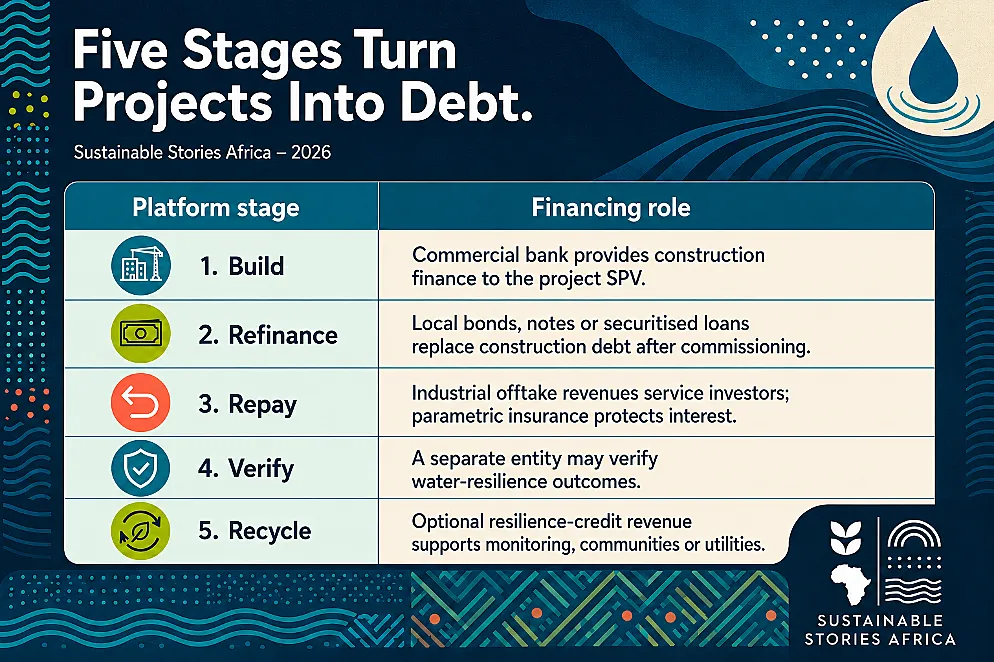
At commissioning;
- A platform SPV draws committed investor funds from local debt markets and refinances the construction loan on pre-agreed terms.
- Long-term repayment comes from an offtake agreement with the industrial user. Parametric insurance can cover interest on the debt after weather events that disrupt revenue.
- Optional, non-transferable resilience credits may add impact funding, but CPI says they are not required for commercial viability.
Bankable Industry Could Strengthen Shared Supply
The attraction is standardisation. Pooling repeatable projects can lower transaction costs, match risk to different investors and create usable water without waiting for utility reform.
Companies gain more predictable supply and pricing; communities could benefit where treated water is returned to public networks, reducing pressure on scarce basins.
A South African commercial bank, unnamed by CPI, has adopted the model and is advancing it towards public launch with a pipeline described as finance-ready.
That is an encouraging signal, not yet proof of pricing, investor demand, operating performance or community benefit.
The first projects will need transparent evidence before claims of billions in mobilisation can be tested.
Safeguards Must Prevent Utility Revenue Erosion
The central risk is that self-supplying industries withdraw reliable revenue from fragile utilities.
- Projects should therefore quantify basin-level water gains, require fair return of surplus treated water where feasible, publish tariffs and allocation rules, and protect community access during scarcity.
- Public authorities must retain regulatory oversight even when assets are privately financed.
- The model should also avoid foreign-currency mismatches by prioritising local debt and must disclose who bears construction, demand, climate and refinancing risks.
- Guarantees should be targeted and time-bound, preventing public capital from absorbing losses while private investors retain the upside.
Path Forward – Prove the Model, Then Widen Access
The immediate task is a transparent South African launch with independently verified costs, water gains, investor terms and effects on utilities and neighbouring communities.
If those safeguards hold, replication could follow in Egypt, Morocco, India and other deep capital markets, while adapted guarantees may open access for partially bankable utilities in Kenya and Zambia. Scale should follow evidence, rather than precede it.
Culled From: How a New Debt Structure Aims to Fix Water Financing in Emerging Markets