


The Financial Conduct Authority has widened listed-company reporting under UK SRS but dropped its plan to make climate disclosure mandatory.
The decision matters because it aligns the UK with the ISSB baseline while giving companies more room to decline individual disclosures.
Investors will judge whether explanations become specific or settle into boilerplate.
Broader Rules, Softer Compulsion
The UK has widened sustainability reporting for listed companies while stepping back from making climate disclosure compulsory.
- On 30 September 2026, the Financial Conduct Authority (FCA) published policy statement PS26/19, moving in-scope companies from TCFD-based reporting to UK SRS S1 and S2 under a comply-or-explain approach.
The regime applies to accounting periods starting on or after 1 January 2027, with first reports in 2028.
OneStop ESG's analysis argues that both things are true:
- The UK is asking companies to report on more issues while giving them more room to decline any single disclosure.
How those two moves settle will decide what investors actually see.
What Moved and What Was Dropped
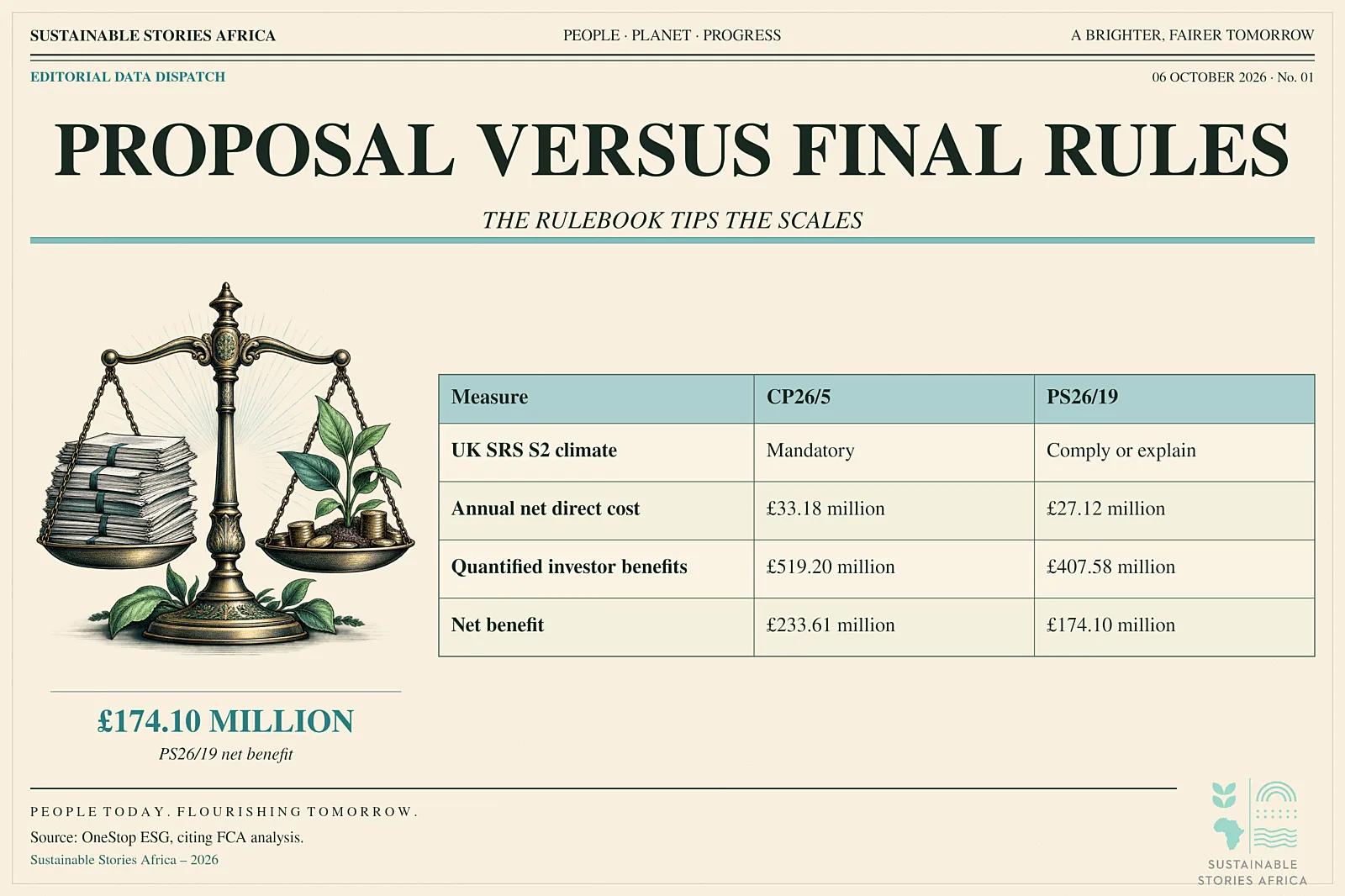
In January, consultation paper CP26/5 proposed that UK SRS S2 climate disclosures would be mandatory, with only Scope 3 on comply-or-explain.
- The final rules place both S1 and S2 on comply-or-explain.
- Secondary-listed companies and depositary receipt issuers, once expected to signpost home-country reporting, will now report against UK SRS like everyone else.
- More than 90% of respondents backed replacing TCFD with UK SRS.
The FCA's cost-benefit figures show the trade-off.
- Estimated annual net direct cost to business falls from £33.18 million to £27.12 million, but quantified investor benefits fall from £519.20 million to £407.58 million, and net benefit from £233.61 million to £174.10 million.
The model assumes 37% of domestic issuers will explain against most of UK SRS.
Explaining is not ignoring.
- Companies skipping any S2 requirement must summarise what they have not met, give reasons and set out plans to disclose later.
- A draft technical note, open for consultation until 28 October 2026, signals that generic boilerplate will not suffice.
Calling the change deregulation overstates it.
- The earlier TCFD rules were also comply-or-explain, and Reuters reported that an FCA review found 92% of FTSE 350 companies complied with TCFD in their 2025 annual reports.
On wider reporting, 78 of 113 respondents backed comply-or-explain for S1, though more than a quarter of those supporters asked for a clear path to mandatory reporting.
A Common Language That Works
If explanations are specific, name missing data and shrink year by year, comply-or-explain could deliver credible disclosure without unnecessary burden.
- Disclosures will sit in the annual report beside the financial statements, in front of audit committees.
- Companies must also state whether they obtained third-party assurance and whether they have published a climate transition plan, making gaps easy to spot.
The wider regime also arrives in stages, with relief periods that defer rather than remove the data challenge.
The risk is a regime that looks ambitious but yields little.
- The FCA has set no review date or committed pathway to mandatory S1 or S2, which leaves investors uncertain.
Watch the First Reporting Cycle
Companies should treat the explanation route as a discipline, not an exit, and prepare Scope 3 methods, scenario analysis and controls that a finance director can defend.
Investors should press for decision-useful explanations.
The FCA will set out its supervisory approach in the second half of 2027, and its first reports in 2028 will show whether flexibility strengthens or weakens market confidence.
Path Forward – Flexible Rules Still Demand Specific Explanations
The FCA is advocating ISSB-aligned reporting that is broader than TCFD, but applied flexibly.
The technical note consultation closes on 28 October 2026, and a supervisory approach is expected in the second half of 2027.
Companies must prepare Scope 3, scenario analysis and assurance disclosures, while investors will test whether explanations improve year by year.
Culled from: Broader Standards, More Flexible Rules: What the FCA's UK SRS Decision Means for Climate Disclosure | OneStop ESG