
Written By Eyikojoka Diboku
For more than three decades, Udo Udoma & Belo-Osagie’s Managing Partner, Jumoke Lambo, has worked on some of Nigeria’s most consequential legal and regulatory shifts, helping shape the frameworks that guide telecommunications, data protection, investment, and corporate governance.
Her story is not only about the law. It is about building systems that protect people, strengthen institutions, and prepare Africa’s largest economy for a more connected, accountable, and sustainable future.
Between Early Flights And Endless Responsibilities
The first flight to Abuja often left before dawn.
In the dim quiet of the airport terminal, Jumoke Lambo would sit with legal briefs balanced beside a handbag and half-finished notes marked carefully in blue ink. Hours later, after meetings, negotiations, and long stretches of regulatory discussions, she would board the final evening flight back to Lagos. Then she would return home, not simply as a lawyer overseeing critical projects, but as a wife, mother, mentor, and steady centre of family life.
For nearly two weeks, that became routine.
Years later, she would recall the period with remarkable calm. No dramatic language. No performance of sacrifice. Just a simple conviction that professional excellence should never require abandoning the people one loves.
That quiet discipline would eventually define her career.
Today, as Managing Partner of Udo Udoma & Belo-Osagie, Lambo stands among the most respected legal minds shaping Nigeria’s telecommunications, data protection, employment, aviation, and regulatory landscape. However, beneath the titles and decades of achievement remains a woman still guided by the same principles that first drew her to law: fairness, dignity, and responsibility
A Childhood Shaped By Justice Conversations
Long before boardrooms and policy frameworks, there were conversations.
Growing up, Lambo spent hours listening to discussions about governance, fairness, and current affairs led by her uncle, Femi Okunnu. Those exchanges, often ordinary in setting but profound in influence, slowly shaped her understanding of justice not as an abstraction, but as something that touched everyday lives.
She studied at Methodist Girls High School, Yaba, Lagos and Ellerslie Girls' School in the United Kingdom before earning her law degree from the University of Bristol. However, even while abroad, Nigeria remained emotionally present in her imagination: a country filled with possibility, contradiction, and institutions still being formed in real time.
After returning home and being called to the Nigerian Bar in 1989, she joined Udo Udoma & Belo-Osagie during her National Youth Service. She never left.
What began as a young lawyer’s entry into practice gradually became a 37-year institutional journey, one built patiently through consistency rather than spectacle.
In many ways, her professional life mirrors the evolution of Nigeria’s private sector itself: ambitious, adaptive, occasionally turbulent, but steadily expanding into new frontiers shaped by technology, investment, and globalisation.

Drafting Frameworks Behind Nigeria’s Connectivity Revolution
One assignment changed everything.
When the Federal Government of Nigeria, through the Bureau of Public Enterprises, assembled a consortium of international experts to review and redesign the country’s telecommunications regulatory structure, Lambo was part of the team that helped shape what would later emerge as the Nigerian Communications Act 2003.
The work was demanding, technical, and historically important.
At the time, Nigeria stood at the edge of a communications revolution. Internet penetration remained limited. Mobile connectivity was still developing. Investors needed certainty. Regulators needed structure. Citizens needed access.
Behind the eventual boom in mobile telephony, fintech innovation, and digital entrepreneurship were years of invisible legal architecture policy drafting, regulatory reviews, institutional negotiations, and compliance systems carefully constructed to support national growth.
For Lambo, the experience became transformative.
“It sparked my interest in telecommunications and technology,” she once reflected, noting that the sector now contributes significantly to Nigeria’s economy.
But the deeper significance lay elsewhere.
Telecommunications was never only about infrastructure. It was about access; access to information, markets, education, banking, opportunity, and human connection. Good regulation, she understood, could widen participation in national development rather than concentrate power around a few institutions.
That perspective would later shape much of her work in data protection and regulatory governance.
Humanising Regulation In A Digital Africa
As Africa’s economies digitised rapidly, new questions emerged.
Who protects citizens’ personal data? How should governments regulate technology responsibly? What happens when innovation grows faster than accountability systems? How can trust survive in increasingly data-driven societies?
Lambo moved directly into that space.
At Udo Udoma & Belo-Osagie, she helped expand the firm’s Telecommunications, Media and Technology practice and led its data protection advisory work. Under her oversight, the firm became a licensed Data Protection Compliance Organisation supporting companies navigating Nigeria’s evolving digital governance requirements.
However, her contribution extended beyond private advisory work.
She supported initiatives involving the National Information Technology Development Agency and the Nigerian Communications Commission, contributing to policy reviews, stakeholder awareness programmes, and cybersecurity training for judges.
The work may appear procedural from the outside. However, its consequences are profoundly human.
A weak data protection system can expose citizens to exploitation. Poor governance frameworks can discourage investment. Regulatory uncertainty can slow innovation and widen inequality.
In that sense, Lambo’s career has become part of a larger African story, one where sustainable development increasingly depends not only on infrastructure or capital, but on institutional trust.
And trust, she believes, must be designed intentionally.
Leadership Rooted In Care And Responsibility
Within the firm, colleagues often speak about another side of her leadership: presence.
Despite overseeing multiple practice groups and corporate portfolios, Lambo remains deeply involved in employee welfare and pastoral care. She listens. She counsels. She creates space for emotional honesty inside environments often shaped by pressure and performance.
For her, professional success cannot come at the cost of human well-being.
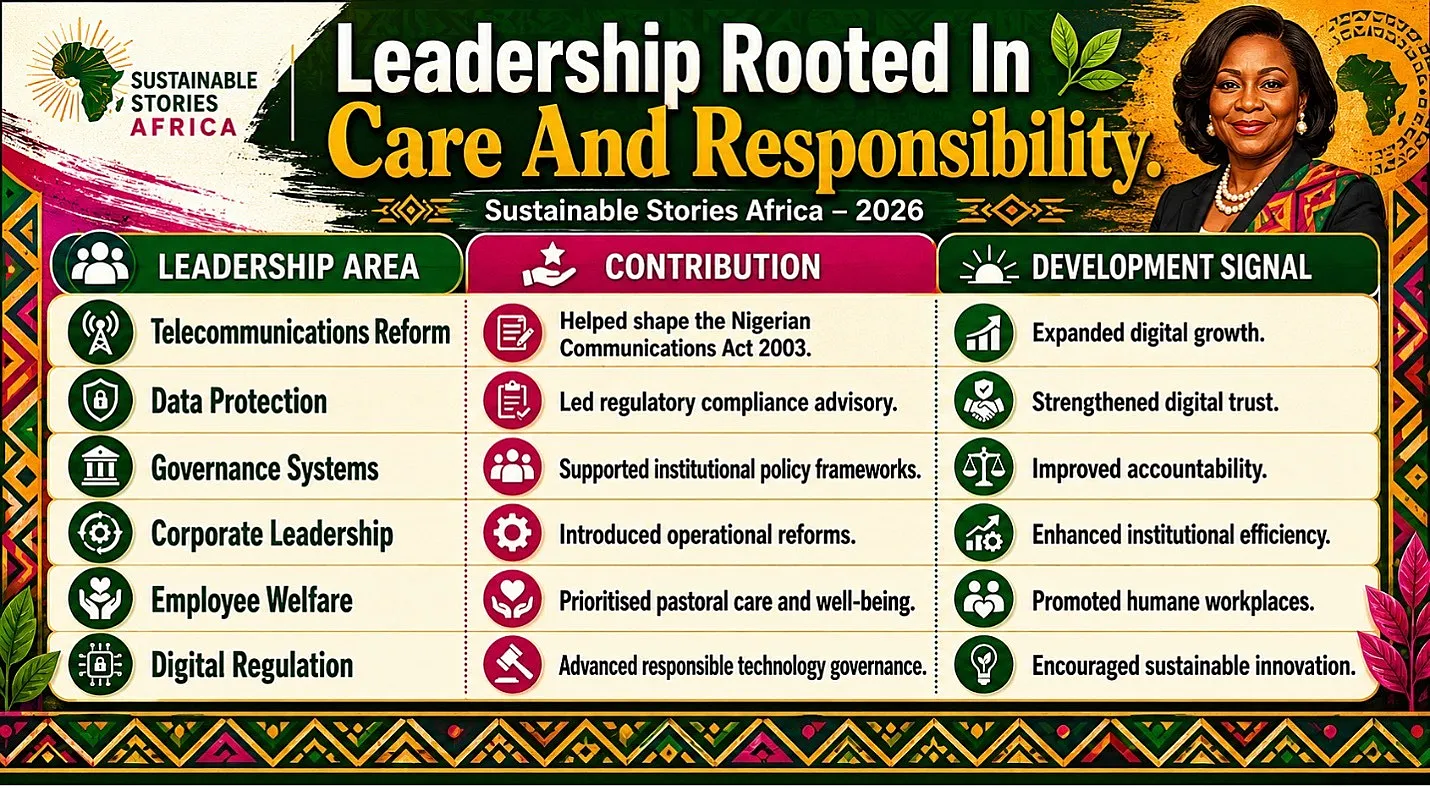
That philosophy deepened during her secondments to 9mobile, then Etisalat Nigeria and later Union Bank of Nigeria, where she restructured legal departments and introduced operational systems, designed to improve efficiency.
The experiences exposed her to the realities of institutional strain: overstretched teams, shifting priorities, organisational uncertainty, and the emotional fatigue hidden beneath corporate language.
Rather than hardening her leadership style, the exposure appeared to soften it.
She became more attentive to how people experience institutions internally, not just how those institutions appear externally.
That distinction matters deeply in modern Africa, where conversations around sustainability increasingly include workplace culture, governance ethics, mental wellness, and responsible leadership.