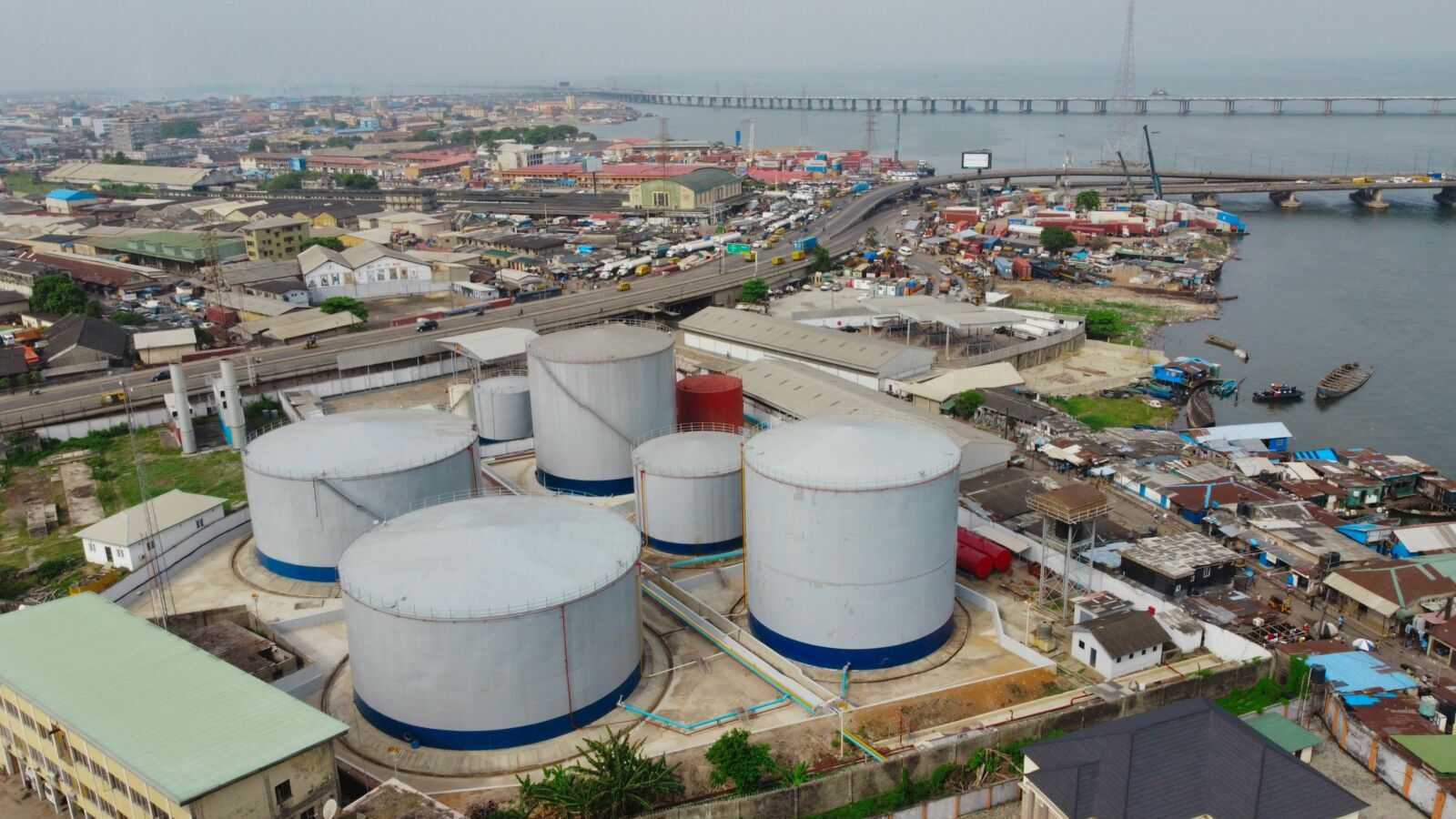
Nigeria's Energy Transition Plan charts an ambitious $410 billion roadmap to net-zero by 2060, targeting energy poverty affecting 92 million citizens alongside the climate crisis. The plan is well-designed and internationally acknowledged.
However, while peers, such as South Africa, Senegal, Vietnam and Indonesia, have secured Just Energy Transition Partnership financing,
Nigeria has not converted ambition into bankable projects or private capital flows. This is no longer a missed opportunity. It is a governance failure.
Nigeria's $410 Billion Climate Crossroads
On the 17th of February 2023, more than 70 of Nigeria's most consequential private sector voices gathered in Lagos for a frank conversation. The Nigeria Energy Transition Office (ETO), backed by Sustainable Energy for All (SEforALL) and the Global Energy Alliance for People and Planet (GEAPP), had convened a landmark private sector roundtable, a room full of financiers, lawyers, energy developers, and institutional investors who collectively hold the keys to one of the most ambitious climate plans ever designed by an African country.
They did not come to celebrate. They came to problem-solve. What emerged from that afternoon of deliberation was a sobering picture: Nigeria has a plan; however, the connective tissue between vision and execution remains dangerously thin.
Three years on, with the ETP now updated in 2024 to reflect a revised $500 billion requirement and a 277GW power target by 2060, the urgency has only grown.
The question before every Nigerian policymaker, financier, and entrepreneur is no longer whether the transition is necessary; however, questions remain as to whether the country has the institutional muscle, the financial architecture, and the political will to deliver it.
The Gap Is Staring Us in the Face
Nigeria needs $410 billion to achieve net-zero by 2060. It has identified $23 billion in investable projects. Only $17 billion of that is expected to come from the private sector.
However, three years after the first private sector roundtable, the financing pipeline remains stubbornly thin.
This is not a hypothetical problem. It is a live crisis, playing out in every delayed solar IPP, every unlit village, every factory running on diesel generators, and every rural woman still cooking on charcoal.
The ETP identifies the challenge across five critical verticals: power, cooking, oil and gas, industry, and transport.
Achieving net-zero across these sectors requires $150 billion in power generation alone, $135 billion in transmission and distribution, $79 billion in clean cooking, $21 billion in industry, and $12 billion each in transport and oil and gas decarbonisation.
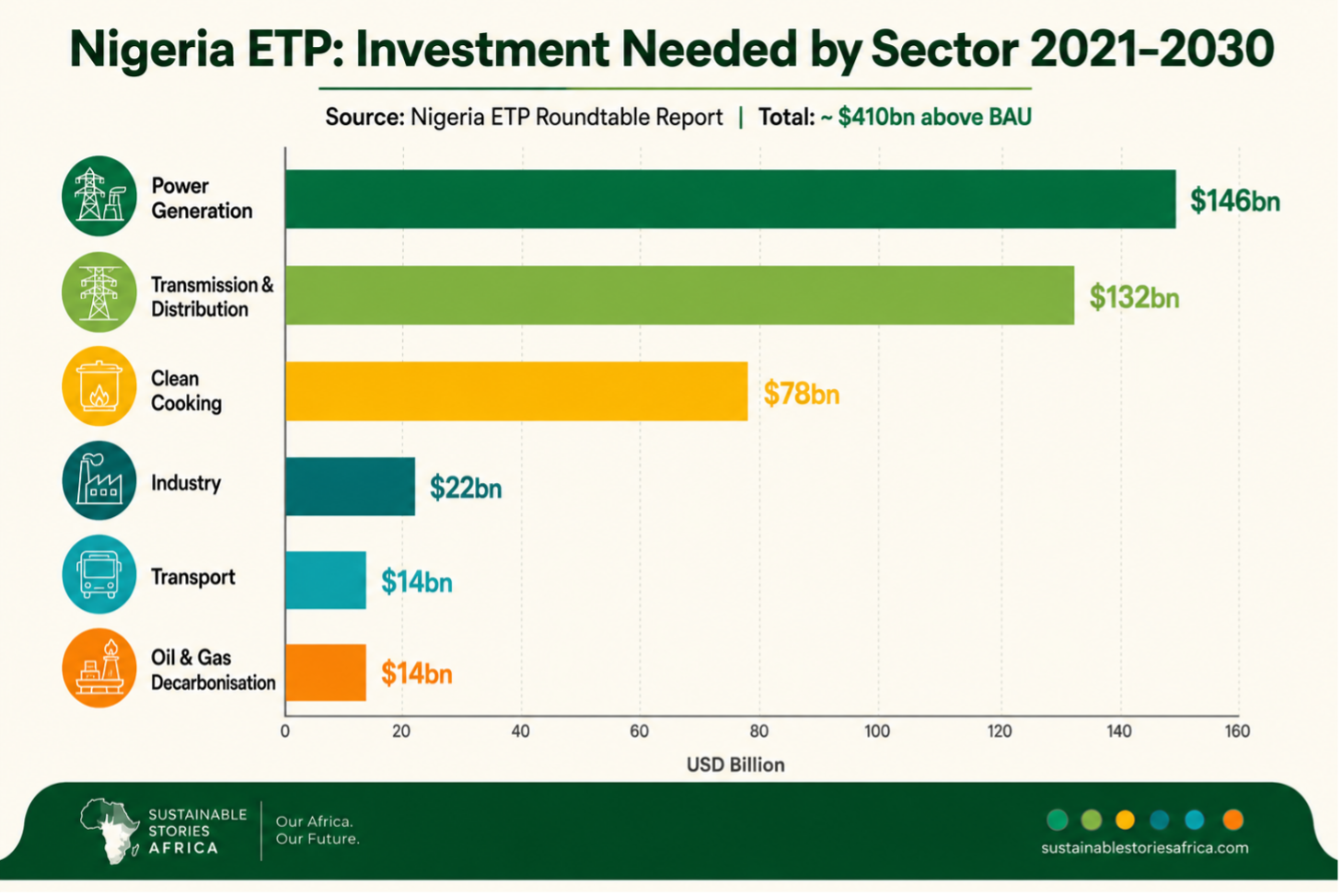
These are not abstract spreadsheet numbers. They represent the real cost of transforming a country of 220 million people, Africa's largest economy and most populous nation, from a fossil-dependent energy system to one that powers development while simultaneously meeting global climate commitments.
The central claim of this piece is blunt: Nigeria's transition will not happen on goodwill and roundtables alone. It requires the private sector to stop spectating and start executing.
What the Data and Africa Tell Us – Nigeria's Position vs. African and Global Peers
When the private-sector roundtable convened in February 2023, the global JETP architecture was already being stress-tested across emerging markets.
- South Africa had signed its $8.5 billion JETP deal with the G7 and the EU in November 2021.
- Senegal had secured its $2.5 billion partnership by 2023.
- Vietnam and Indonesia had gone further, with Vietnam clinching a $15.5 billion deal and Indonesia a landmark $20 billion JETP package, in which 50% of committed capital is expected to come from the private sector, compared to under 20% in South Africa's initial arrangement.
JETP Financing pledged: Africca vs Asia (2022-2025)
Nigeria, despite being one of the continent's largest economies and the first African country to develop a detailed Energy Transition Plan, has yet to secure a JETP deal.
This is not because the international community is uninterested; it is because Nigeria has not yet been able to present a sufficiently bankable pipeline of projects that international capital allocators can anchor to.
As participants at the Lagos roundtable bluntly noted: several of them had "not been presented with any ETP projects for serious consideration despite an abundance of rhetoric on energy finance and infrastructure in general".
The Eight Bottlenecks Holding Nigeria Back
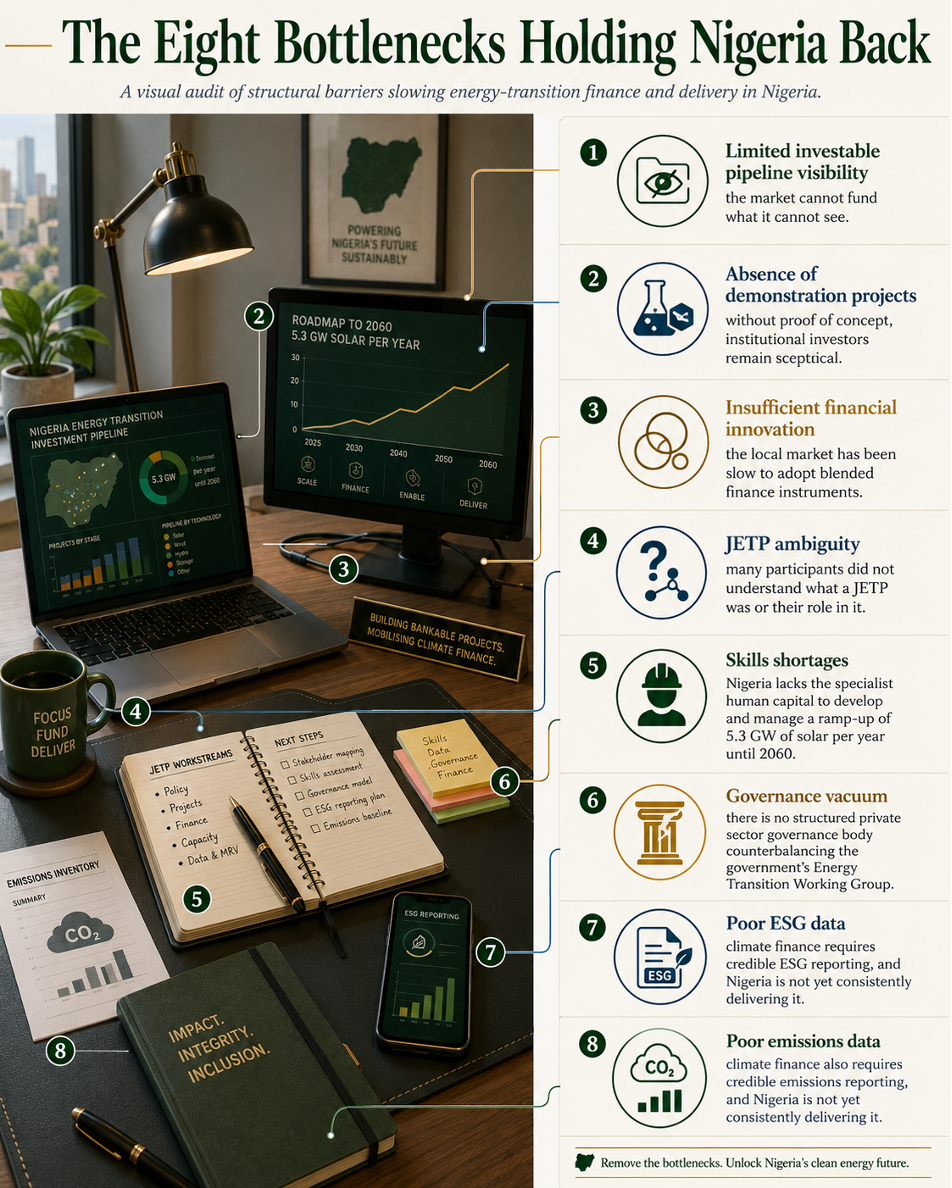
The Lagos roundtable was remarkably candid. Participants identified eight structural bottlenecks that explain why private capital has been reluctant to flow into ETP projects:
- Compare this to South Africa, where the JETP Investment Plan articulates $98 billion in investments across electricity, green hydrogen, and transport, with clear sector-by-sector pathways.
- Or Kenya, which has leveraged its geothermal resources to build one of the most investor-friendly renewable energy frameworks on the continent.
- Or Gabon, which, as pointed out by Nana Maidugu, Head of ESG at the Nigerian Sovereign Investment Authority during the Lagos roundtable, has already certified 90 million carbon credits under the UN's REDD programme and is using the proceeds to fund infrastructure projects.
Nigeria's own forests and biodiversity offer the same opportunity. It has simply not yet been seized.
What Nigeria Gains If the Private Sector Steps Up – A Vision Worth Fighting For
The vision is within reach. By 2040, Nigeria could be adding 5.3 GW of solar capacity annually, channelling pension fund capital, a $35 billion-equivalent pool growing at 10% – 15% per annum, into clean energy bonds, while InfraCredit's guarantee architecture unlocks local currency financing at scale.
Angola's achievement of 800MW of solar with battery storage, highlighted by Sun Africa CEO Hakeem Shagaya, proves this is not an ambition without precedent.
The economic logic is compelling. Nigeria's updated Energy Transition Plan estimates that reaching net-zero by 2060 will require approximately $500 billion in appropriate spending and deliver $686 billion in fuel savings.
The net gain: $186 billion. The transition is not a sacrifice. It is a superior investment that also generates jobs in solar manufacturing, grid engineering, clean cooking distribution and carbon market management, precisely what Nigeria's young, growing labour force needs.
The status quo offers no neutral ground. With 92 million citizens lacking electricity and 175 million without clean cooking solutions, the cost of inaction, including those measured in respiratory illness, lost productivity, gender inequality and foregone industrial output, far exceeds the cost of transition.
Staying still is not caution. It is a choice to remain poor.
What Must Be Done and By Whom
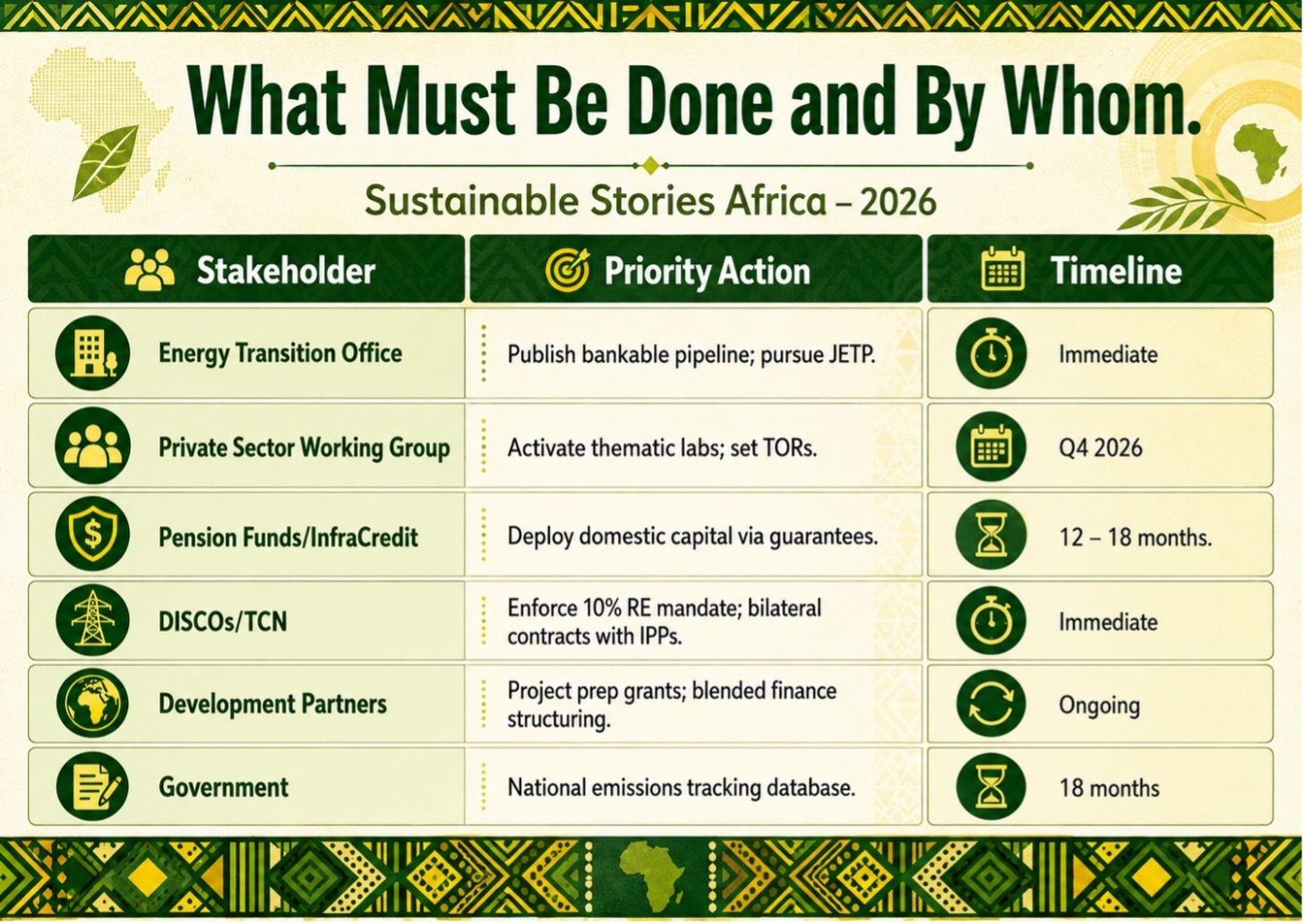
The Lagos roundtable did not just diagnose the problem; it produced a credible agenda for action. Three years later, those action points remain as urgent as ever, and deserve to be stated plainly:
For Government and the Energy Transition Office:
- Publish bankable investment memoranda for priority projects, including the 14 Solar IPPs, Solar Power Naija and Sun Africa NDPHC Solar Projects
- Enforce the 10% renewable energy mandate for DISCOs and operationalise payment waterfall mechanisms for solar IPPs
- Build a national emissions tracking database to unlock carbon market financing
- Enter JETP negotiations urgently; delay is costing Nigeria access to billions in concessional and blended finance
For the Private Sector:
- Activate the Private Sector Working Group, secured from over 50 institutions, as a governance body with clear terms, thematic labs and quarterly deliverables
- Mobilise pension fund capital through credit guarantees, blended structures and local currency instruments
- Convert roundtable commitments from ARM-Harith, Helios and Sterling Bank into signed term sheets and financial close
- Build internal ESG reporting capacity to remove barriers to international capital
For Multilateral and Development Partners:
- Frontload project preparation grants to accelerate bankability
- Structure de-risking instruments, revenue ring-fencing, stabilisation funds and blended finance, aligned to Nigerian market realities
Path Forward: Nigeria Cannot Wait Any Longer – From Dialogue to Deal Flow
Three years after Nigeria's landmark 2023 energy transition roundtable, the measure of progress is not dialogue, but a deal flow.
South Africa, Senegal, Vietnam and Indonesia have moved from political will to signed financing agreements and measurable gigawatts.
Nigeria must follow. The path is defined: activate the Private Sector Working Group, operationalise the pipeline, pursue the JETP, and deploy domestic pension capital.
With 92 million citizens still without electricity, another cycle of well-attended roundtables is not an option.
This opinion article was written by the Editorial Board Desk of Sustainable Stories Africa, drawing on Nigeria's Energy Transition Plan Private Sector Roundtable Report (February 2023), updated ETP data from the Nigeria Energy Transition Office, and comparative analysis of Just Energy Transition Partnerships across Africa and the Global South.