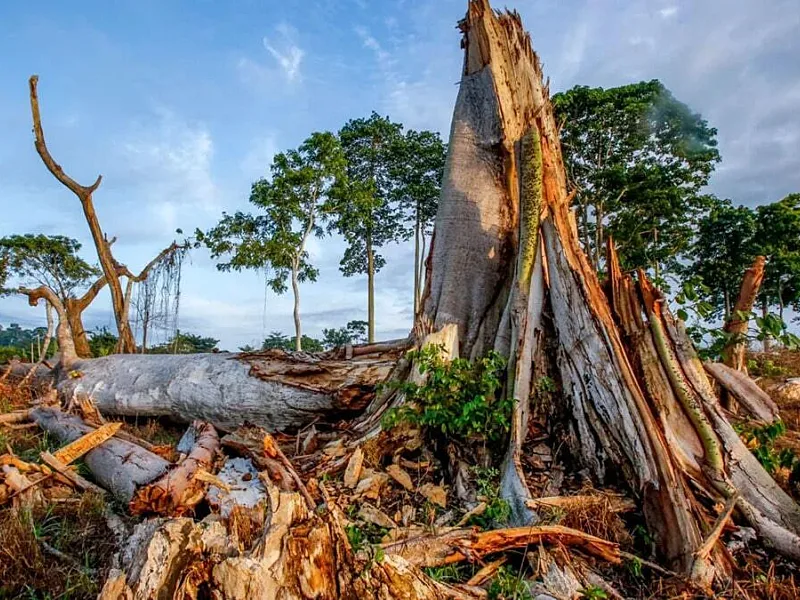

COP31 ended without agreement on its overarching cover decision, leaving difficult questions about fossil fuels and climate finance unresolved.
For Africa, the setback exposes the distance between recognising vulnerability and financing protection.
African governments should defend climate justice while making delivery measurable through funded adaptation, reliable clean energy and public accountability.
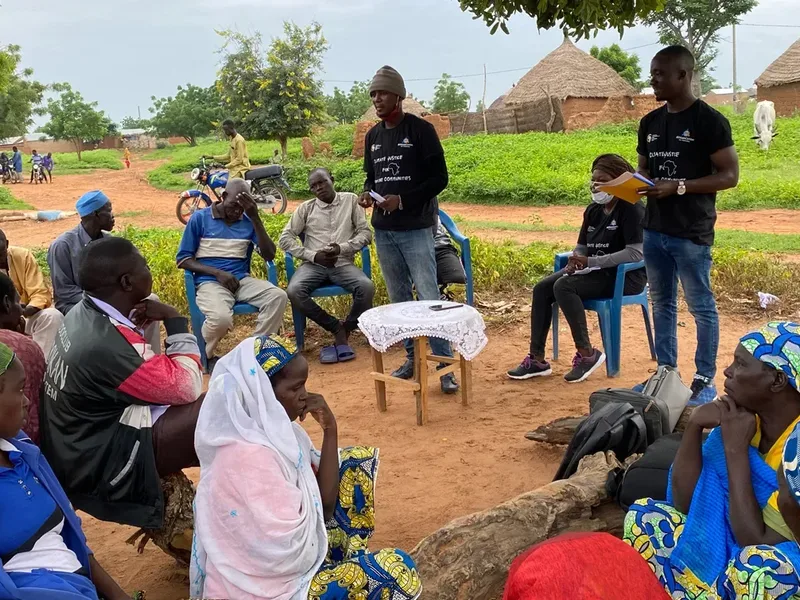
Communities need support that reaches them, with clear responsibilities for governments and financiers.
Antalya Exposes The Cost Of Delay
Africa should respond to COP31 with a concrete demand: climate commitments must come with finance, delivery dates and evidence of protection.
- The summit closed in Antalya on 22 November without consensus on its overarching outcome.
- That failure leaves unresolved political choices with consequences that extend to public budgets and household livelihoods.
The Presidency’s cover text, dated 22 November at 02:00, is a draft, not an adopted agreement.
- Its proposed roadmaps and requests cannot be presented as new COP31 commitments.
- It nevertheless reveals the scale of the needs negotiators confronted and the practical solutions under discussion.
UN Secretary-General António Guterres captured the stakes: there is “no ambiguity in the science”.
- Africa’s response should combine pressure on major emitters and finance providers with stronger domestic implementation.
- Waiting for another diplomatic breakthrough leaves communities exposed; abandoning cooperation would weaken the forum through which vulnerable countries demand support.
Make Protection The Test Of Progress
Every financing pledge should face the same question:
- What will change for people expected to live with rising climate risks?
African governments should demand support on fair terms and publish what that support delivers, so responsibility remains visible on both sides.
Read The Numbers With Their Conditions
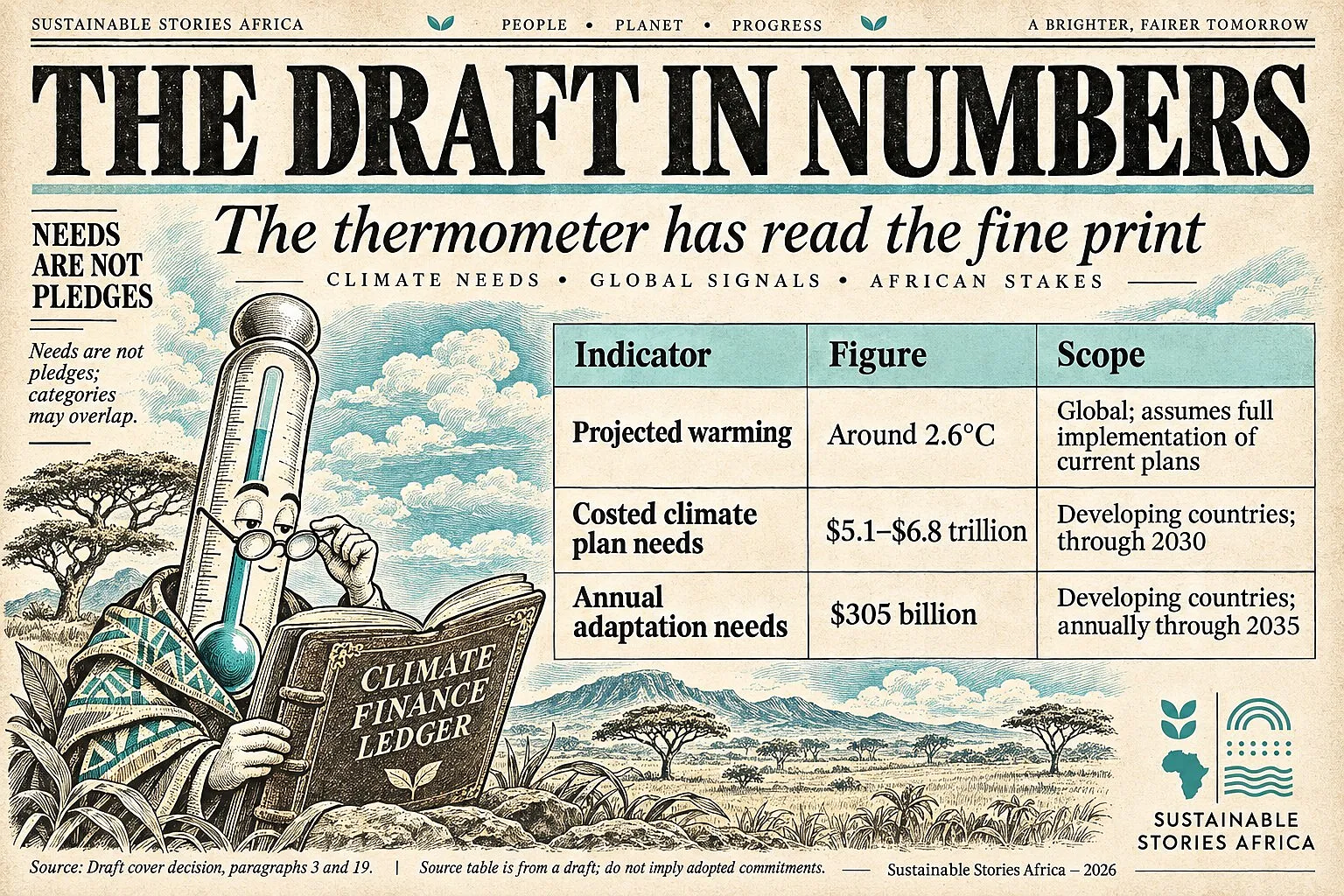
The draft estimates warming of around 2.6°C if current national climate plans are fully implemented.
- This conditional projection warns of insufficient ambition and the importance of delivering existing plans.
- It also identifies large developing-country financing needs.
- These are broader developing-country estimates, not an African allocation or confirmed funding. [paras 3, 19]
For a coastal district planning flood defences, that distinction matters.
- A global financing aspiration cannot pay a contractor until resources are approved and disbursed.
- A farmer needs an actionable forecast and support to respond.
These illustrative situations explain why the quality and accessibility of finance deserve as much attention as headline totals.
The fossil fuel dispute also demands a more careful African conversation.
- Before the close, countries from Africa and other regions demanded stronger fossil fuel language and finance.
- Ghana, speaking for the African Group at the closing plenary, acknowledged weaknesses in finance, loss and damage, and just transition, while saying the group would not obstruct consensus.
African interests cannot be reduced to defending extraction or endorsing an identical transition timetable everywhere.
- Oil revenues, industrial development and energy access create different national choices.
- The shared test should be whether transition policies protect livelihoods while reducing climate exposure.
- Recognising these differences must strengthen practical cooperation rather than excuse indefinite delay.
The draft’s technology choices also deserve scrutiny.
- It recalls the UAE Consensus in totality without explicitly repeating the transition away from fossil fuels.
- Paragraph 40(h) proposes a global aspiration for gigatonne-scale carbon capture, utilisation and storage by 2035.
African policymakers should demand credible costs and evidence before committing scarce public resources.
- Separately, paragraph 36 says carbon dioxide removal should complement emissions reductions.
- A future technology promise cannot justify postponing reductions achievable today.
Precision matters on adaptation finance too.
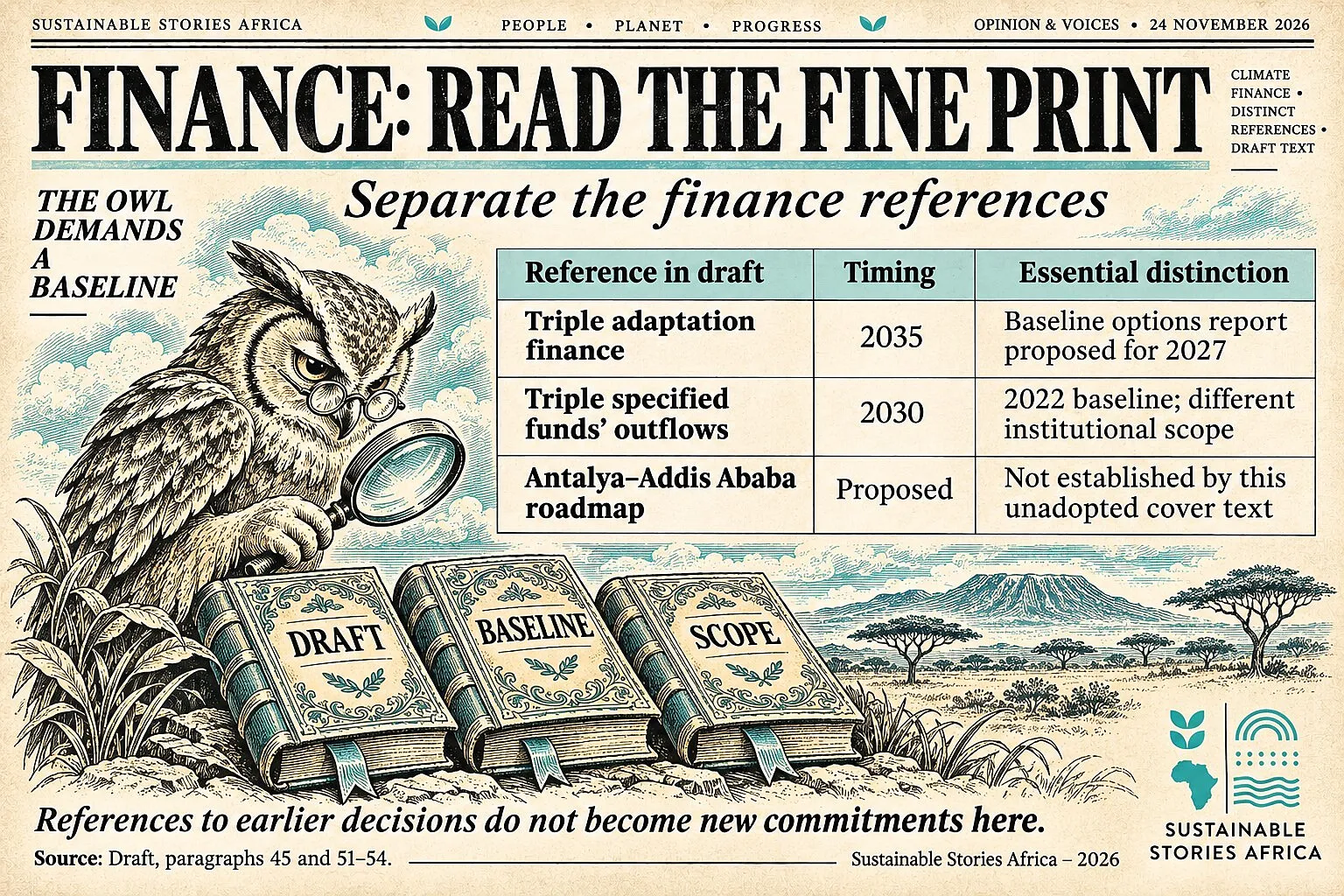
- The draft discusses tripling adaptation finance by 2035, with work proposed on the baseline, alongside a separate reference to tripling specified climate funds’ annual outflows from 2022 levels by 2030.
- Combining them into one promise would obscure different scopes and deadlines. [paras 45, 51–54]
Make Climate Policy Useful In Daily Life
There is useful work to build on.
Simon Stiell’s closing remarks distinguish the failed overarching decisions from progress elsewhere in negotiations and the Action Agenda.
UNFCCC’s subsequent account reports advances on just transition and adaptation indicators. Africa should use these channels while continuing to challenge the political shortfall.
The draft links early warnings to anticipatory action, social protection and finance.
- It also connects electrification with grids, clean cooking and reliable energy access.
- Applied well, these priorities could protect a clinic’s refrigeration, help a small processor maintain production or give residents time to move before floodwater arrives.
- These are practical applications, not reported project outcomes. [paras 27–30, 40]
The 35% electrification ambition discussed in the draft concerns electricity’s share of total final energy consumption globally by 2035.
- It is not a household connection target or a renewable electricity percentage.
- UNFCCC separately reports voluntary support for that ambition under the Action Agenda; this does not make the cover draft adopted. [para 40(d); 6]
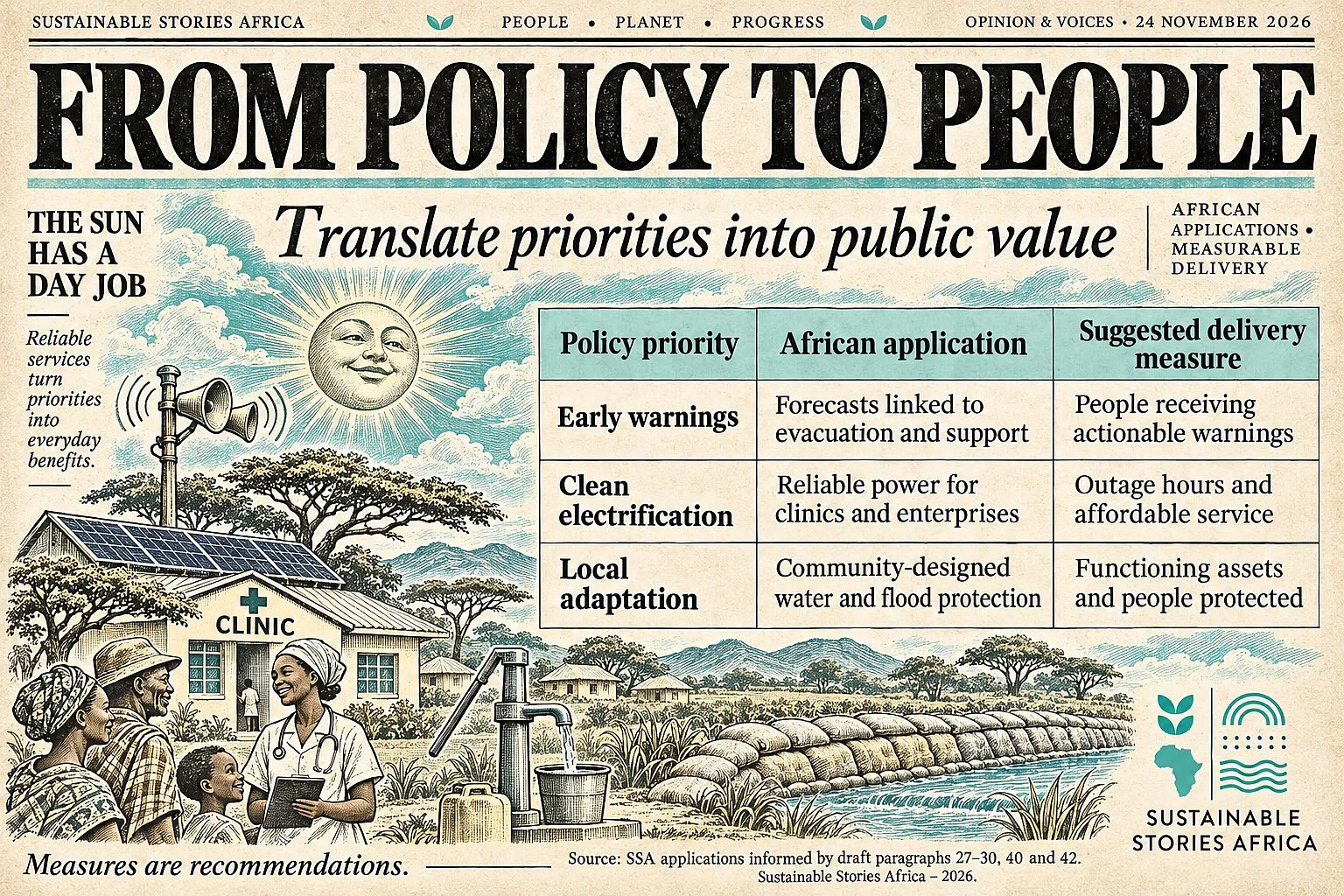
A credible African transition would therefore judge investment by service quality and distribution.
- Who gains reliable power?
- Who bears the cost?
- Which workers receive support?
- The draft’s emphasis on participation and local government provides a useful basis for demanding that women, young people and affected communities influence project design and oversight. [paras 81–83]
This requires funding maintenance and local skills alongside construction.
- A solar installation without repairs, or a warning system without trusted communication, cannot provide dependable protection.
- Procurement should identify who operates each asset and how running costs will be paid after external project support ends.
Give Finance And Delivery Named Owners
Finance ministries should translate national climate plans into costed priorities that identify responsible agencies, maintenance costs and financing gaps.
Environment ministries cannot deliver this alone.
- Agriculture, energy, health and local government agencies should own the services their climate programmes promise.
- A shorter list of deliverable investments is more useful than an uncosted catalogue.
Developed-country providers and multilateral funds should publish predictable funding schedules and reduce application barriers.
- The draft identifies high capital costs, limited fiscal space and transaction costs, and a call for grant-based and highly concessional adaptation finance.
- Project preparation support and simpler access deserve immediate attention, especially where essential public protection generates little commercial revenue. [paras 49–50, 58–59]
African development banks and private financiers should identify where affordable lending can support viable enterprises, while governments protect public adaptation from unsuitable debt.
Businesses should disclose material climate risks and credible investment plans.
Parliamentarians, journalists and civil society should follow funds from announcement to expenditure and ask communities whether promised services actually work.
Accountability must also apply to providers.
- A public register should separate pledged, approved and disbursed funding, identify grants and loans, and disclose repayment terms.
- African institutions need funded capacity to maintain these records.
- Reporting requirements that consume scarce administrative resources without accelerating access would reproduce the very barriers reform should remove.
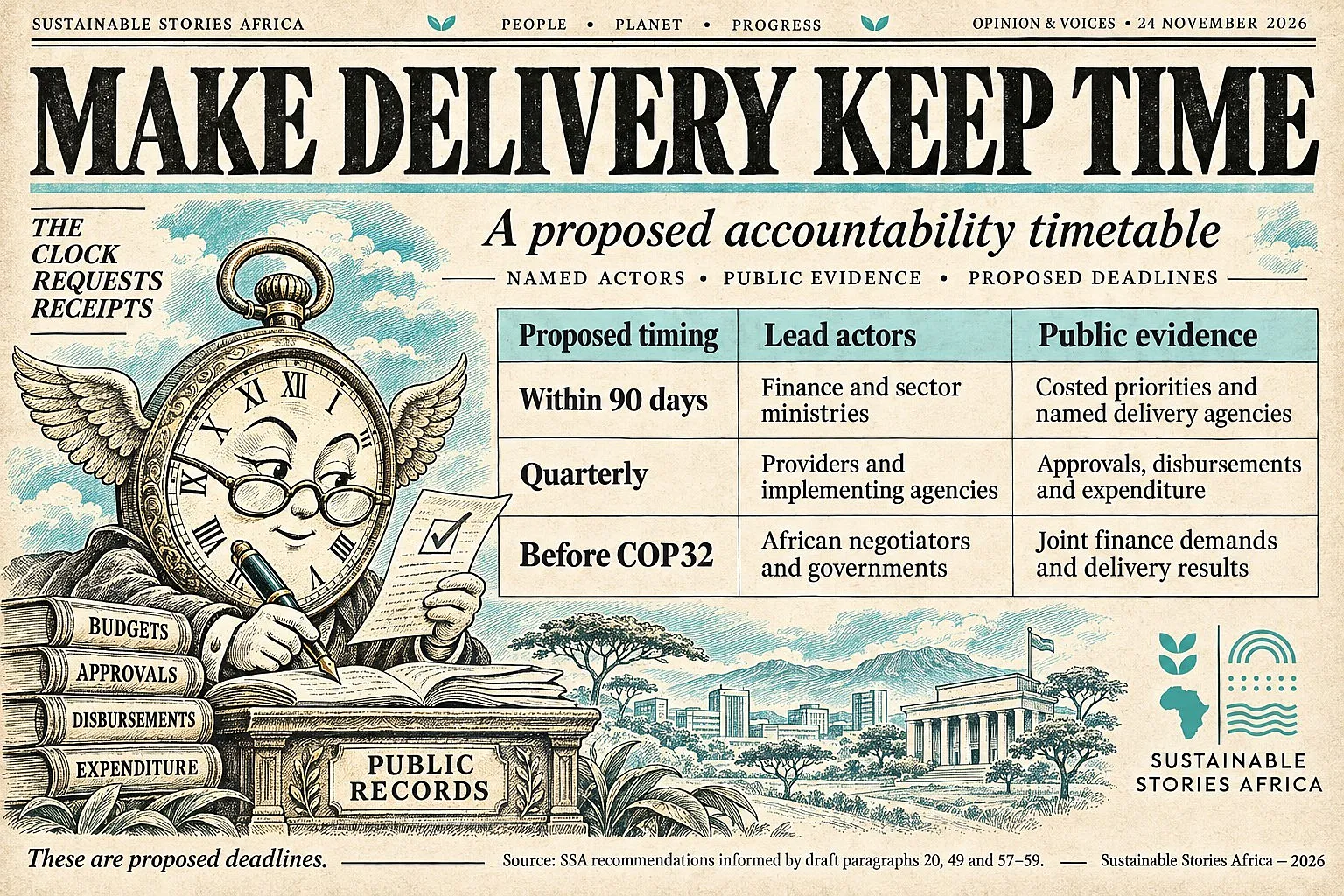
Ahead of COP32 in Addis Ababa, African negotiators should seek explicit transition language alongside credible finance terms and community protection.
- Consensus deserves defence because smaller countries need a voice.
- Its credibility depends on transparent negotiations and implementation that citizens can verify.
Path Forward – Put African Communities First After Antalya
Africa should arrive at the next summit with shared financing priorities and evidence of what is working locally.
Major emitters must cut emissions faster, and developed countries must deliver support. African governments must make that support traceable.
Measure progress through people protected, livelihoods sustained and reliable energy delivered.
Antalya’s disappointment should sharpen those demands and the accountability required to fulfil them.