Nigeria’s National Development Plan sets priorities.
Its Medium-Term Expenditure Framework estimates what government can finance, and annual appropriation authorises public spending.
Citizens should be able to follow each commitment through to a service they can use.
As Nigeria prepares its next plan, that test matters across African and emerging markets, where public finance has to sustain essential services and help mobilise private investment.
What the mised
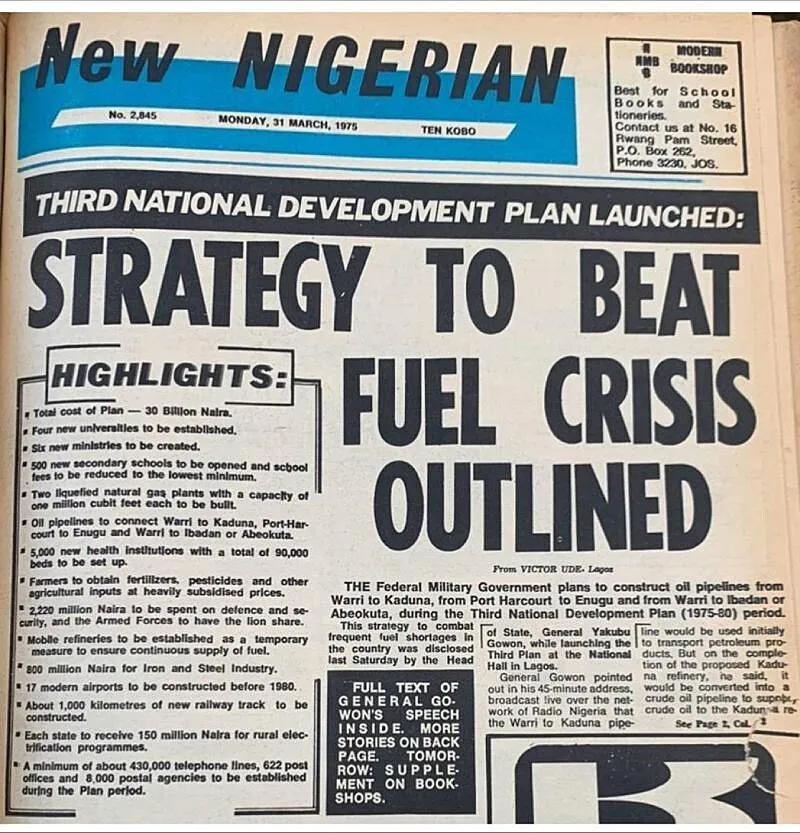
The front page of the New Nigerian on 31 March 1975 put fuel shortages at the centre of a national development story.
General Yakubu Gowon’s government had just launched the Third National Development Plan for 1975 – 1980.
- The paper reported plans for pipelines from Warri to Kaduna, Port Harcourt to Enugu, and Warri to Ibadan or Abeokuta.
Check the small box on the left.
- Here were four new universities, 500 secondary schools and 5,000 health institutions with 90,000 beds, all on the same page as fuel supply.
- The commitments were specific enough for readers to ask what would be built where, and who would benefit.
We would ask the same questions today.
- A clinic meant to stay open through a flood or a power outage needs a suitable site, a reliable electricity supply and money for upkeep.
- How long that clinic keeps serving people is a practical measure of sustainability.
The budget is part of the answer.
The N30 Billion Question
The N30 billion on that front page was the programme announced for the whole plan period.
- The total was subsequently revised to about N43.3 billion.
- The first number tells us what the government announced in March 1975.
- The second tells us the scale of the revised commitment.
- To find out what people received, we would still need spending and service records.
- That is the distinction we want to make when a plan is next presented.
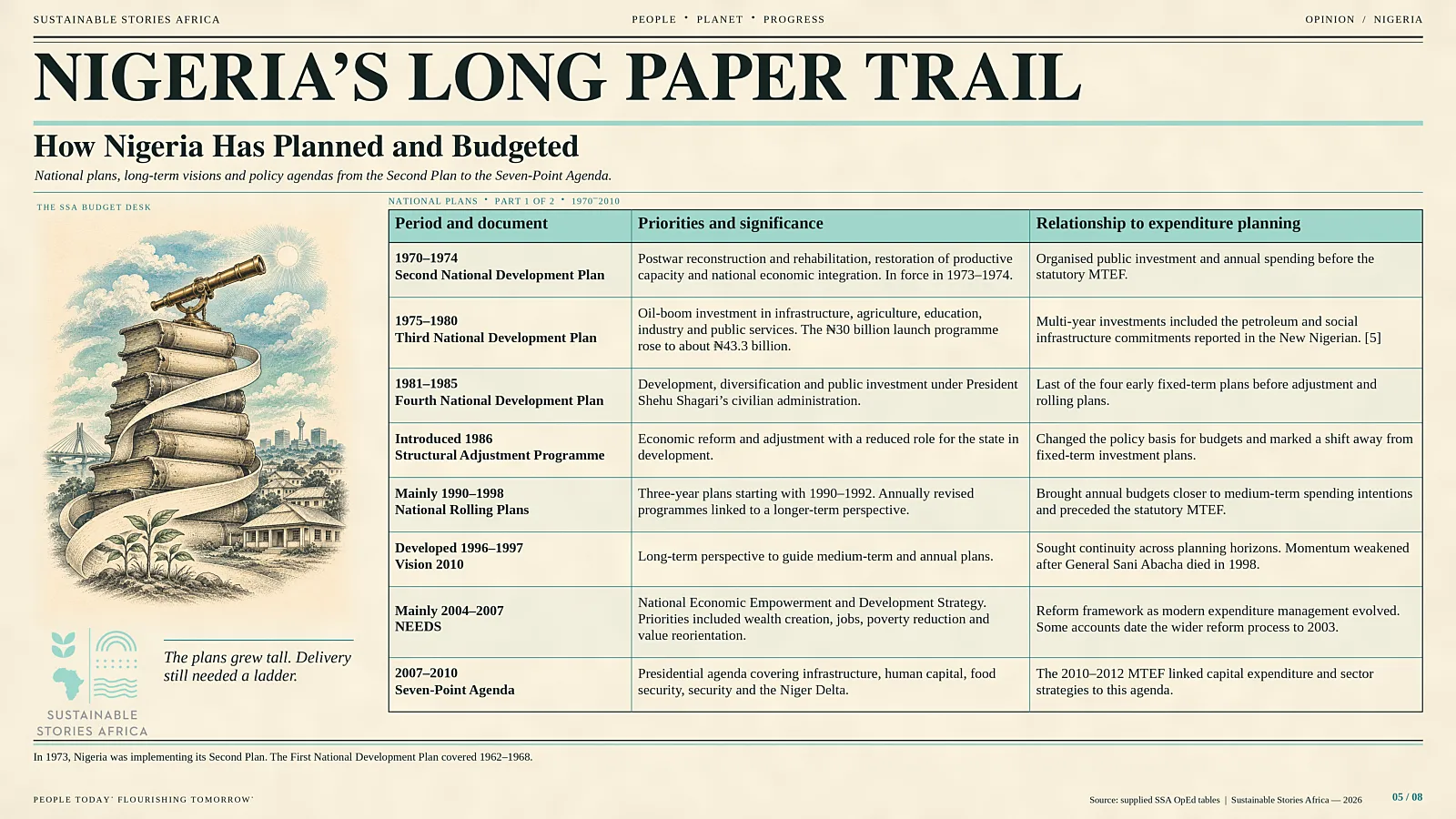
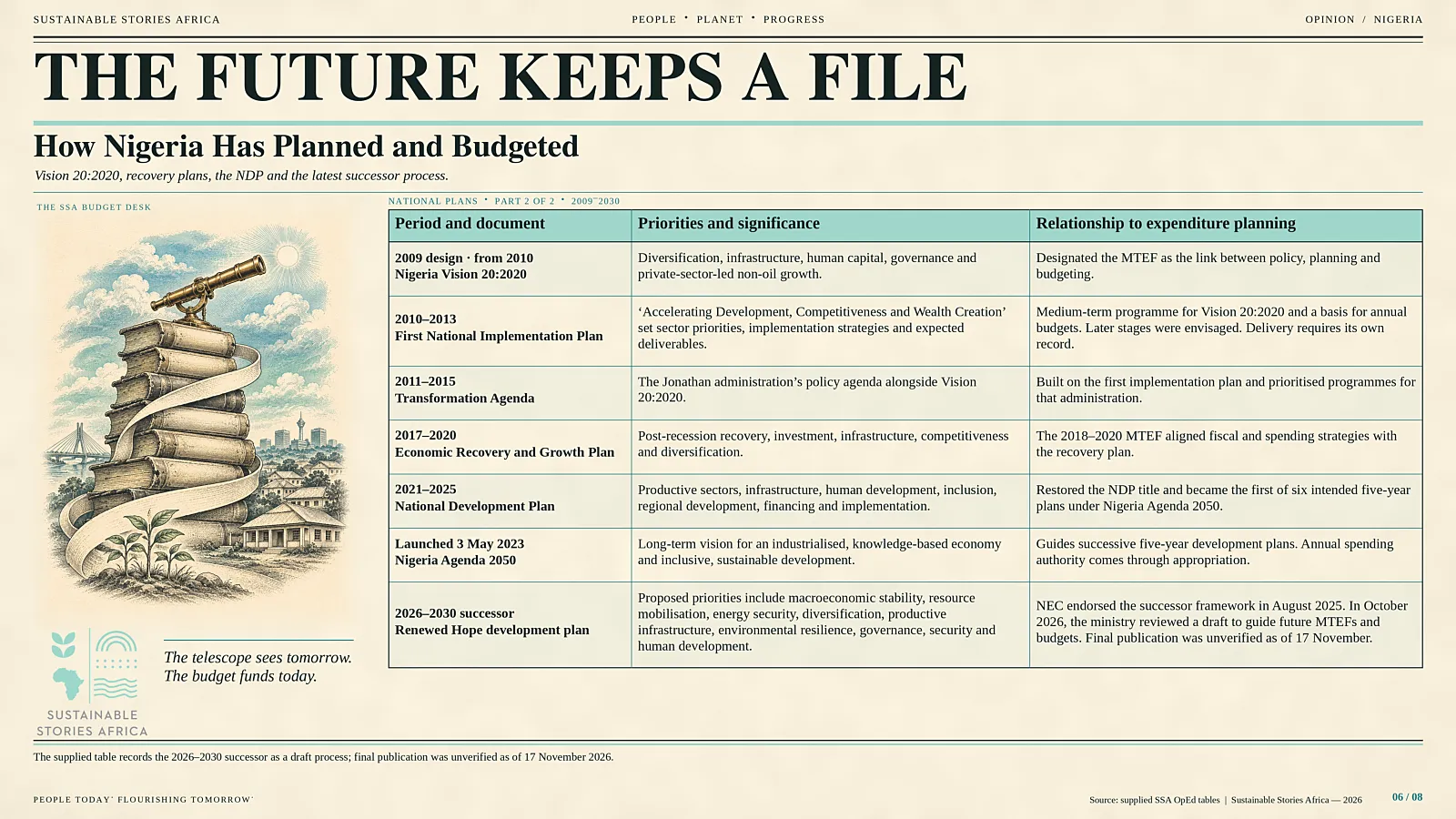
A National Development Plan (NDP) sets out the outcomes to pursue across the economy.
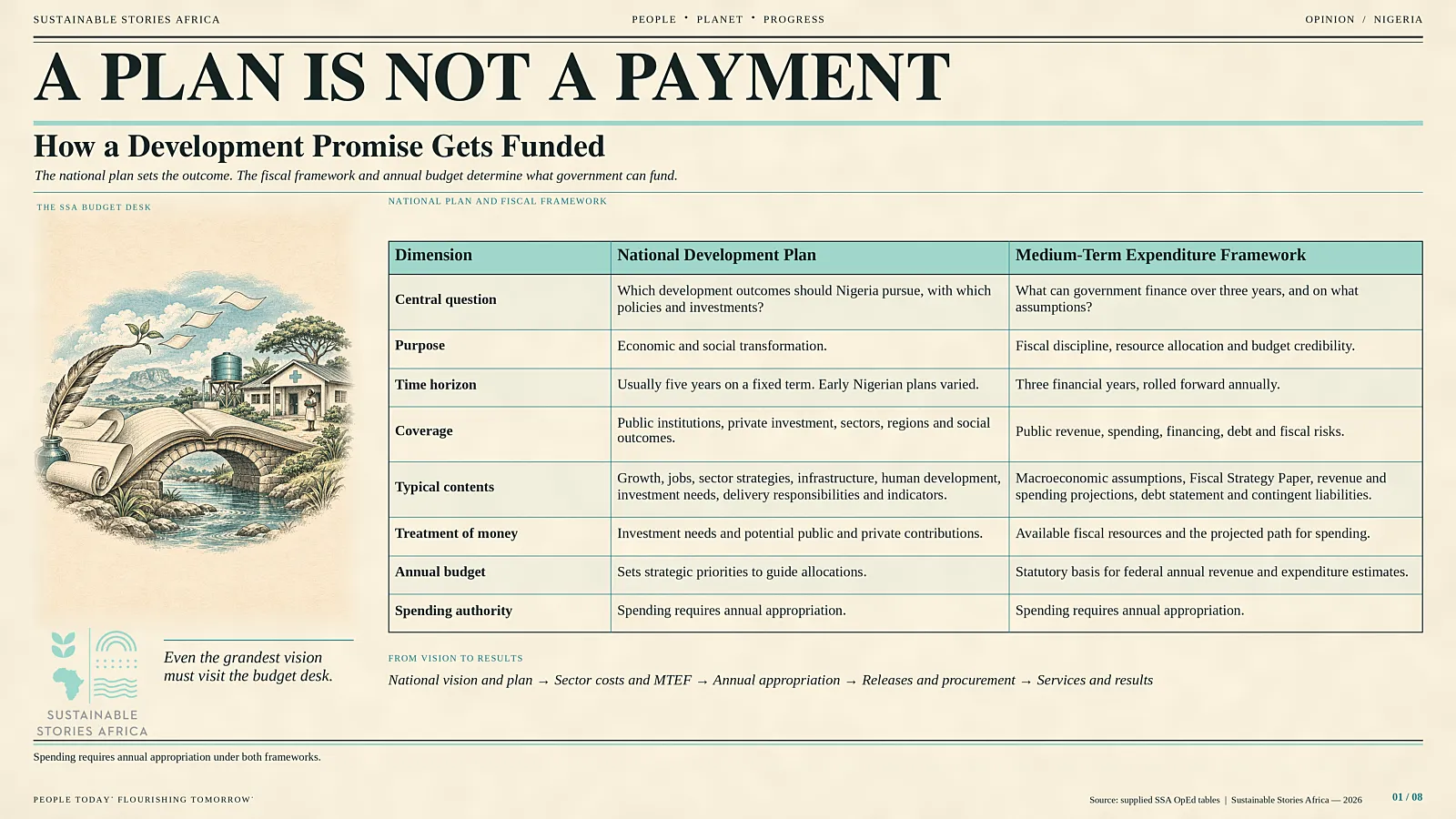
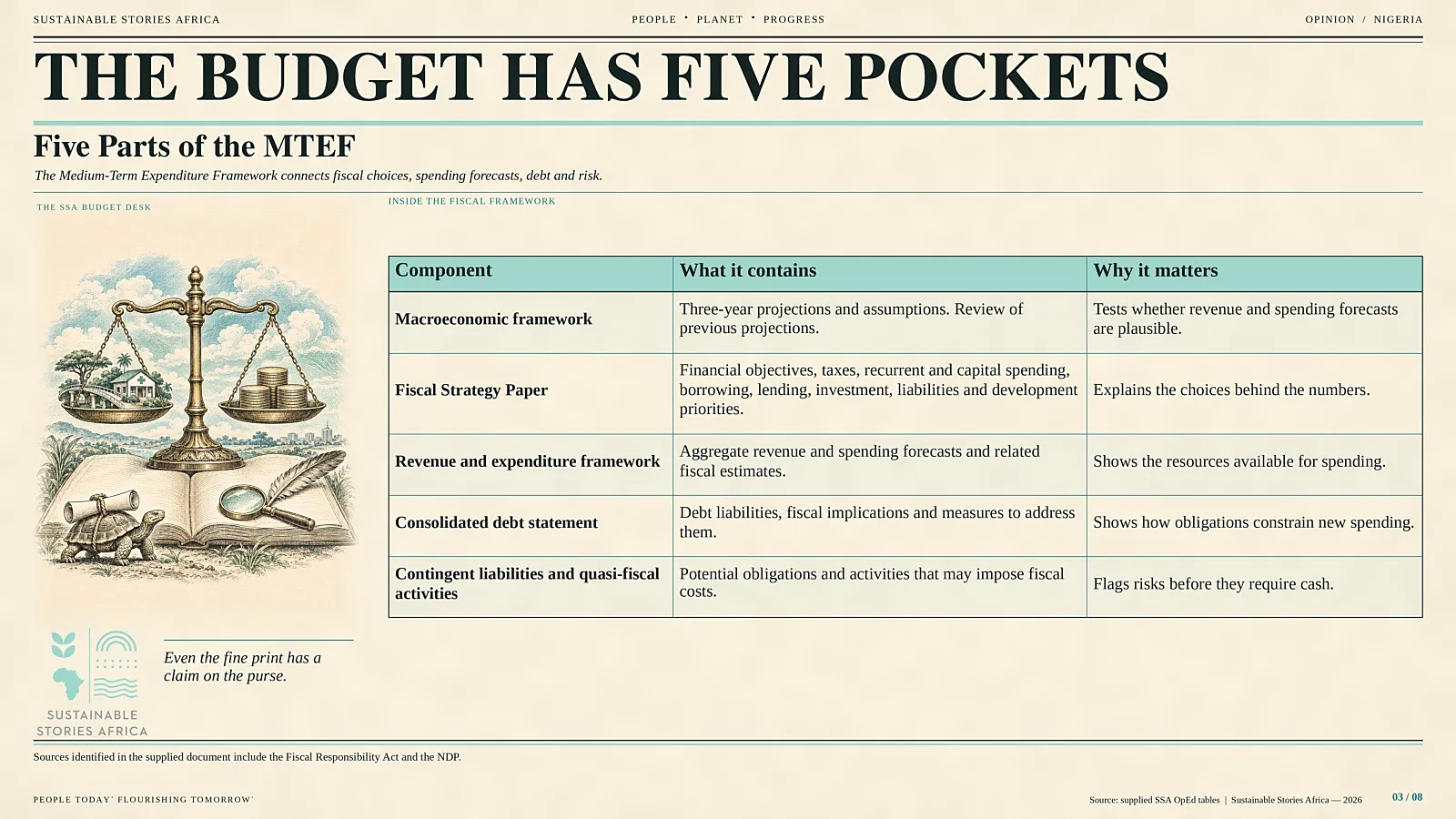
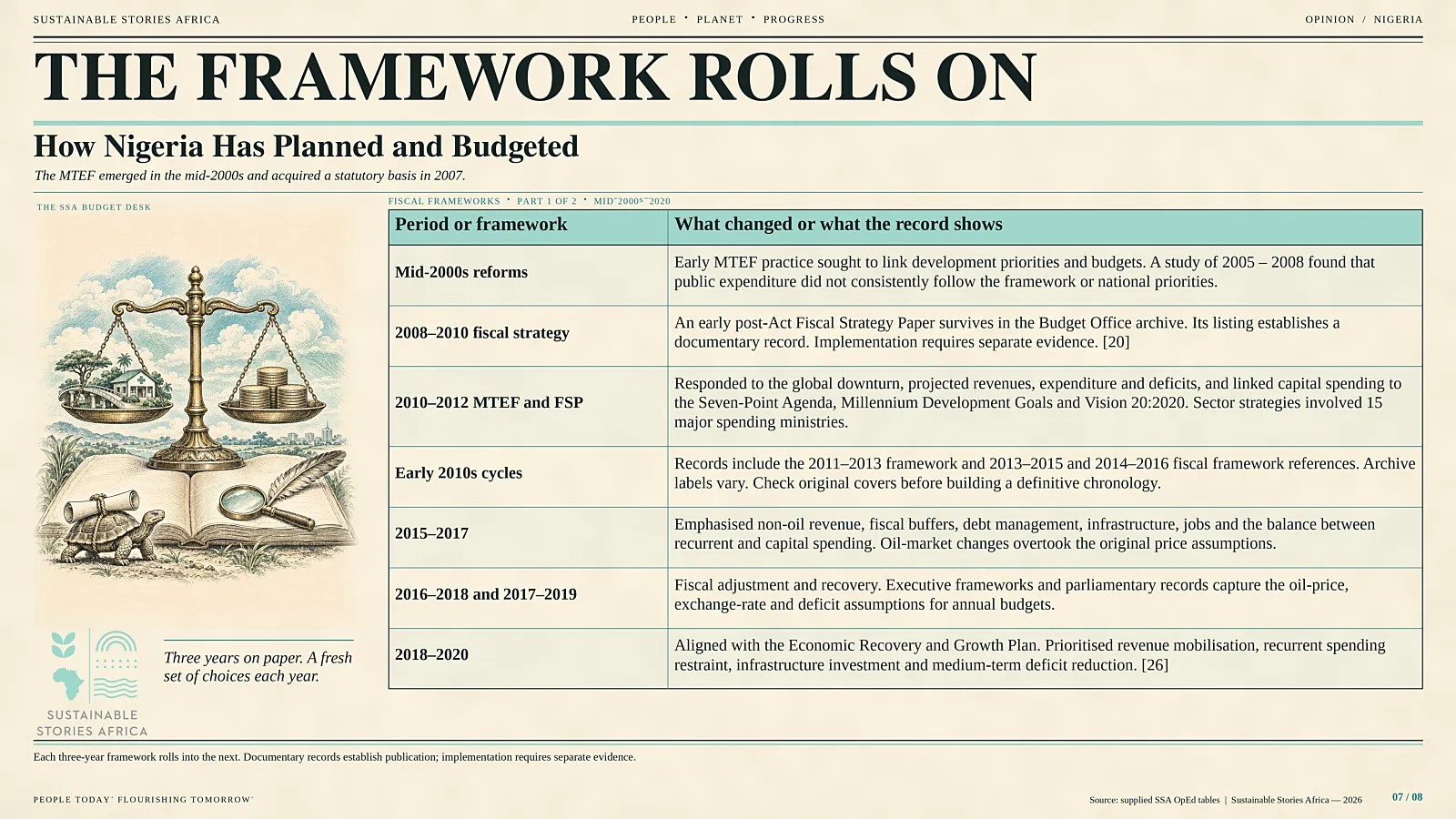
The Medium-Term Expenditure Framework (MTEF) estimates how much government can raise, spend and borrow over three rolling financial years.
The annual budget proposes the year’s allocations.
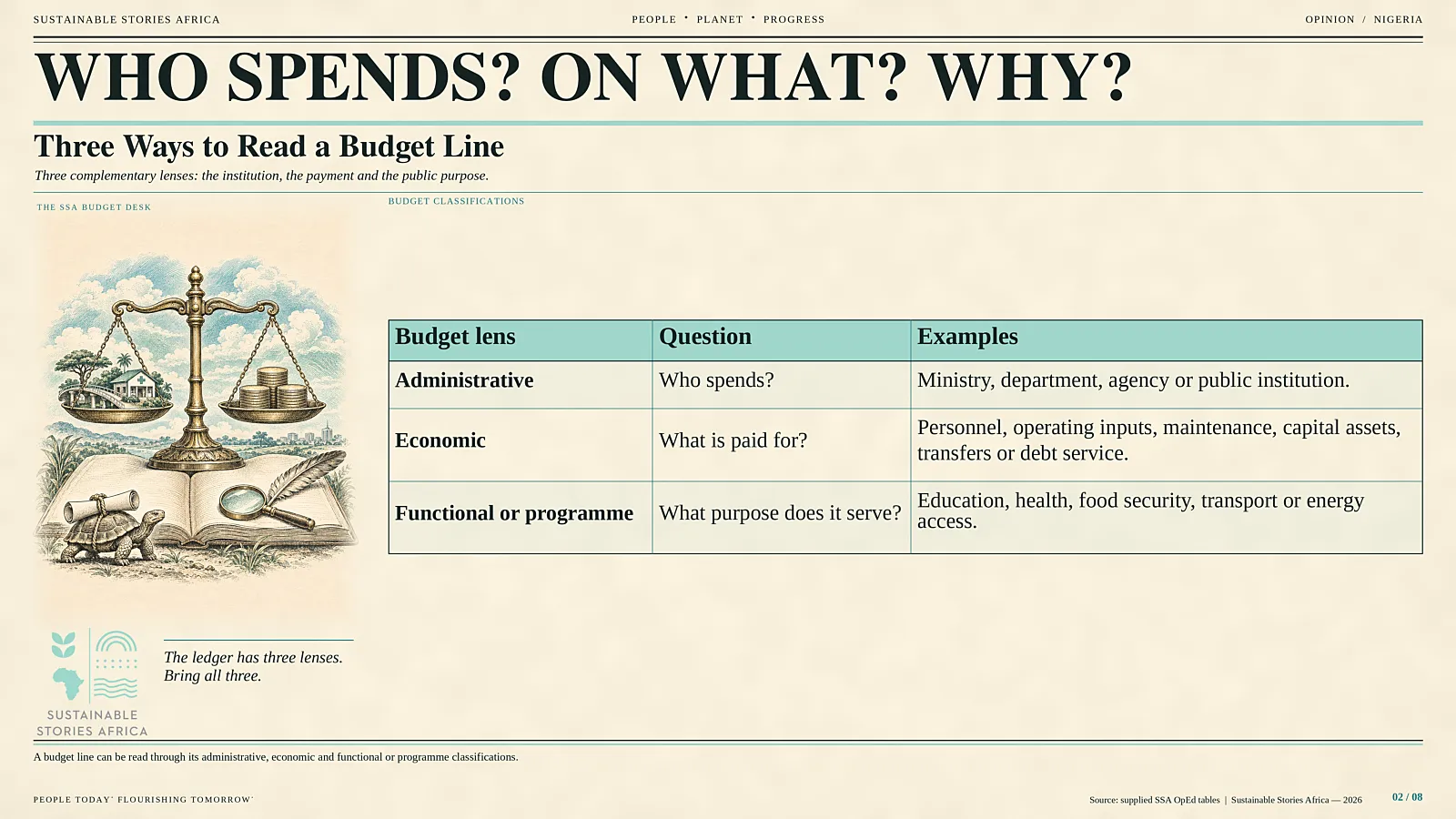
The Appropriation Act gives government authority to spend from the relevant public funds.
Each document answers a different question, and each should lead the reader to the next.
What Government Can Afford
Consider the 2021 – 2025 plan.
- At its launch, the Presidency put total investment needs at N348.1 trillion over five years.
- Government at all levels was expected to provide N49.7 trillion (14.3%), and the private sector N298.3 trillion (85.7%).
- The planned split makes the policy question concrete.
- Which roads, power investments and reforms would government fund, and what would persuade businesses to commit their own money?
The plan aimed to create 21 million full-time jobs and to lift 35 million people out of poverty.
- The launch cited average real growth of about 5%.
Its later Nigeria Agenda 2050 presentation to the National Economic Council (NEC) projected average growth of 4.65% for the same five-year period.
- We should start any review of the plan by showing those projections alongside the observed results and explaining which version is being used.
The Fiscal Responsibility Act 2007 provides a legal basis.
Under section 18, federal annual estimates must draw on the MTEF and reflect its medium-term priorities.
- The Fiscal Strategy Paper sets out policy choices such as tax, spending and borrowing.
- Costed sector programmes then have to fit spending ceilings.
This takes a common set of assumptions about oil output and prices, the exchange rate, inflation and revenue.
- When those assumptions shift, the funding timetable for projects may have to shift with them.
Section 12 sets an ordinary deficit limit of 3% of estimated GDP, with the National Assembly responsible for setting another sustainable percentage.
- The Act also provides an exception when the President judges there is a clear and present threat to national security or sovereignty.
- The annual estimates must provide past performance figures, two further years of revenue and expenditure profiles, and a fiscal risk appendix.
These records help explain which projects the government can afford to start.
We have seen what assumptions changes do.
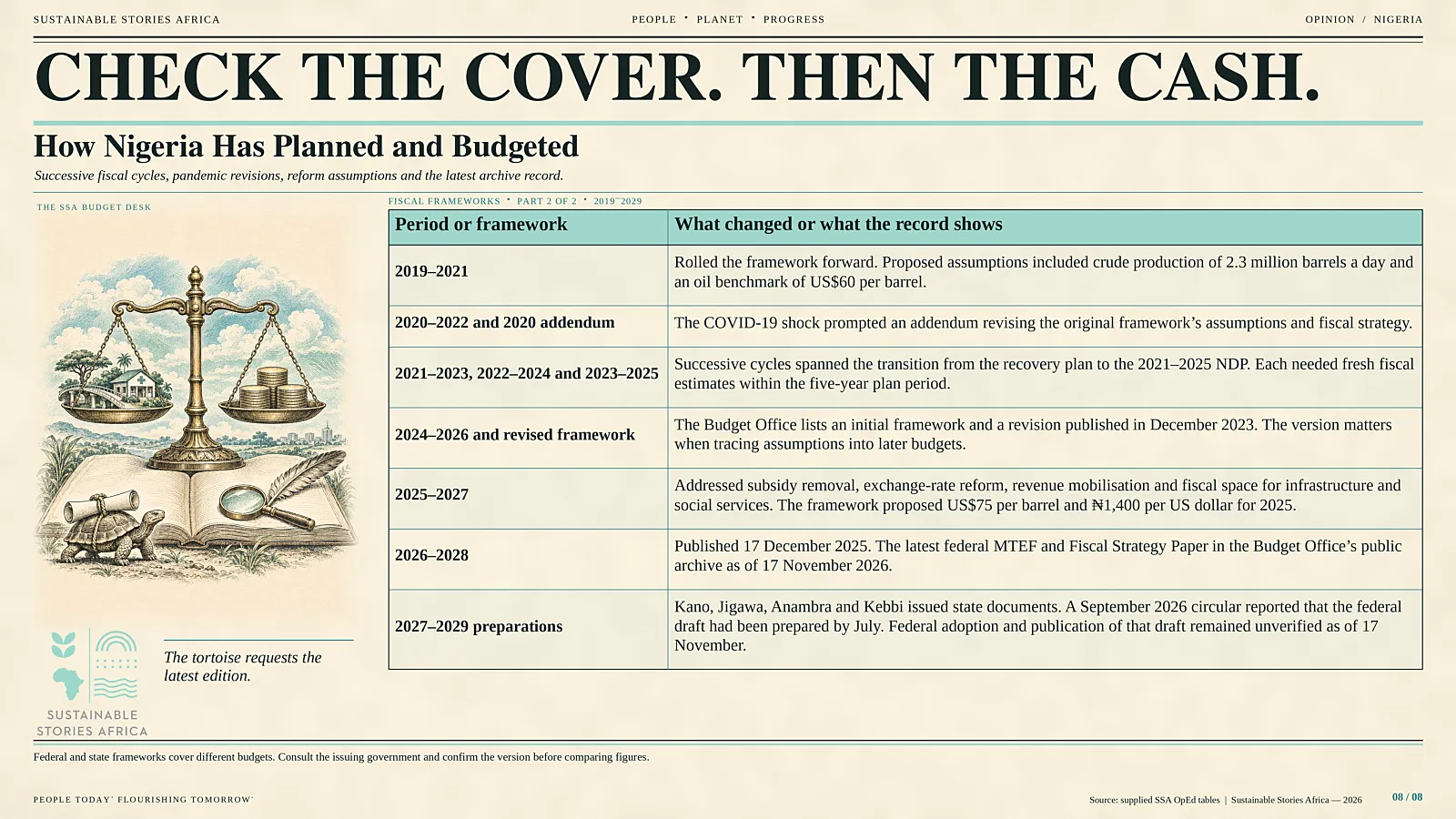
- The original 2015 – 2017 framework proposed a $78 oil benchmark for 2015.
- The Central Bank records $53 a barrel in the eventual budget.
The COVID-19 addendum to the 2020 – 2022 framework is another example of fiscal plans being revised after circumstances changed.
- An honest comparison with actual spending starts by identifying the version that informed the appropriation.
A rolling three-year framework can serve a fixed five-year plan.
The 2021 – 2023, 2022 – 2024 and 2023 – 2025 frameworks covered different stretches of the same NDP, updating what government expected to raise and spend.
- In a transition year, we should look for the list of projects being carried forward and for an explanation of where their remaining costs sit in the new framework.
The 2026 – 2030 transition gives this question fresh urgency.
- The planning ministry was still reviewing the draft successor plan on 20 October 2026, with an aspiration to reach a $1 trillion economy by 2030.
The most recent federal MTEF in the Budget Office’s public archive on 17 November covered 2026 – 2028.
- A September circular reported that a federal 2027 – 2029 draft had been prepared.
- The public will need to see how the final documents connect and which commitments carry over from the last plan.
When the Clinic Is Open
Imagine a ward promised a clinic.
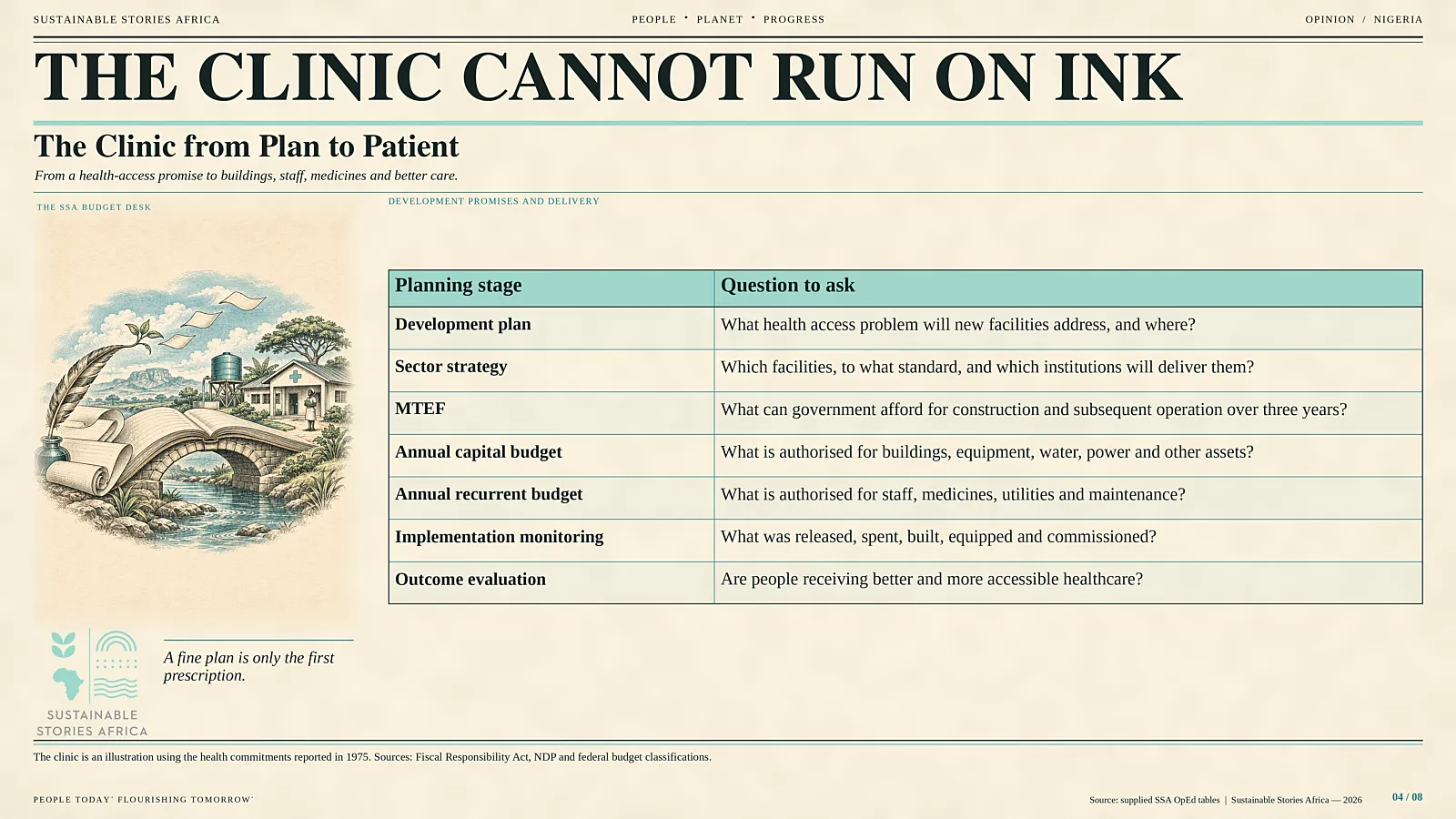
- Its sector plan identifies the location, the population to be served and the standard of care.
- Construction, equipment, water and power sit in the capital budget. Nurses, medicines, utilities and maintenance need recurrent funding.
- The MTEF has to make room for both over several years.
The annual appropriation tells us what can be spent this year, and release and procurement records tell us what happened next.
- For the family that goes there, the result might be a shorter journey, a nurse attending to a delivery or medicine available when needed.
- We want the performance report to tell us how often the clinic opens, whether staff and medicines are available, and how far people still travel for care.
- A completed building belongs in that report.
- So does evidence that the service works.
The pipeline story on that front page raised a similar question about coordination.
- A line from Warri to Kaduna could carry petroleum products.
- Its contribution to fuel supply would depend on refining, storage, distribution and operating arrangements.
- A ministry can finish its stretch of work while a delay elsewhere keeps the network from functioning.
When several institutions share a project, the budget has to follow the order in which their work is needed.
The same discipline helps businesses and financiers decide whether to invest.
- A road, a grid connection or a water line may determine whether a project can operate.
- A clear record of who is paying, when work is due and what happens if revenue falls gives communities a basis to question delays and investors a basis for judging risk.
Make the Budget Line Traceable
The planning ministry and Budget Office should give each major commitment a public identifier that follows it from the NDP into the costed sector strategy, MTEF and appropriation.
- For every project, publish the starting point, target, location, responsible agency, full cost and expected operating costs.
- If a new forecast forces a change, show which milestones move, how much is reallocated and where the remaining funding is expected to come from.
Legislators should ask ministries to reconcile the appropriation with cash releases, spending and delivery in quarterly reviews.
- The Budget Office already publishes implementation reports.
- Matching those reports to the same project identifiers would let a reader track the money over time.
- Where federal and state budgets share responsibility, both governments should publish their respective commitments and explain any gaps.
Companies and lenders should disclose what they have committed and which public works their investments depend on.
Journalists, civic groups and residents can take the project record to a site visit or a budget hearing and ask what has changed.
We must start with one question at every site.
- Can we match what people are using today to the budget line that paid for it?
Path Forward – Give Every Promise a Public Record
Begin with the next budget.
Publish a plain-language record for each major development commitment, with its allocation, releases, spending and the service it is meant to deliver.
Update that record when the assumptions or the schedule change.
The 1975 front page gave Nigerians a list of promises.
What should we look for first in a public record that showed where each promise stands today?
New Nigerian, 31 March 1975. The front page reports the launch of the Third National Development Plan.
Sources
Archival image from the New Nigerian, no. 2,845, 31 March 1975, front page.
The law and the budget process [1] Fiscal Responsibility Act 2007 · [2] Federal budget process · [3] Federal expenditure classifications · [4] Quarterly implementation reports
Development planning and the historical record [5] World Bank brief on the Third Plan · [6] UMass history of Nigerian planning · [7] AfDB review of planning episodes · [8] Review of the 2005–2008 MTEF · [9] Nigeria Vision 20:2020 · [10] First National Implementation Plan · [11] Transformation Agenda midterm report
The national plans and Agenda 2050 [12] 2021–2025 National Development Plan · [13] State House launch figures · [14] Public and private investment split · [15] Nigeria Agenda 2050 launch · [16] Agenda 2050 presentation to NEC · [17] NEC on the Renewed Hope framework · [18] Ministry’s October 2026 draft plan review · [19] BusinessDay report on the draft’s priorities
Federal fiscal frameworks [20] Budget Office MTEF archive · [21] 2010–2012 MTEF and Fiscal Strategy Paper · [22] Original 2015–2017 MTEF and Fiscal Strategy Paper · [23] Central Bank of Nigeria fiscal policy records · [24] 2016–2018 MTEF · [25] Senate report on the 2017–2019 MTEF · [26] Legal 500 briefing on the 2018–2020 MTEF · [27] 2019–2021 MTEF and Fiscal Strategy Paper · [28] 2020–2022 MTEF addendum · [29] Revised 2024–2026 fiscal framework · [30] 2025–2027 MTEF and Fiscal Strategy Paper · [31] 2026–2028 MTEF and Fiscal Strategy Paper · [32] PUNCH report on the federal draft and call circular
State publications covering 2027–2029 [33] Kano · [34] Jigawa · [35] Anambra · [36] Kebbi