For decades, American universities, Harvard, MIT, Stanford, Johns Hopkins, set the global standard for academic freedom, drawing African scholars for doctoral training.
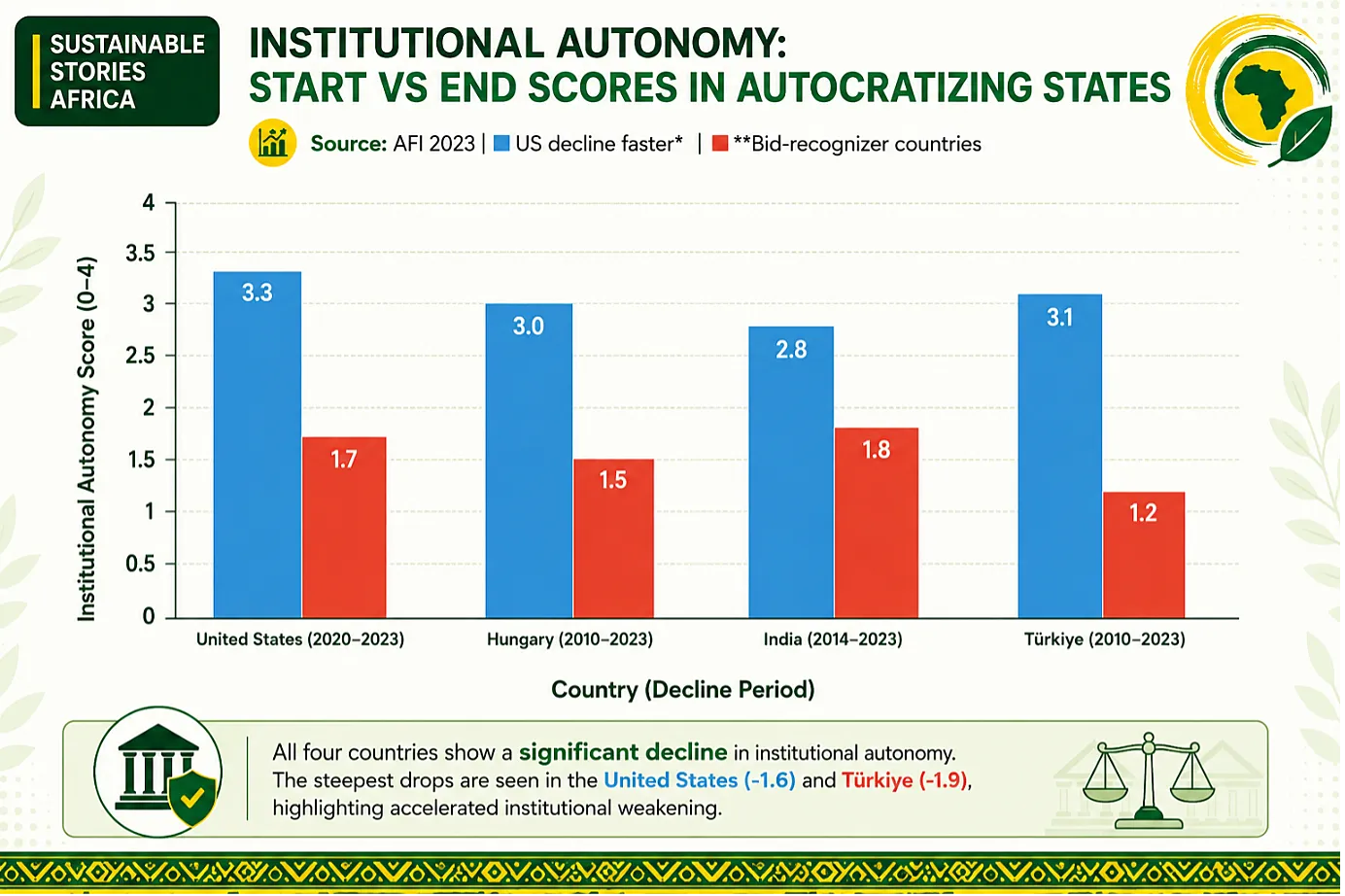
The Academic Freedom Index 2026 Update now reveals the extraordinary: the US has suffered the fastest decline in institutional autonomy of any comparable democracy, its score collapsing from 3.3 in 2019 to 1.7 in 2025, a 50% drop, now rated only "moderate."
For Africa, this is no distant concern. Academics rely on US institutions for research partnerships, postgraduate training, and grant funding.
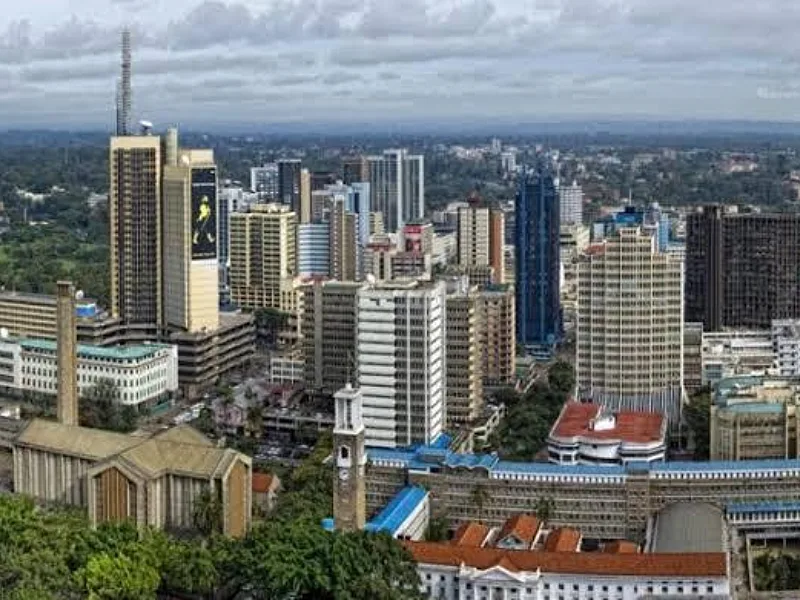
As America's academic system bends to political pressure, the impact transcends Lagos, Nairobi, Accra, Cape Town, and Kampala, demanding that Africa build its own resilient infrastructure for academic freedom.
If America Can Fall, So Can Africa.
Let us be precise about what the AFI 2026 data shows. Unlike Hungary's gradual 15-year decline (2010–2025) or Türkiye's 7-year slide (2010 – 2017), the United States' institutional autonomy score halved in just six years, from near-complete autonomy (3.3 on a 0–4 scale) to moderate autonomy (1.7), the steepest rate among comparable democracies tracked by the AFI.
The mechanism was not a coup or constitutional collapse, but a quieter erosion: state-level legislation, federal executive orders, weaponised research funding, DEI directives, politicised accreditation, and public confrontations with elite universities that sent a chilling signal system-wide.
Thousands of federal research grants were terminated or frozen, while proposed budget cuts of up to 35%, roughly $32 billion, forced universities to reallocate resources, curtail research in fields like gender studies and environmental justice, and align institutional priorities with short-term political and fiscal pressures.
The US Collapse in Context
The AFI 2026 report places the US decline in comparative perspective, and the comparison is damning.
Compared with Western European and North American peer nations, the average level of institutional autonomy has deteriorated only marginally, from approximately 3.7 in 2015 to 3.52 in 2025. Against this peer average, the US stands alone in the severity of its trajectory.
Against autocratising countries, the US comparison is equally alarming.
- Hungary, which began eroding academic freedom under Viktor Orbán's government in 2010, took 15 years to develop a comparable level of institutional autonomy decline.
- India and Türkiye similarly showed more gradual deteriorations.
The US achieved its decline in 5 – 6 years, during which no democratic norms were formally suspended, no constitutional amendments were passed, and no military authority was invoked.
The tools were budgetary leverage, regulatory power, and executive intimidation. They worked.
What This Means for African Academics and Institutions
The implications for Africa are concrete, not theoretical. Consider four dimensions of African exposure to the US academic freedom crisis:
Research funding dependency.
- Many of Africa's most important research institutions, across medicine, public health, agriculture, climate science, and governance, depend on US government funding (NIH, NSF, USAID) or US-based foundations (Gates, Rockefeller, Ford).
- When that funding is conditioned, frozen, or redirected by political mandate, African research programmes are directly affected.
- The AFI 2026 report notes that thousands of federal research grants were terminated or frozen under the second Trump Administration, including grants to partnerships with African universities and researchers.
Brain drain amplification.
- The US academic crisis is producing a reverse talent flow; European and Canadian universities are actively recruiting American scholars fleeing political pressure.
- This has intensified the competition for global academic talent, further reducing Africa's ability to attract and retain the diaspora expertise it needs to develop a domestic knowledge economy.
Model erosion.
- For decades, African university reform movements pointed to US institutional models, independent governing boards, tenure protections, competitive grant funding, and academic freedom policies as aspirational templates.
- When those models are themselves dismantled in their country of origin, the global normative architecture for academic freedom weakens.
- Africa cannot outsource its academic freedom defence to the United States any longer.
Publishing and dissemination platforms.
- US-dominated academic publishing, including journals, databases, and conference networks, has historically provided African scholars with access to global knowledge exchange.
- If political conditions in the US lead to further restrictions on what can be published, or if US-based digital platforms are subject to content restrictions, African academics will face collateral damage.
Africa's Academic Freedom Imperative – Building From Within
The AFI 2026 report offers its own counter-narrative: resistance works.
Courts in the United States have partially checked executive overreach, reinstated frozen grants and affirmed the illegitimacy of politically motivated funding conditions.
Academic institutions, civil society organisations, and faculty associations have organised, litigated, and publicly resisted. These pushback mechanisms have slowed, if not halted, the decline.
For Africa, the lesson is not despair; it is preparation. Academic freedom is not given; it is built, defended, and sometimes restored.
The countries that have improved, including The Gambia and the DRC, did so through deliberate institutional choices, not historical luck.
The path Africa must walk is one of genuine academic freedom and sovereignty: ensuring that the continent's universities are governed by laws and institutions strong enough to withstand political pressure from any direction, domestic or foreign.
This means more African journals, more African academic publishing infrastructure, more intra-African research partnerships, more African postgraduate training capacity, and more African academic freedom monitoring.
It means building a deep bench of institutional defenders, lawyers, judges, civil society activists, and media platforms that the AFI 2026 report shows are the real guardians of academic freedom when political actors turn hostile.
An African Academic Freedom Agenda for 2026 and Beyond
This opinion makes five concrete recommendations, grounded in AFI 2026 data:
Diversify research funding away from US dependence
- African universities and research councils must accelerate the development of domestic and regional funding mechanisms: continental research funds through the AU, co-funding agreements with European partners, Gulf investment in African academic infrastructure, and South-South research partnerships
Establish an African Academic Freedom Charter
- A formal continental instrument, developed through the African Union and endorsed by African heads of state, committing to specific, measurable standards of institutional autonomy and campus integrity.
Build an African Scholars at Risk Network
- An African-hosted, African-staffed monitoring and solidarity organisation that tracks academic freedom violations across the continent, provides support to at-risk scholars, and advocates at the AU and UN level.
Constitutionalise university autonomy in every African constitution
- Where constitutions are silent or ambiguous on university autonomy, this must be corrected. Constitutional review processes should be used to enshrine specific protections.
Invest in African academic publishing infrastructure
- African academic journals, databases, and open-access platforms must be developed and resourced to reduce dependence on US and European publishing gatekeepers.
Path Forward – Africa's Knowledge Sovereignty Begins at the University Gate
The AFI 2026 data deliver an uncomfortable truth: even the world's most powerful democracy, with its most resourced universities, failed to protect academic freedom once political will turned against it.
If it happens at Harvard or Columbia, it can happen anywhere. Africa's universities remain the continent's most strategic long-term asset; their freedom to teach, research, and question underpins every other dimension of development.
Building that foundation, in law, institutional culture, and continental solidarity, must begin now, before the threat arrives.