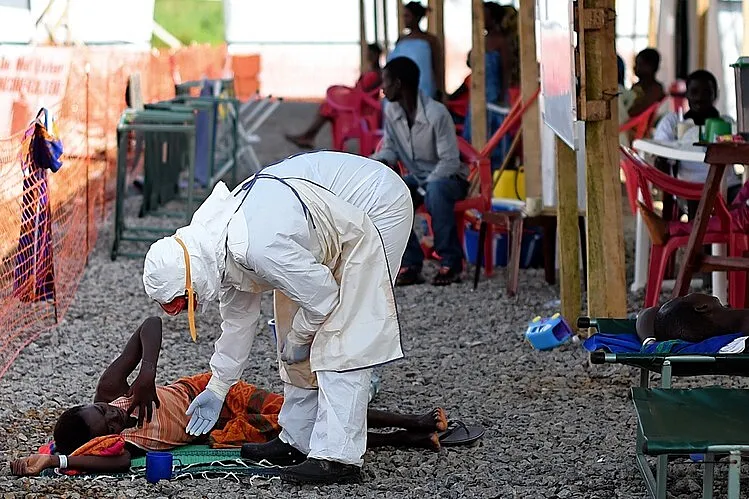
Africa's 2026 Ebola crisis in the DRC is not merely a health emergency; it is an accelerating assault on the human capital that holds fragile communities together.
In Bunia's markets, clinics, classrooms, and transport corridors, the virus is disproportionately killing the very workers on whom economic survival depends.
The stakes for Africa's development agenda have never been higher. As neo-nationalism and collapsing health systems collide with a rare, vaccine-resistant Bundibugyo strain, the cost is being silently written in lost incomes, shuttered enterprises, and devastated households, rather than just in death counts.
When the Healer Falls: Bunia's Invisible Reckoning
Lives Lost, Livelihoods Broken, and the Human Capital Crisis No One Is Pricing
The Ebola outbreak in eastern Democratic Republic of Congo is being measured in confirmed cases and deaths, 782 and 178, respectively, as of mid-June 2026.
However, the numbers alone cannot capture what is being lost. With the outbreak now reaching Goma, a densely populated transport hub, the risk of faster and wider spread is real and urgent.
What the statistics obscure is an economy of grief being built street by street. Market traders, community health workers and teachers, the connective tissue of functioning societies, are dying at disproportionate rates. This is not incidental. It is structural.
The current outbreak involves the Bundibugyo strain, a rare Ebola variant with no licensed vaccines or targeted treatments. The WHO has declared a Public Health Emergency of International Concern. The Africa CDC has escalated to a Public Health Emergency of Continental Security.
In a region already navigating one of the world's worst humanitarian crises, this is not simply a health event. It is an ESG emergency, a governance failure, a social collapse and a human capital crisis unfolding simultaneously.
The Frontline Is Falling
Africa is not losing strangers to Ebola. It is losing the people who make societies work.
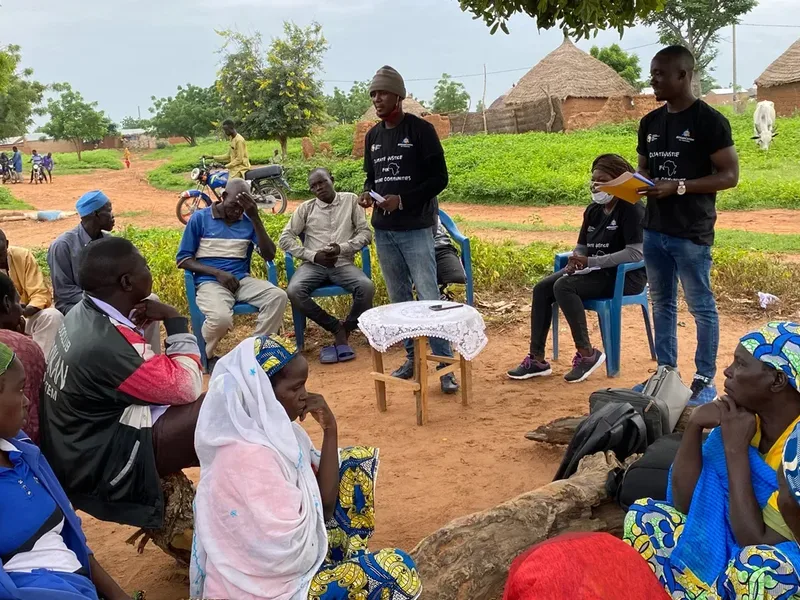
In Bunia, the outbreak's epicentre, the toll falls hardest on workers whose roles demand proximity, health workers, market vendors, teachers and community mobilisers.
These are not abstract casualties. They are the human infrastructure on which households, local economies and service delivery depend.
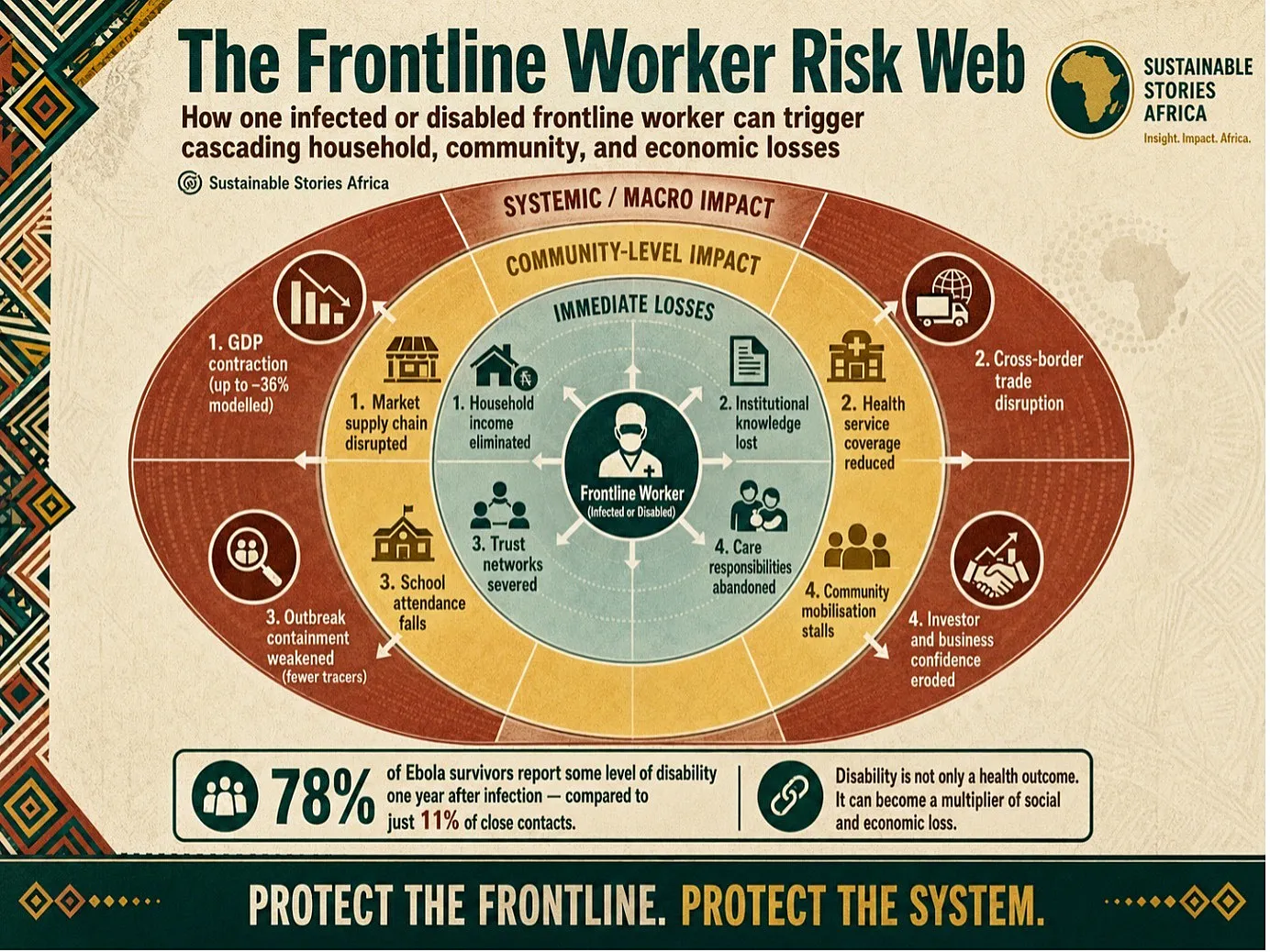
When a community health worker dies, she takes institutional knowledge and trust networks with her.
The long-term burden is equally severe. A landmark seven-year longitudinal study published in JAMA Neurology in June 2026, tracking 148 Ebola survivors in Liberia, found that
- 56.1% reported cognitive dysfunction.
- 66.2% suffered persistent headaches.
- 49.3% experienced depression.
- 57.4% reported memory loss seven years after infection.
These are productivity deficits, income deficits and dignity deficits. Ebola does not just kill; it disables the living.
The human cost of ebola survival
The economic evidence reinforces this. Research on Sub-Saharan African outbreaks found GDP declines of up to 36%, peaking in the third year post-outbreak.
For eastern DRC, each wave compounds decades of structural underdevelopment.
This is not a natural disaster. It is the predictable consequence of neglected health systems and the chronic deprioritisation of community health workers.
A Crisis Inside a Crisis
The Bundibugyo strain changes everything and exposes what was already broken.
What makes the 2026 DRC Ebola outbreak uniquely alarming is not only its scale, but also the absence of the tools that previously contained it.
The Bundibugyo strain has no licensed vaccine and no targeted treatment. During the 2018 – 2020 outbreak, the rVSV-ZEBOV vaccine enabled ring vaccination and community reassurance.
That option no longer exists. Frontline workers, already exhausted by years of conflict and displacement, are entering communities equipped with little beyond protective equipment and contact tracing protocols.
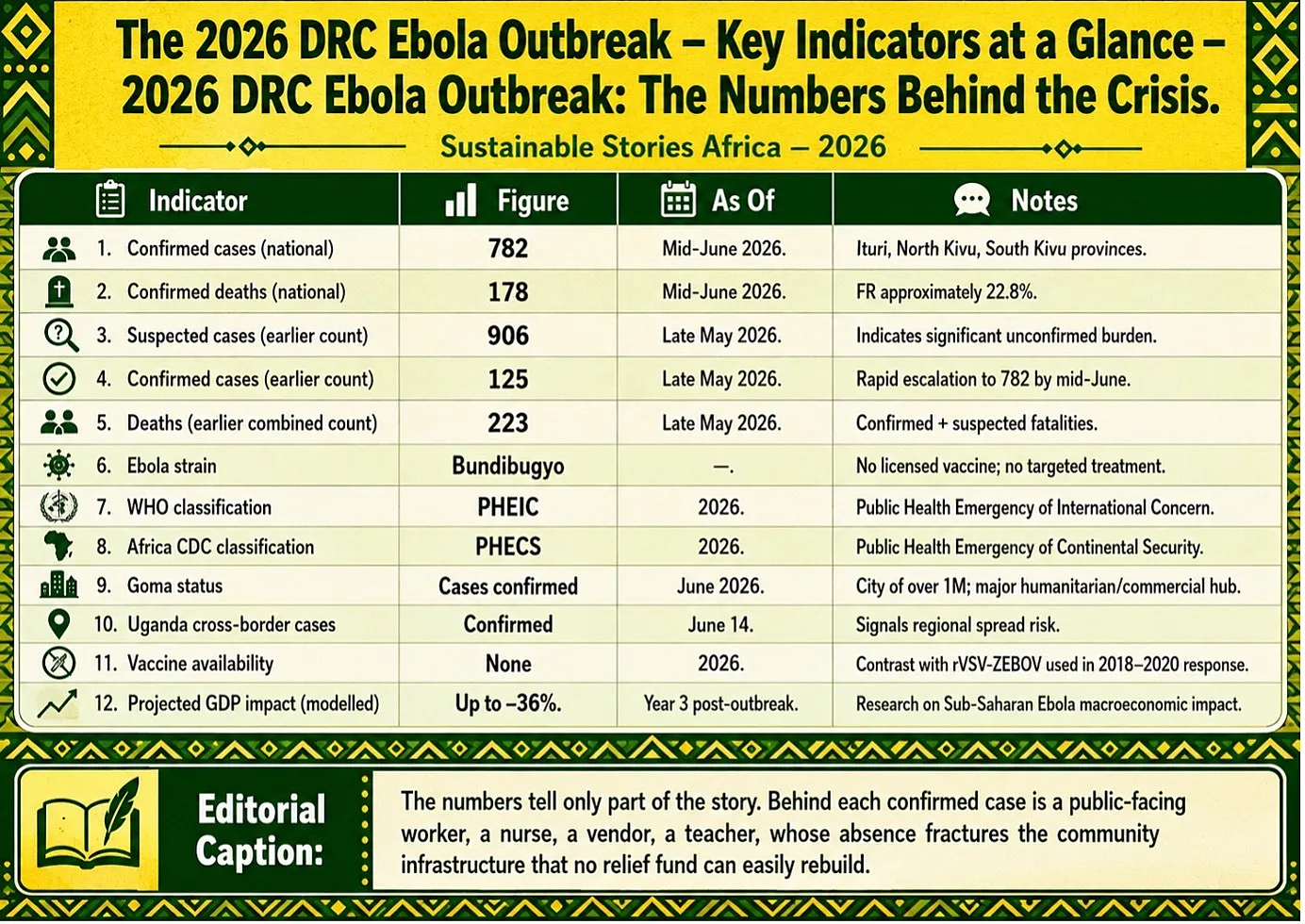
By late May 2026, 125 confirmed cases, 906 suspected cases and 223 deaths had been recorded across the provinces of Ituri, North Kivu and South Kivu.
The confirmation of cases in Goma, a city of over one million people and a critical humanitarian and commercial hub, signals potential regional spread that could destabilise cross-border trade routes connecting DRC to Uganda, Rwanda and beyond.
Uganda confirmed cases as of June 14, 2026.
For public-facing workers, the exposure risk is existential.
- A market woman cannot quarantine her livelihood.
- A nurse cannot choose not to respond.
The virus finds the worker because the worker, by definition, is always present.
The long-term toll compounds this crisis. Research found that 78% of Ebola survivors had some level of disability one year after infection, compared to 11% of close contacts, with some Central African cohorts reporting symptoms more than twenty years later.
When survivors are nurses, traders and teachers, survival itself becomes a prolonged, invisible second crisis.
What Africa Stands to Gain and Lose
The choice is not between spending and saving. It is between investing now and paying far more later.
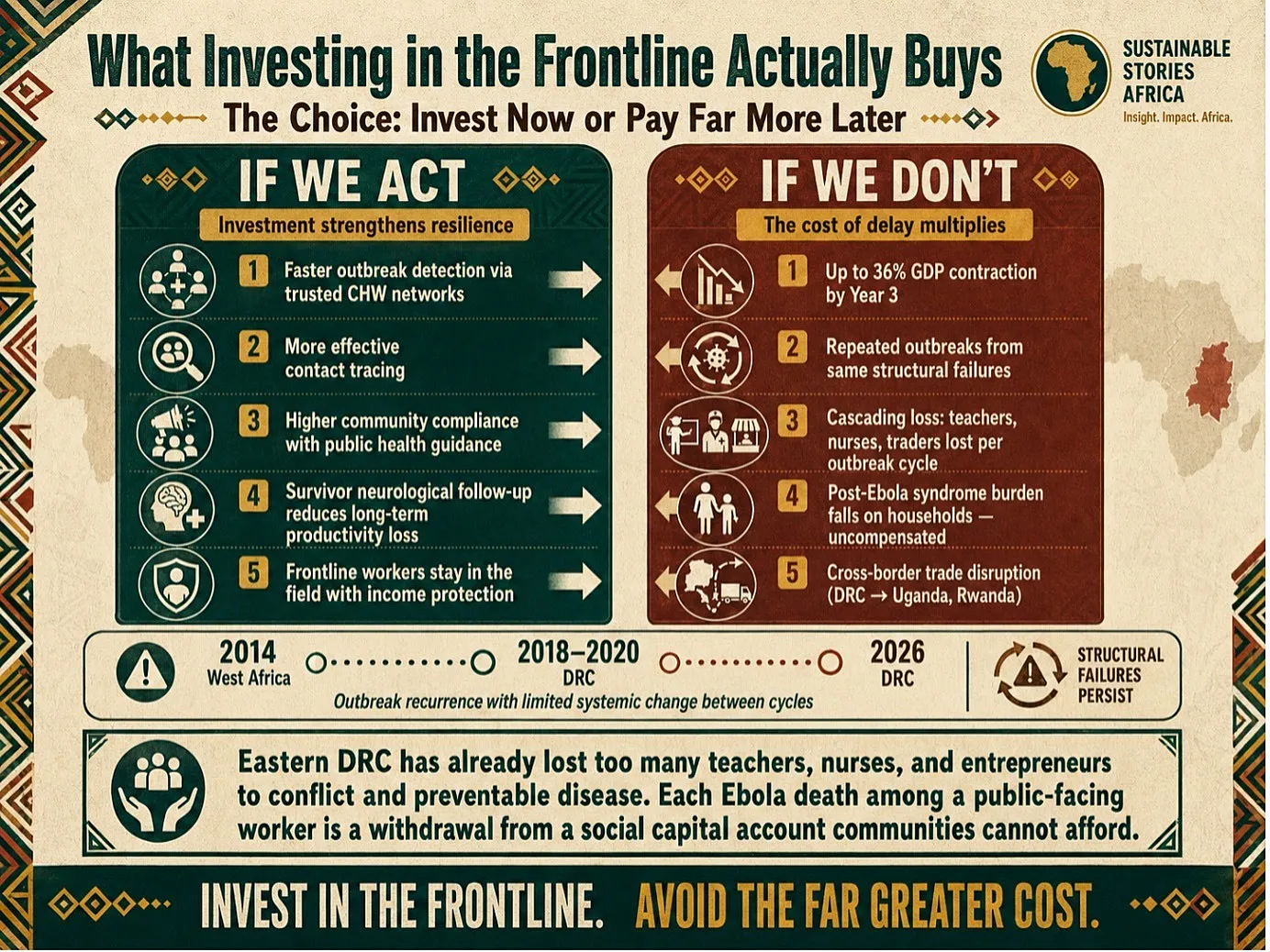
If African governments, international partners and the private sector treat this outbreak as a genuine systemic emergency rather than a recurring humanitarian footnote, the dividends will be transformative.
Regions with robust, trusted and well-resourced community health worker systems detect outbreaks faster, trace contacts more effectively and achieve higher public health compliance.
This is not theoretical; it is the lesson of every successful Ebola response, from Guinea-Conakry in 2021 to Equatorial Guinea in 2023.
Investing in the frontline workforce means the exposed health worker receives prophylactic support, psychological care and income protection, making her more likely to stay in the field.
It means Ebola survivors receive the neurological follow-up that the JAMA Neurology study explicitly recommends, reducing post-Ebola syndrome burdens on households and health systems.
What is lost if the status quo holds is not abstract. Eastern DRC has already surrendered too many teachers, nurses and entrepreneurs to conflict and preventable disease.
Every Ebola death among a public-facing worker is a withdrawal from the social capital account that communities in crisis can least afford.
INFOGRAPHIC BRIEF 2:
A Clear Agenda for Governments, Partners, and Business
The response must match the scale, and the system must change.
These actions are not aspirational. They are urgent and achievable.
Classify frontline health workers as essential infrastructure.
- African governments must provide income protection, insurance and occupational health coverage on par with formal public servants. The Bunia crisis is a direct consequence of the casualisation of community health cadres.
Fast-track emergency funding.
- International partners and development finance institutions must prioritise community engagement, contact tracing personnel and survivor care. With no Bundibugyo vaccine available, human systems are the only tool of containment.
Embed survivor neurological care into recovery protocols.
- The June 2026 JAMA Neurology findings, tracking survivors across seven years, make the case unambiguously: cognitive dysfunction, memory loss and depression carry direct socioeconomic consequences.
Activate private sector ESG commitments now.
- Mining companies, telecoms and logistics firms operating in Ituri and North Kivu must fund community health infrastructure and contribute to survivor rehabilitation, before the outbreak ends, not after.
Reframe the narrative.
Media and civil society must move beyond casualty counts toward human capital analysis. Every death-toll headline without a livelihood impact figure tells only half the story.
Path Forward – Bunia Cannot Wait
Africa's Frontline Deserves Better Now
The Ebola crisis in eastern DRC tests whether Africa's health systems and development partners have genuinely learned from 2014 and 2018. The answer, so far, is incomplete.
Community health workers remain under-protected. Survivor neurological care remains unfunded. Human cost is still measured in deaths alone, not in the years of diminished productivity that follow survival.
The path forward demands systemic investment in frontline worker protection, survivor care and community trust.
Africa cannot build the knowledge economy it deserves while leaving its most essential workers its most exposed.