In 2019, invasive alien species cost the global economy $423 billion, while 69% of CDP-disclosing companies reported water-related risk exposure worth up to $225 billion, nearly double the cost of addressing it.
These are documented losses that are already affecting supply chains, credit ratios, and earnings.
For African businesses at the epicentre of both crises, the question is no longer whether nature risk matters, but whether they can afford to keep waiting.
The Numbers That Change the Conversation
There is a reason the nature-risk conversation has struggled to gain traction in African boardrooms and finance ministries: until now, the financial evidence has been scattered, sector-specific and difficult to apply to strategic decision-making.
That is changing. The Oxford-TNFD evidence review has assembled the most rigorous collection of nature-related financial risk data yet published, and two categories of risk stand out above all others for their scale, immediacy, and relevance to Africa: water stress and invasive alien species.
Together, these two risk categories already represent trillions of dollars in documented economic losses, with evidence from every major global region, including Sub-Saharan Africa, where fall armyworm alone costs agriculture up to $12.1 billion per year.
The evidence is no longer emerging. It is here. And it is material.
The Numbers Are Already Staggering
Water is the world's most documented nature-related financial risk. In 2022, 69% of publicly listed companies disclosing water data through CDP reported exposure to water risks worth up to $225 billion, almost double the $119 billion it would cost to address them. Potential impacts include:
- Production disruption (44%)
- Higher operating costs (24%)
- Revenue reduction (11%)
- Supply chain disruption (9%)
- Operational closure (8%)
- Constrained growth (5%)
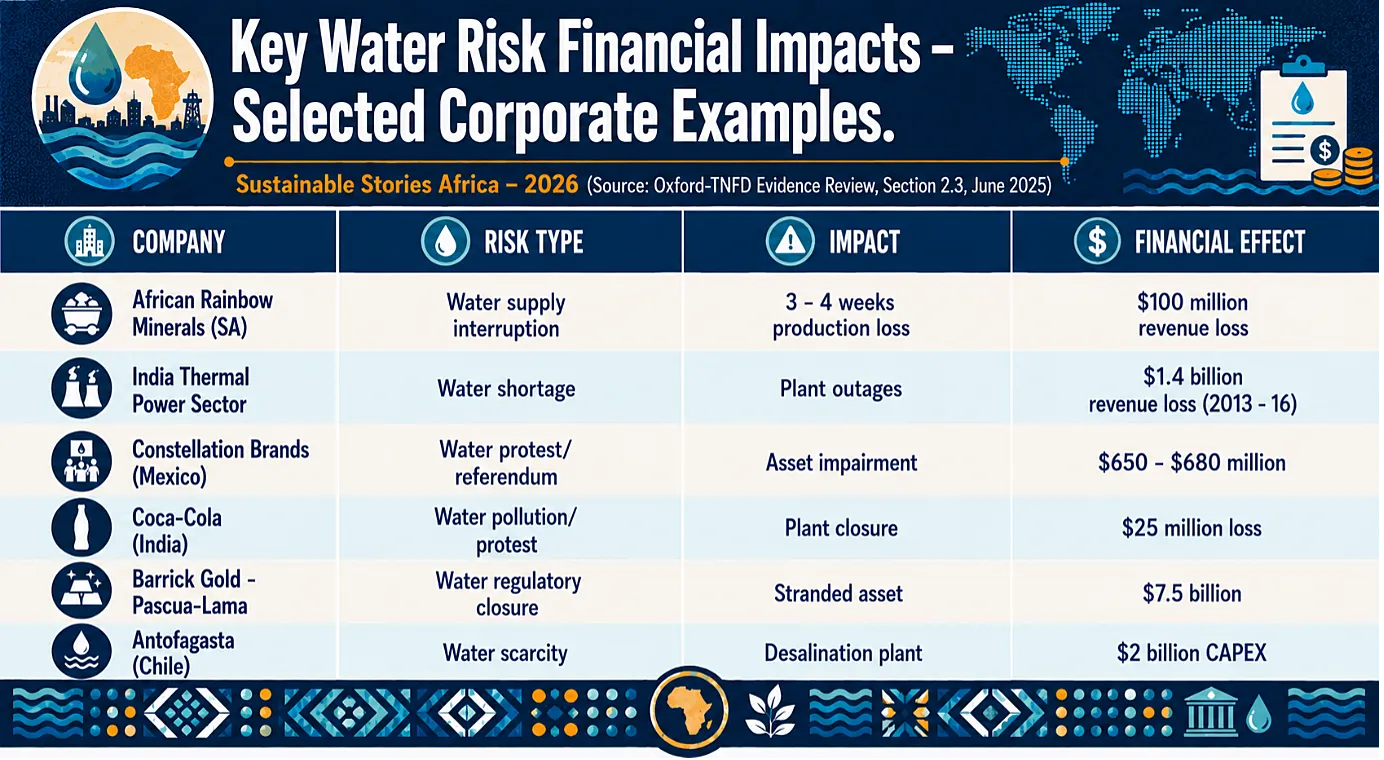
Water supply disruptions at 14 of India's 20 largest thermal power companies caused over $1.4 billion in revenue losses between 2013 and 2016.
African Rainbow Minerals, a South African mining company, suffered $100 million in revenue losses in 2017 due to water supply interruptions.
On biological invasions, global cumulative costs from 1970 to 2020 totalled $1.738 trillion, with global annual costs quadrupling per decade since 1970, and projected to continue rising.
In 2019 alone, the annual cost of invasive species reached $423 billion.
The Sector by Sector, the Evidence Mounts
Africa leads the world in vulnerability to biological invasion. Fall armyworm, the single most documented invasive alien species for agricultural damage, causes estimated annual maize crop losses of:
- 58% in Zimbabwe
- 49% in Benin
- 46.5% in Ethiopia
- 45% in Ghana
- 40% in Zambia
The total annual cost of fall armyworm to African agriculture is estimated at $9.4 billion (range: $7.7 – $12.1 billion).
Cumulative costs of biological invasions in Africa from 1970 to 2020 reached $17.8 –78.9 billion, with the largest impacts on agriculture.
The banana industry illustrates global systemic risk for biological invasion. Panama Disease Tropical Race 4 (TR4), now present in 21 countries, threatens 80% of global banana production, with global losses estimated at $493 billion discounted over 40 years.
A five-year delay in developing a resistant banana variety alone would cost $94 billion.
Quantifying What Prevention Is Worth
The evidence review makes a compelling economic case for proactive investment in nature protection and risk assessment.
Companies that effectively manage biodiversity, pollution and water risk demonstrate better refinancing options, a difference of 93 basis points in long-term refinancing costs.
GDP losses from unchecked water risk are projected at 8% for high-income countries and 10% – 15% for lower-income countries by 2050 under business-as-usual scenarios, in a world where Africa already faces the highest vulnerability to water stress, food insecurity and crop losses.
The cost of prevention consistently proves far smaller than the cost of response: water contamination from PFAS pollution could cost over $1.6 trillion to clean up in the UK and Europe alone, compared to documented prevention costs a fraction of that scale.
What Africa's Businesses and Governments Must Do Now
The metrics are clear. The actions required are equally clear:
- Financial institutions must integrate water stress and invasive species risk into credit assessments for agribusiness, mining and energy sector lending across Africa
- Agribusiness companies in fall armyworm-exposed regions must build documented financial risk models for their nature dependencies, using the TNFD LEAP approach as a structured baseline
- Regulators in water-stressed markets (including South Africa, Kenya, Nigeria and Egypt) must urgently move towards mandatory water risk disclosure, aligned with CDP frameworks
- Governments must fund early detection and rapid response systems for invasive alien species, recognising that $66 billion in annual African agricultural losses are directly attributable to them.
- International development finance must direct capital toward nature-positive agriculture, watershed protection and crop diversity programmes, sectors where the return on prevention dramatically exceeds the cost of failure
Path Forward – Africa's Agriculture Cannot Absorb These Losses
Prevention Costs Far Less Than Collapse
Africa's food systems cannot absorb $9.4 billion per year in fall armyworm losses while simultaneously delivering food security, rural livelihoods and economic growth.
The evidence is clear: prevention, through early detection, biosecurity investment, nature-positive agricultural practice and mandatory corporate risk disclosure, costs a fraction of the documented losses.
The window to prevent the next Panama Disease-scale catastrophe in African agriculture is open.
However, it requires urgent financial, political and institutional commitment to nature risk management now.