
ACCA's redesigned qualification, rolling out from 2027, places substantially stronger emphasis on technology integration, data analytics, sustainability reporting, and strategic business leadership, alongside rigorous technical accounting foundations.
FinPolNomics frames the change as far more than an examination structure reshuffle. It is an authoritative signal that finance careers are being fundamentally rebuilt around digital fluency, ESG literacy, and enterprise value.
For African students and employers across banking, regulation, audit, public institutions, and private enterprise, the transition demands immediate planning because qualification pathways shape the talent readiness, audit quality, finance transformation capacity, and cross-border employability of the next generation of African finance professionals.
Finance Skills Are Being Rewritten Now
The accounting and finance profession is entering a defining moment of transition across Africa and globally.
ACCA's redesigned qualification, scheduled to begin rolling out in 2027, responds directly to a market in which finance professionals are now expected to command data architecture, technology platforms, sustainability measurement, commercial judgment, and strategic leadership, alongside the rigorous technical accounting standards that have always defined the profession's credibility.
The FinPolNomics framework translates that shift into practical guidance for students and employers.
Completed examinations and current progress will continue to count under carefully structured transition arrangements; however, the direction of travel is unambiguous: future-ready finance talent will require broader, more integrated capabilities to remain employable, effective, and valuable across African markets.
The stakes for African economies are immediate and practical.
Banks, regulators, listed companies, public institutions, fast-growing startups, and major development projects all need finance professionals who can better support financial reporting, stronger institutional controls, technology-enabled transformation, quality ESG disclosure, and genuinely sustainable growth at the enterprise and national level.
The Finance Career Landscape Is Shifting Irreversibly
The 2027 redesign is not a bureaucratic housekeeping exercise. It is ACCA's formal response to a finance talent market that has already fundamentally changed.
Organisations deploying AI, building ESG reporting frameworks, managing digital transformation programmes, and navigating complex multi-jurisdictional regulatory environments cannot afford finance professionals whose capabilities stop at technical accounting.
For African students who are mid-journey through the current qualification, the message is urgent but manageable: understand the transition rules, map your pathway forward, and begin aligning your learning strategy with the competencies that the next decade will actually demand.
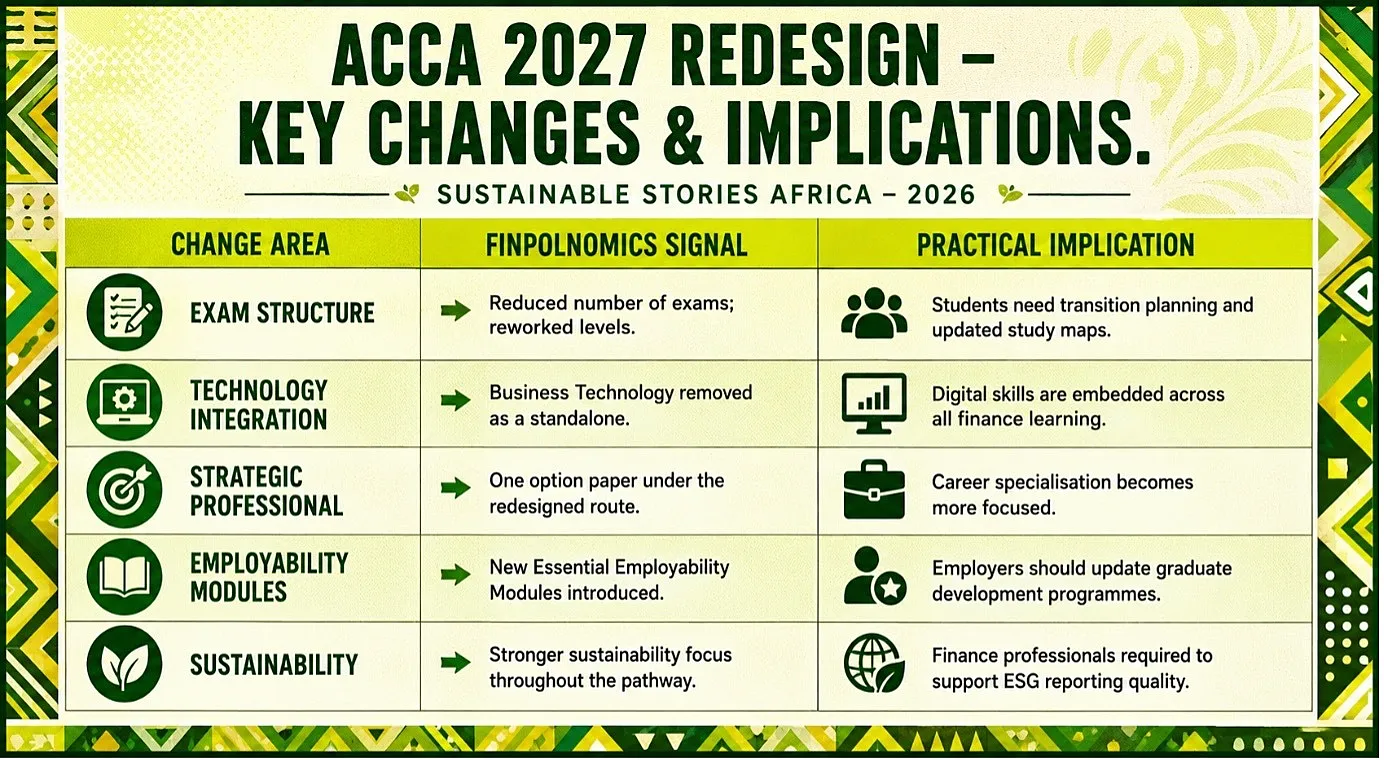
Technology And Sustainability Move To Centre Stage
The redesigned pathway deliberately reduces structural complexity while placing substantially more weight on applied professional competence.
The FinPolNomics summary identifies fewer required examinations, a shorter qualification journey for well-prepared students, and the deliberate removal of Business Technology as a standalone examination paper, because digital capability is being embedded as a cross-cutting competence throughout the entire structure.
The first redesigned examinations begin in 2027, with Strategic Professional pathway changes, including a single Options examination, taking effect from September 2027.
For students currently at the Applied Skills or Applied Knowledge levels, transition tools will confirm which completed examinations carry forward and what additional requirements apply.
The message for students is not simply to finish faster. It is to prepare more strategically.
Data literacy, professional employability, awareness of sustainability reporting, and strategic business leadership are becoming core elements of the accountant's professional value proposition, rather than optional extras for the ambitious few.
What Future-Ready Finance Talent Makes Possible
Finance teams that combine rigorous technical accounting with digital fluency, sustainability intelligence, and strategic commercial judgment can do far more for the organisations they serve.
They can advise confidently on AI governance frameworks, design ESG disclosure architecture, evaluate capital allocation decisions under uncertainty, build more reliable forecasts, and communicate with investors and boards with the credibility that modern markets demand.
For African economies competing for international investment, development finance, and strategic partnerships, the quality of institutional finance talent is not a background variable.
It is central to the credibility, governance standards, and sustainability performance that international partners assess.
Students, Employers, and Tutors Must Act Now
Students should not wait until 2027 to begin transition planning. The recommended immediate actions are to use ACCA's official transition tools to confirm which examinations are carried forward, understand which new modules will be required, align study plans with career objectives, and have an early conversation with employers about how the redesign affects their training and development support.
Employers relying on ACCA-qualified talent pipelines should treat the redesign as a workforce planning priority.
Graduate training budgets, study leave policies, internal rotation programmes, and performance development frameworks may all need updating to reflect the new qualification architecture and the expanded competency expectations it embodies.
Path Forward – Prepare Early, Stay Future-Ready
The ACCA qualification redesign should act as a catalyst for every student, every educator, and every employer to reconsider what finance capability actually means in 2027 and beyond.
The future finance professional will combine deep accounting technical strength with digital fluency, sustainability literacy, data intelligence, and leadership judgment to translate financial insight into strategic decisions.
Africa's finance talent strategy must move decisively in alignment with that change; early, deliberately, and with the ambition that the continent's growth opportunities demand.