A new African Development Bank-hosted facility has mobilised nearly €168 million to finance climate-aligned infrastructure and confront the economic and environmental pressures behind displacement.
Its first €24.5 million portfolio spans Ethiopia, Angola and Mauritania. The decisive question is whether approved capital can become reliable water, roads, energy, jobs and resilience quickly enough for vulnerable communities.
Climate Finance Meets Africa’s Migration Pressures
The African Development Bank’s Rome Process/Mattei Plan Financing Facility moved from institutional design to its first investment portfolio in 2025, approving or advancing three operations worth €24.5 million across water, transport and energy.
Those commitments sit tangibly among projects valued at €342.5 million and are expected to improve climate resilience for about 1.22 million people, create 7,602 direct and indirect jobs, and avoid an estimated 71,934 tonnes of carbon-dioxide-equivalent emissions.
The figures come from the RPFF, Rome Process | Mattei Plan Financing Facility Annual Report 2025, published by the African Development Bank in 2026.
The report presents the facility as a development-led response to the linked pressures of climate change, fragile livelihoods and irregular migration.
For communities in drought-stressed Borana, remote eastern Angola or rural Mauritania, however, the test is more immediate.
Climate finance only becomes meaningful when a family reaches safe water, a farmer reaches a market after heavy rain, or a village gains electricity capable of supporting work and essential services.
A Small Facility With Outsized Ambition
Nearly €168 million was pledged to the RPFF by the end of 2025, with €161.5 million (96%) paid in.
Italy contributed the largest share across three channels, alongside the UAE's $25 million equivalent and Denmark's December commitment, leaving approximately €142 million in cash available for new initiatives after project commitments and operating costs.
This capital base matters because the RPFF, hosted by the AfDB, pursues something more ambitious than isolated asset funding.
It deploys concessional loans, investment grants, and technical-assistance grants to support sovereign infrastructure across energy, transport and water sectors through which climate shocks become household crises.
The facility gained Board approval on 10 February 2025, followed by Operational Guidelines on 30 May, the Technical Coordination Unit, and three Governing Council meetings, including the first in-person session in Rabat.
AfDB Vice-President Kevin Kanina Kariuki said the facility had "moved decisively from concept to implementation."
However, approval isn't delivery: no disbursements occurred for the two approved projects by year-end, with first disbursements expected in 2026.
Mauritania's technical-assistance operation only secured final approval on 9 January 2026, meaning most reported outcomes remain projected and not achieved.
Three Projects Test The Financing Thesis
In Ethiopia's Borana Zone, the programme addresses a lived reality: drought determines water access, livestock survival and household economic security.
Plans include solar-powered water systems, reservoirs, catchment protection, reforestation and rangeland rehabilitation, among improved sanitation for 3,000 people and 40 household biogas digesters.
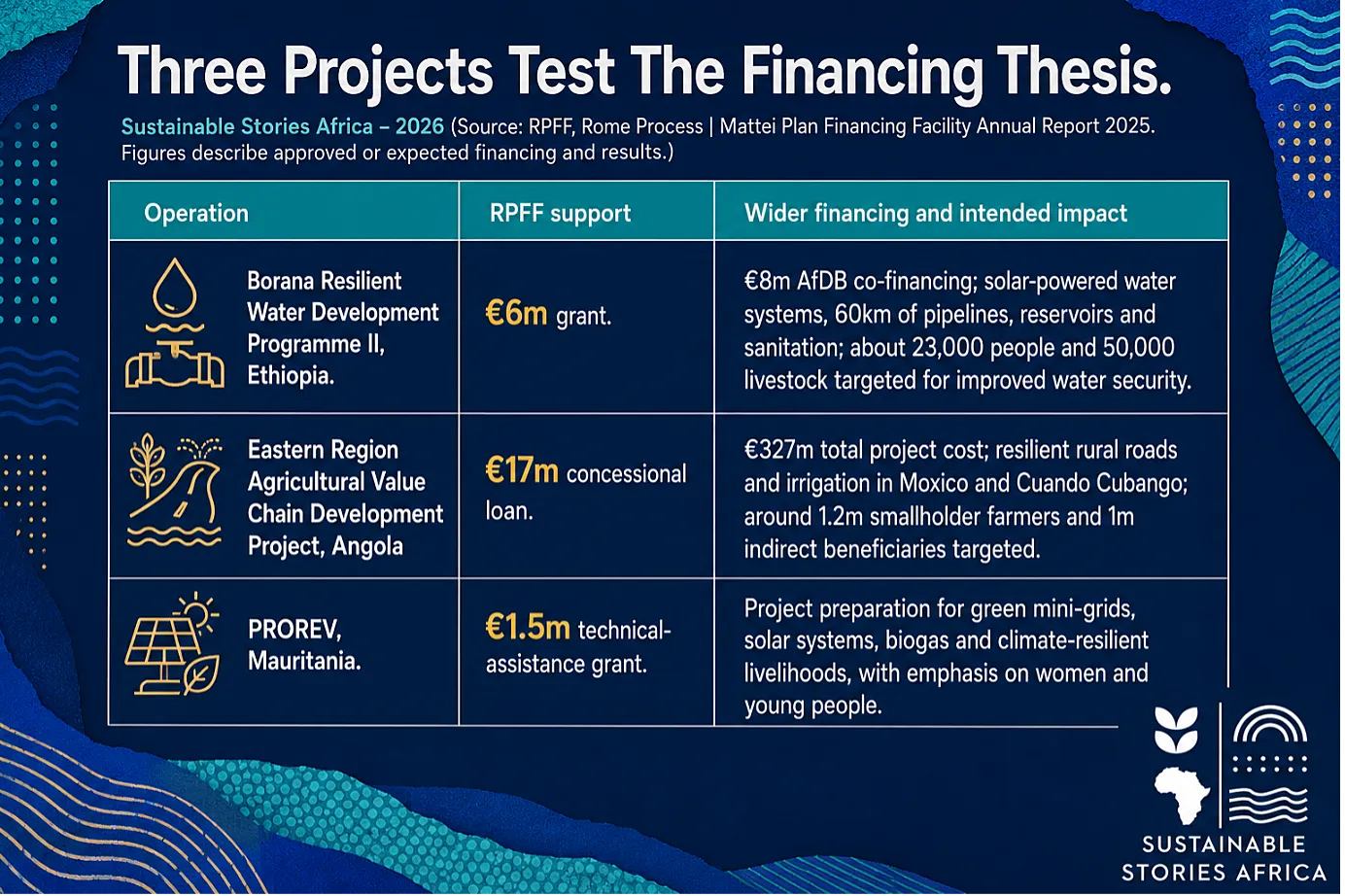
Angola's project demonstrates that climate resilience extends beyond renewable-energy capacity.
- Rehabilitated rural roads should withstand extreme weather, lower transport costs, and reduce post-harvest losses, while irrigation stabilises production.
- The RPFF's €17 million commitment is modest against the €327 million total project cost, but it anchors €163 million from the AfDB and €147 million from IFAD and government co-financing.
Mauritania shows concessional capital's different role:
- A €1.5 million grant funds feasibility work, environmental assessments, PPP support and feed-in-tariff analysis, the less visible groundwork determining whether green mini-grids become viable services.
Across the portfolio, €24.5 million in RPFF commitments anchored €171 million in AfDB financing (roughly sevenfold leverage) and €147 million from other partners.
RPFF capital represents just over 7% of the €342.5 million total; its value lies in risk absorption and readiness, not scale.
Infrastructure Benefits Reach Beyond Concrete Assets
If delivered as designed, these projects could make climate adaptation tangible. The report estimates 1,223,300 people better equipped to cope with climate impacts, 3,150 gaining access to essential services including sanitation, and 7,602 direct and indirect jobs created, alongside an expected 71,934 tCO₂e emissions reduction adding mitigation value to a resilience-focused portfolio.
The deeper opportunity is economic continuity. Resilient roads preserve market access, reliable water protects health and livestock, and decentralised electricity extends productive hours while supporting cold storage and small enterprises, allowing households to adapt without selling assets or moving under distress.
This requires care in managing the facility's migration mandate. Infrastructure shouldn't be treated as a tool for preventing mobility, since migration can itself be a legitimate adaptation strategy.
The stronger proposition is to reduce forced, unsafe movement by expanding choice, success measured by income, access and agency, not migration statistics alone.
Delay carries costs too: slow disbursement widens gaps between policy and lived experience, while poorly prepared infrastructure risks environmental damage, debt pressure or unmaintainable assets, making local participation and credible safeguards essential.
From Approved Capital To Delivered Outcomes
The initial priority for the AfDB, recipient governments and implementing agencies is disciplined execution.
- Financing agreements, procurement plans and safeguards must move promptly without weakening scrutiny, with results reported against baselines that separate people reached, services delivered and jobs sustained from initial projections.
Second, the facility should publish project-level disbursement and implementation data alongside climate and social indicators.
- To show not just pledged amounts but disbursement speed, completed milestones and beneficiaries, with gender, youth, disability and geographic breakdowns revealing whether inclusion commitments survive implementation.
Third, governments must plan for maintenance and institutional ownership from the outset:
- Water points need local management and recurrent budgets, roads require maintenance systems, and mini-grids need tariffs balancing viability with affordability, while technical assistance should strengthen regulators and community organisations rather than remain confined to transaction preparation.
Finally, donors should treat the 2025 portfolio as a learning platform before scaling.
- The 2026 plan targets 12 approvals worth €96.1 million and 16 total projects, growth demanding stronger monitoring, evaluation and coordination with Rome Process partners.
Path Forward – Scaling Finance With Local Impact
The RPFF now needs to convert its €142 million cash position and expanding pipeline into timely, locally owned services.
Priorities are disbursement, transparent project tracking, robust safeguards, community participation and maintenance systems that keep assets working after construction.
Its 2026 scale-up can advance African climate resilience and inclusive development if leverage is judged by more than capital mobilised.
The defining measure will be whether water flows, roads remain open, energy supports livelihoods, and vulnerable communities gain genuine choices.