Africa Group 1’s 2026 Interim Report lands at a difficult moment: growth is recovering, but debt, food insecurity, climate shocks and geopolitical risk are narrowing policy room.
The report’s central question is practical: can World Bank Group financing, reforms and private capital move fast enough to turn crisis response into jobs, resilience and sustainable growth?
A Crisis Test For African Resilience
Africa Group 1’s 2026 Interim Report frames the next phase of Africa’s development challenge as a delivery test: not simply whether financing exists, but whether governments and institutions can convert it into jobs, reliable services, resilient food systems and private investment.
The report covers a constituency of 22 African countries at the World Bank Group, from Kenya, Ethiopia and Tanzania to Sierra Leone, Rwanda, Botswana, Mozambique, The Gambia and Zimbabwe.
Its message is clear: the global economy is slowing, financing is tighter, and the margin for policy error is narrowing.
The stakes are immediate. Global growth is projected to slow to 2.6% in 2026, while Sub-Saharan Africa’s recovery remains uneven and vulnerable to debt stress, weak productivity and recurring shocks.
For households, the story is felt in food prices, transport costs and access to work; for governments, it is felt in debt service, delayed projects and shrinking fiscal buffers.
Shockwaves Now Test Africa’s Financing Model
The report’s sharpest warning is that Africa is entering another shock cycle before fully recovering from the last one.
The Middle East conflict, it notes, could affect Sub-Saharan African economies through energy prices, shipping routes, trade flows, investment and remittances.
In a severe disruption scenario, oil could rise above $110 per barrel, global growth could fall sharply below previous projections, and inflation could surge again.
That is not an abstract macroeconomic risk. Higher fuel and fertiliser costs can quickly become higher food prices.
The report warns that food price shocks linked to the crisis could push as many as 16 million additional people into food insecurity, with Sub-Saharan Africa (SSA) likely to carry a large share of the burden.
For African governments, this creates a familiar and dangerous policy trap: spend more to protect people, while borrowing costs rise and external financing becomes harder to access.
Many SSA economies already have limited fiscal room, with government debt above 50% of GDP in most countries and external financing needs above 10% of GDP in many cases.
Growth Recovers, But Fragility Still Bites
The regional picture is not all bleak. SSA’s GDP growth is estimated at 4.0% in 2025, up from 3.7% in 2024, supported by easing inflation, stronger commodity prices and resilient consumption and investment.
Nigeria expanded by 4.2%, South Africa by 1.3%, and Ethiopia by 7.2% despite debt distress.
However, growth remains uneven. Non-resource-rich economies such as Uganda and Côte d’Ivoire benefited from favourable agricultural and export conditions, while commodity exporters faced weaker oil prices and sector disruptions.
Severe food insecurity still affected about a quarter of the region’s population in 2025, and undernourishment in SSA rose from 250 million to nearly 280 million people.
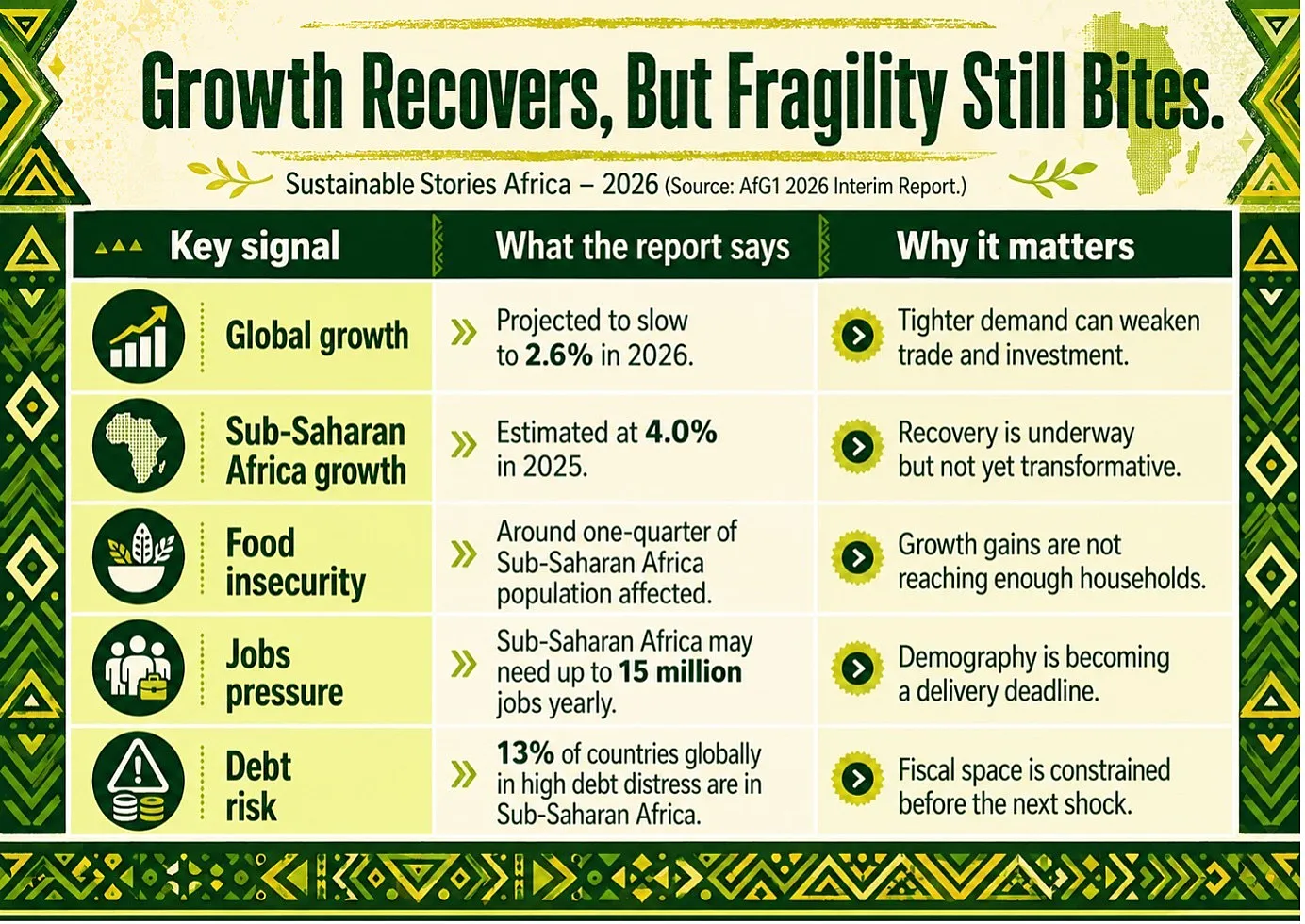
The jobs challenge is perhaps the report’s most important signal of development. SSA is projected to account for half of the global increase in workers by 2030, while needing up to 15 million jobs annually.
That makes employment not just a social policy issue, but the central test of growth quality.
Resilience Can Turn Financing Into Jobs
The opportunity, according to the report, is to use development finance more strategically: not as temporary relief, but as a bridge to structural transformation.
That means stronger infrastructure, better business conditions, resilient food systems, cleaner energy, and deeper private-sector participation.
The World Bank Group’s agenda for AfG1 countries is already moving in that direction. The report highlights the Water Strategy, Small States Strategy, refreshed Fragility, Conflict and Violence Strategy, IDA Private Sector Window reforms, debt sustainability updates and crisis preparedness tools as central to resilience-building.
The financing architecture is also shifting. IBRD net commitments reached $18.8 billion in FY26 H1, with gross loan disbursements of $14.1 billion and net disbursements of $4.9 billion.
IDA21 began with a $99.9 billion replenishment envelope, including nearly $24 billion in donor contributions.
IFC and MIGA are framed as critical to mobilising private capital. IFC engagement across the constituency focuses on financial services, manufacturing, infrastructure, and service provision. MIGA guarantees are being used to reduce political and regulatory risks in energy, transport and finance.
MIGA’s new guarantees rose to $9.5 billion across 44 projects in FY25, while gross outstanding exposure increased to $34.8 billion by FY26 H1.
From Strategies To Delivery, Governments Must Move
The report’s strongest practical lesson is that policy reform must move from paper to execution.
This is especially visible in the Business Ready findings. AfG1 countries’ average 2025 scores stood at 58 for Regulatory Framework, 40 for Public Services, and 55 for Operational Efficiency, compared with global averages of 66, 54 and 60, respectively.
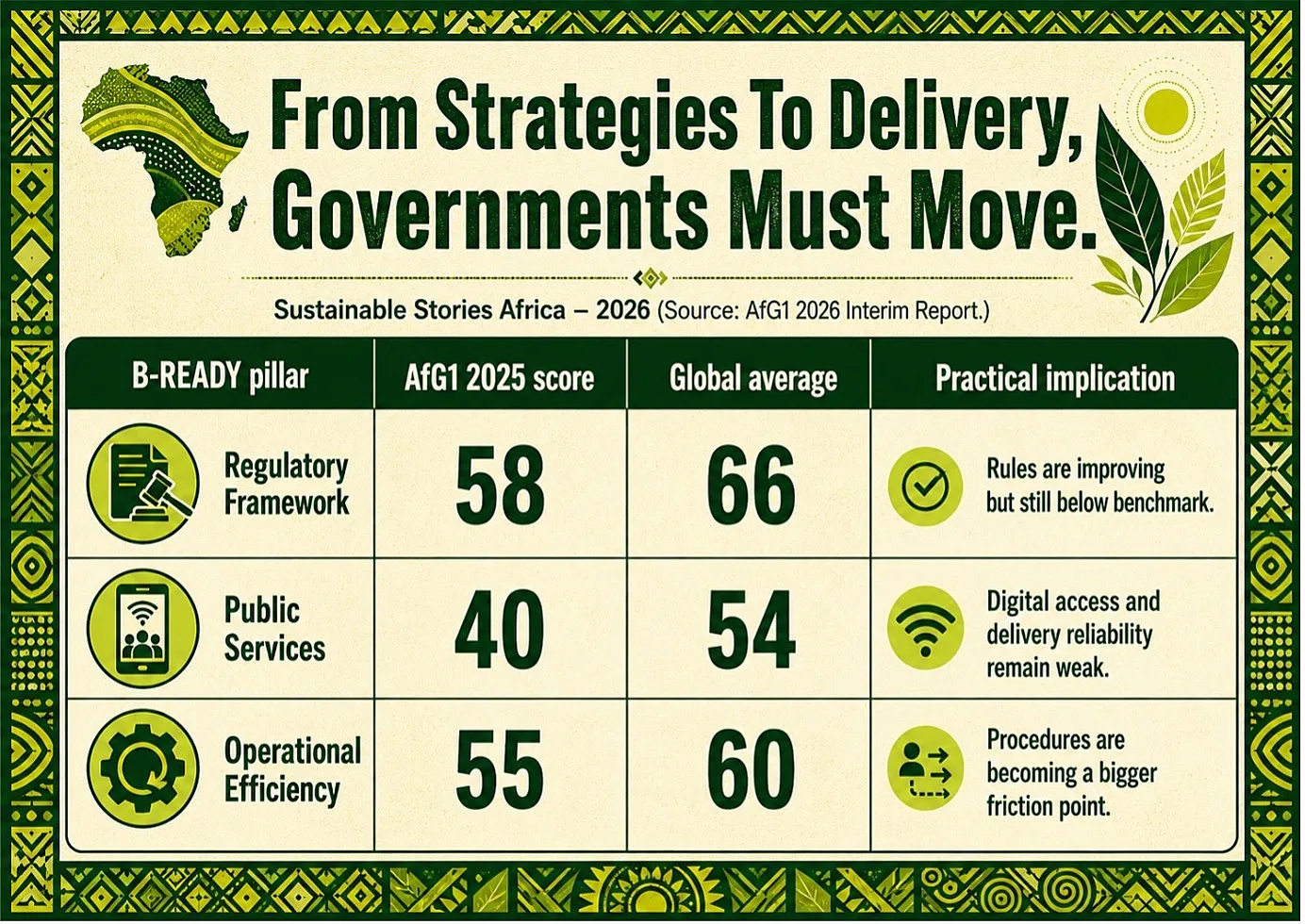
For businesses, this means the problem is no longer just whether laws exist.
It is about whether firms can get permits, clear customs, resolve tax issues and access services without repeated delays. Strong regulations cannot drive investment if public systems remain slow, fragmented or unpredictable.
The action agenda is therefore specific.
- Governments need credible fiscal anchors, stronger debt management, targeted social protection, faster project readiness and better procurement.
- Regulators need service standards and digital systems that work end-to-end.
- Financiers need pipelines that are bankable, climate-aware and implementation-ready.
The report also urges countries to mainstream the WBG Crisis Preparedness and Response Toolkit into country partnership frameworks and annual budget cycles.
The toolkit is already in use across 74 countries, including 32 in Africa, and combines instruments such as the Rapid Response Option, Cat-DDO and Contingent Emergency Response Projects.
For AfG1 countries, the next six months will be tied to turning advocacy into measurable outcomes: Mission 300 for electricity access, AgriConnect for food systems, AIM2030 for medical access and manufacturing, and stronger use of IDA21 windows such as PSW, GROW and CCW.
Path Forward – Build Buffers And Deliver Results
AfG1’s priority now is execution: fiscal anchors, faster disbursements, bankable energy and infrastructure pipelines, and public services that firms can trust.
The sustainability test is whether strategies will result in visible gains, jobs, cheaper power, stronger food systems and resilient health, water and social protection systems.
That is how development finance becomes measurable ESG progress.