Africa's integration challenge concerns what trade produces within economies as much as how much crosses borders.
A World Bank and AFD book argues that regional production networks can connect trade with industrial development.
Its blueprint combines value chains, lower trade frictions, deeper agreements and regional public goods.
Delivery depends on institutions and operating systems that make cross-border business workable.
Regional Integration Links Trade With Production
Africa can gain more from trade by establishing the production relationships sitting behind it.
Integrating Africa: From Threads to Hubs, by Woubet Kassa, Hiau Looi Kee and Jean-Christophe Maur, argues that the continent's trade openness has not translated into the industrial transformation achieved in other regions.
A 2026 report co-published by the World Bank, and Agence française de développement.
- It examines regional value chains, trade costs, agreements and public goods as interdependent parts of a development strategy.
For African firms and policymakers, the central issue is practical.
- A producer needs dependable electricity, compatible standards and affordable logistics alongside market access.
- Removing a tariff can improve one part of that journey while leaving the other constraints intact.
The report therefore links integration to the ability to process, manufacture and supply across borders.
Export Composition Explains The Development Disconnect
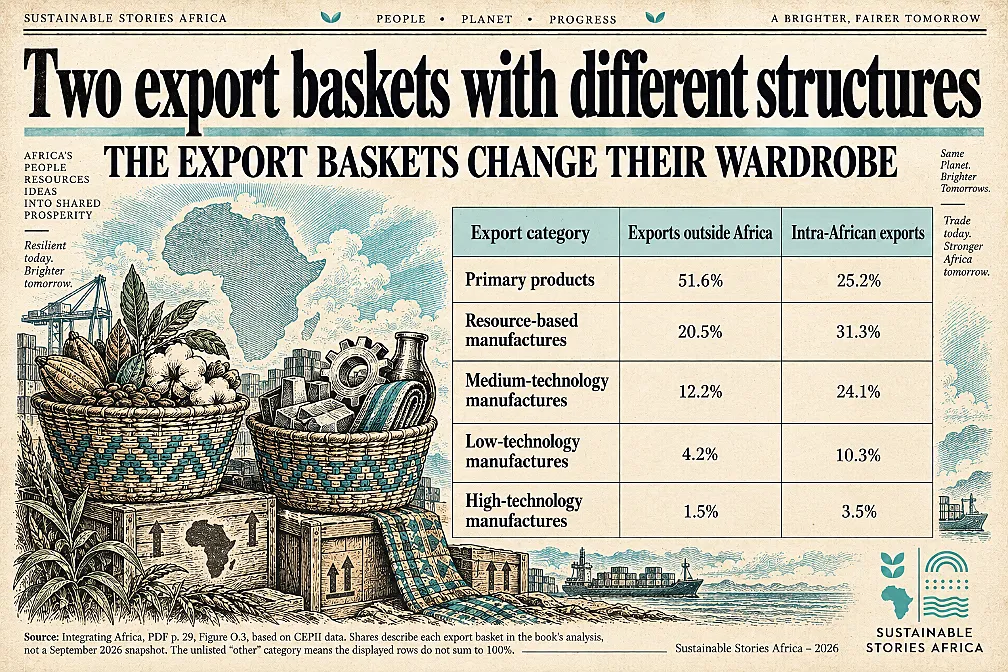
The report’s overview shows that intra-African trade accounts for around 15% – 17% of total exports and includes more processed and manufactured products than exports to the rest of the world.
- This composition matters because production activities can generate demand for suppliers, skills and services within the region.
Its trade-growth comparison illustrates why openness alone is insufficient.
- In 2015, sub-Saharan Africa and East Asia and Pacific both recorded trade-to-GDP ratios of approximately 56%.
- However, sub-Saharan Africa's GDP per capita was only 16% of the East Asian comparator.
These are historical observations used to explain a structural difference, not 2026 national accounts.
The conclusion is not that external trade lacks value.
- Commodity exports can generate revenue and employment.
The problem arises when extraction or primary production has limited connections with the rest of the economy, leaving local firms unable to participate in the more complex activities that follow.
Domestic Frictions Weaken Cross-Border Production
The authors estimate that about 60% of total trade costs arise from unilateral, or domestic, sources.
- These include institutional constraints, logistics problems and fragmented procedures.
- Bilateral differences in standards, permits and transit arrangements add further costs when goods cross a border.
The distinction changes how reform should be designed.
- A customs checkpoint may become faster while a producer still waits for documentation at home.
- A shared road can remain commercially unreliable if operating permissions differ across jurisdictions.
- Businesses experience the combined journey, so integration requires attention to the complete sequence.
The report uses interoperability to describe systems’ ability to work together.
- In plain terms, the information, licences, payments and logistics needed for a transaction should remain usable when it moves between countries.
- That requires cooperation among agencies whose responsibilities extend beyond trade ministries.
Deeper agreements can support these relationships.
- The overview cites research suggesting export gains of up to 56% from deep trade agreements, while shallow agreements deliver smaller gains.
- That figure is an estimate from cited research, not a guaranteed AfCFTA result.
- The scope and enforcement of commitments determine whether firms can rely on them when investing.
Regional Scale Can Expand Industrial Possibilities
Small national markets can struggle to sustain expensive production facilities.
- Regional demand offers a larger customer base, while complementary capabilities can distribute production stages across countries.
- One location may supply an input, another specialise in processing, and another provide logistics or technical services.
The report recommends combining nearer opportunities with more ambitious industrial investments.
- Agro-processing or basic manufacturing may build on existing capabilities with relatively modest support.
- More complex production may require coordinated infrastructure, new technical skills and a longer investment horizon.
- Treating every sector as equally ready risks misallocating limited public resources.
For communities, the potential benefit lies in the work created around production, including maintenance, packaging and transport.
- Those opportunities require deliberate links with local enterprises.
- An industrial hub can remain an enclave if purchasing, training and infrastructure decisions exclude surrounding firms and workers.
Regional public goods provide another shared benefit.
- Power connections, environmental management and digital infrastructure can serve several countries at once.
- Their value extends beyond an individual transaction, which helps explain why private investors may not finance enough of them without a credible public framework.
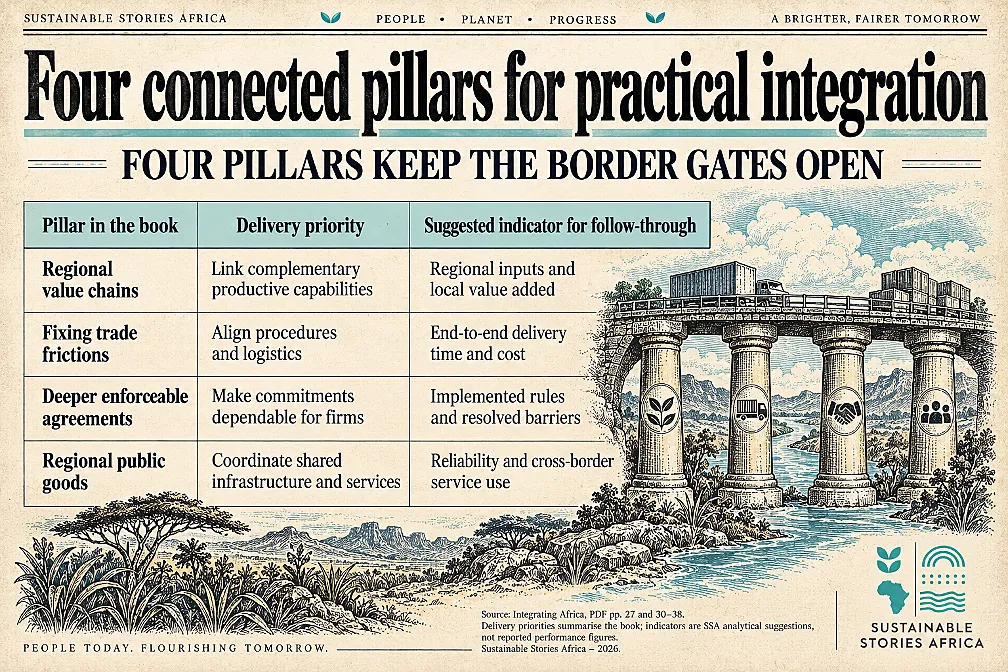
Make Integration Accountable To Firm Experience
Governments should identify specific production corridors and ask firms where transactions fail.
- Mapping these obstacles can reveal whether the binding constraint is electricity, working capital, customs procedures or product certification.
- A corridor programme should then assign responsibilities and publish progress on those constraints.
Regional bodies can support mutual recognition where appropriate and improve the predictability of transit arrangements.
- The objective is to reduce repeated administrative work while maintaining legitimate safety and environmental protections.
- Agreement should be accompanied by implementable procedures, trained officials and accessible information for smaller businesses.
Financiers need to assess shared infrastructure alongside the productive demand it will serve.
- A processing investment depends on input supply and market access; a transport investment depends on reliable operations and maintenance.
- Evaluating those dependencies together can reduce the risk of impressive facilities that remain underused.
Environmental and social safeguards belong within this delivery process.
- Communities should understand land-use implications, employment conditions and access to new infrastructure.
- Regional manufacturing also needs credible environmental information if it is to compete in markets demanding traceability and cleaner production.
Authorities should report outcomes that firms and workers can recognise.
- The number of agreements signed says little about whether a small exporter can complete an order.
- Indicators such as predictable delivery, supplier participation and value added retained in the region offer a more useful account of whether integration is supporting development.
Path Forward – Through Connected Regional Production
Africa's integration agenda should connect trade commitments with the everyday requirements of production.
Regional value chains need aligned procedures, dependable shared infrastructure and enforceable rules.
Governments and regional institutions should select feasible corridors, resolve their main operating constraints and publish measurable results.
The development test is whether firms can expand production and workers can gain opportunities, with environmental and community safeguards built into that expansion.