Research across sub-Saharan Africa finds that restoration can influence tree loss beyond project boundaries.
Natural regeneration and active restoration generally showed beneficial spillovers from the available dataset, while agroforestry showed greater risk of displaced pressure.
The findings argue for landscape-scale monitoring and locally designed safeguards.
They do not directly establish universal effects for every project or measure carbon and biodiversity outcomes.
Restoration Outcomes Extend Beyond Project Boundaries
Restoration can protect trees outside a project's mapped area, or shift land-use pressure into surrounding landscapes.
Restoration-driven positive and negative leakage in sub-Saharan Africa by Xinran Miao and colleagues examines this wider effect using a large geospatial dataset of restoration activity.
The paper was accepted in August 2026 and published online in Nature Sustainability on September 30, 2026.
- It is included here as a subsequent research update to the October 1 editorial edition, rather than presented as research published before that date.
For African restoration programmes and their financiers, the main finding changes the unit of accountability.
- Project boundaries alone may miss substantial benefits or harms.
- Assessing surrounding tree loss, livelihoods and land-use decisions can help establish whether an intervention improves the wider landscape rather than simply delivering visible activity within a funding boundary.
Tree Loss Can Move Across Landscapes
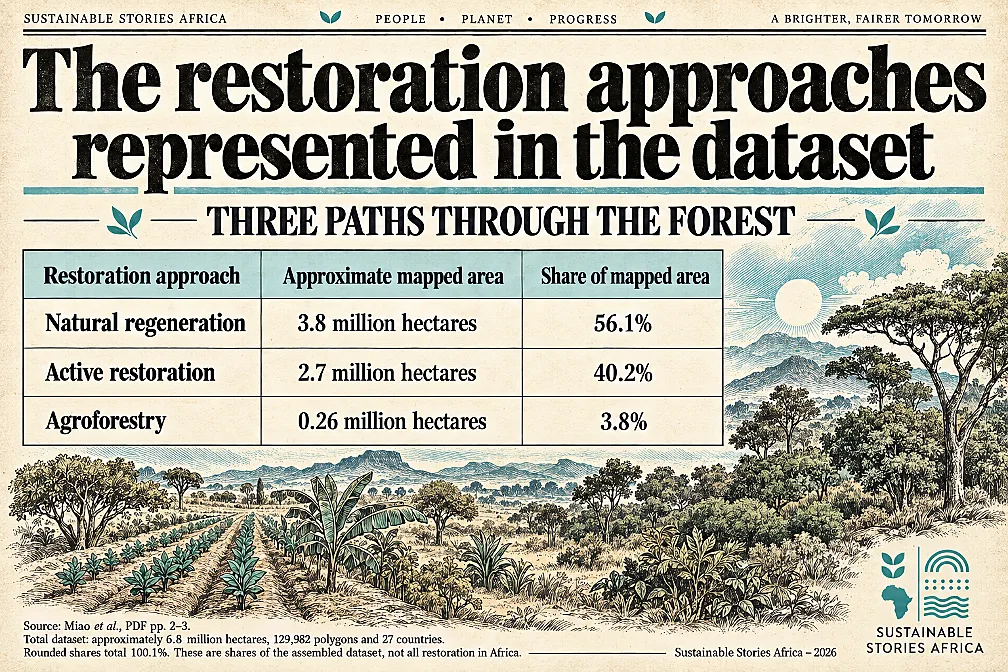
The authors assembled 129,982 restoration polygons covering approximately 6.8 million hectares across 27 countries.
- These polygons represented activity established between 1996 and 2023 and were grouped into 19,229 clusters.
- This database maps a large body of work, but it is not a complete inventory of African restoration.
Natural regeneration accounted for the largest share of mapped area, followed by active restoration and agroforestry.
- Kenya, Ethiopia and Cameroon together accounted for more than 85% of the area in the dataset.
- This concentration limits how confidently pooled results can describe the whole region.
The authors distinguish positive leakage, where restoration is associated with reduced tree loss nearby, from negative leakage, where pressure and loss increase elsewhere.
- In this terminology, “leakage” can therefore describe a beneficial spillover as well as a harmful displacement.
- Explaining that distinction prevents a reader from assuming that all leakage is undesirable.
Methods And Timelines Shape The Findings
The impact analysis retained 10,038 eligible clusters across 18 countries after filtering for suitable wooded landscapes and available records.
- The researchers compared tree-loss patterns before and after restoration with two types of controls: areas restored later and areas that were never restored but had similar measured characteristics.
These methods do not produce identical results.
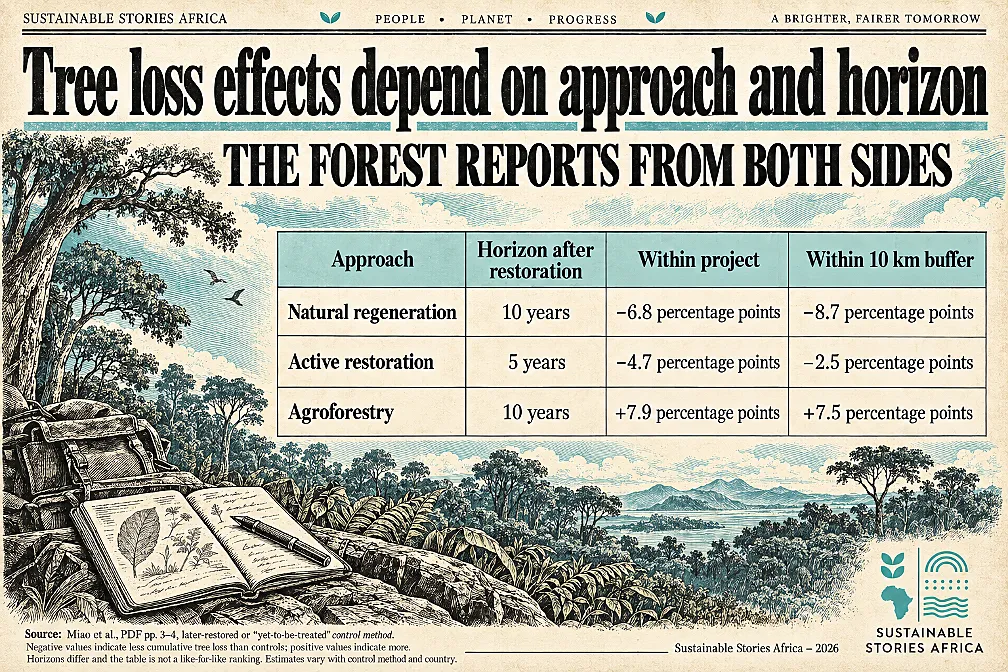
- Using later-restored areas as controls, natural regeneration was associated with 6.8 percentage points less cumulative tree loss inside projects after ten years and 8.7 points less within a ten-kilometre buffer.
- With matched never-restored controls, the estimates were 2.3 and 8.9 points, respectively.
Active restoration also showed beneficial patterns, although longer-term observations were sparse.
- Agroforestry generally showed the opposite pattern in this dataset.
- With later-restored controls, tree loss after ten years was 7.9 percentage points higher inside projects and 7.5 points higher in the ten-kilometre buffer.
These changes are percentage-point differences relative to controls, not percentages of hectares newly restored.
- The analysis uses satellite-derived tree-cover loss and does not directly measure tree-cover gains, net carbon sequestration or biodiversity recovery.
- A reduction in observed tree loss should not be converted into any of those outcomes without additional evidence.
Livelihood Support Can Strengthen Restoration Benefits
The study discusses several possible mechanisms behind beneficial spillovers.
- Restoration may supply fuelwood or other forest products, provide employment or support local conservation practices.
- Better conditions on existing farmland could also reduce pressure to clear elsewhere.
These are plausible explanations discussed by the authors, not mechanisms separately proven by the geospatial analysis.
Negative displacement can arise if an intervention reduces access to productive land or household resources without a viable alternative.
- For agroforestry, added trees may compete with crops in some settings, prompting expansion elsewhere.
- Outcomes depend on species, land-use history and management arrangements, which the study could not fully model.
Agroforestry therefore should not be dismissed as inherently damaging.
- The paper itself discusses contrasting experiences, including beneficial livelihood outcomes in a Kenyan programme and implementation difficulties elsewhere.
- Its pooled result identifies a risk that requires diagnosis, rather than a universal verdict on combining trees with farming.
The development opportunity is to design restoration around the people using the landscape.
- Secure tenure, suitable incentives and community involvement can make protection more durable.
- The ecological benefit of natural regeneration also deserves attention when funding models place greater emphasis on conspicuous planting than on the recovery and protection of native woody ecosystems.
Finance Restoration Across The Whole Landscape
Governments and project developers should assess existing land uses before selecting an approach.
- That assessment needs to identify how households obtain food, fuelwood and income, and what might change when restoration begins.
- Communities should participate in choosing arrangements that protect rights and provide workable alternatives where access changes.
Monitoring should extend beyond the project boundary and continue long enough to detect delayed effects.
- The study found that some patterns emerged after several years, while uncertainty increased at longer horizons because fewer projects had suitable records.
- Short funding cycles can therefore miss both harmful displacement and beneficial spillovers.
Carbon and restoration standards should incorporate credible leakage assessment without assuming that every measured reduction in nearby tree loss generates an issuable carbon credit.
- Baselines, additionality, permanence and carbon measurement still require their own evidence.
- Landscape benefits and financial claims need to remain connected through transparent methods.
Public reporting should also state the limits of satellite measures and coverage.
- The study excludes broader displacement beyond ten kilometres and cannot establish all ecological outcomes.
- Combining spatial monitoring with livelihood and field assessments can give decision-makers a fuller account of what changed and why, including whether benefits are shared fairly.
Path Forward – Through Accountable Landscape Restoration
Restoration programmes should monitor surrounding landscapes, protect land rights and address livelihood pressures.
Project success needs evidence of wider outcomes alongside activity inside the funded boundary.
African governments, communities and financiers should choose approaches that fit local conditions, and fund sustained monitoring.
The study supports careful leakage safeguards and recognition of native regeneration, while additional evidence remains necessary for carbon, biodiversity and long-term livelihood claims.