Africa's mineral endowment is substantial but uneven. A World Bank study argues that fragmented national strategies cannot fully connect those resources with processing, manufacturing and industrial development.
Its proposed developmental regionalism framework combines mineral intelligence, industrial capacity and regional production networks.
The opportunity depends on as much as governance, infrastructure, skills and geology, with communities sharing the benefits and environmental costs addressed.
Mineral Wealth Requires Shared Industrial Capabilities
Africa holds important minerals for low-carbon technologies; however, extraction alone does not secure industrial development.
Regionalising Green Transition Minerals for Structural Transformation in Africa, by Gideon Ndubuisi, Elvis Korku Avenyo, Solomon Owusu and Woubet Kassa, argues for coordinated regional strategies that connect minerals with productive capabilities.
A World Bank study dated October 2025, with maps marked November 2025. Its figures are historical estimates compiled from several sources, rather than a new September 2026 inventory.
The central issue for African and emerging markets is how to retain more value while building viable industries.
- The report describes substantial continental reserves alongside limited national bargaining power, weak technological capacity and infrastructure constraints.
- It proposes developmental regionalism: organising shared industrial and resource strategies around the capabilities of several countries rather than expecting each to develop a complete value chain independently.
Continental Abundance Masks Uneven Mineral Positions
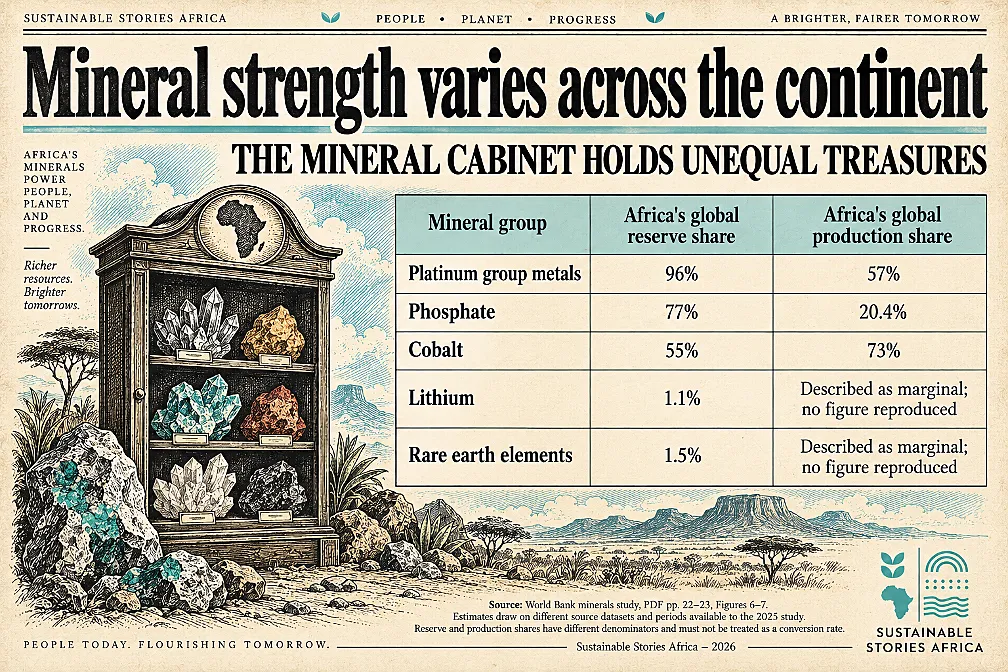
The study reports that Africa holds approximately;
- 96% of global platinum-group-metal reserves
- 77% of phosphate reserves
- 55% of cobalt reserves.
At the same time, its estimated shares of lithium and rare-earth reserves are only 1.1% and 1.5%, respectively.
- A broad statement about mineral abundance can therefore obscure large differences between materials.
The distinction between reserves and production matters too.
- Reserves are estimates of economically recoverable mineral stocks under relevant conditions; production measures extraction over a period.
- Neither directly measures refining capacity, manufacturing capability or the domestic value retained from an export.
The report maps 41 identified green transition minerals, finding verified African deposits, reserves or production for 36.
- It identifies at least one such mineral in 48 countries in its sample.
- That mapping shows geographic breadth; however, a known deposit is not equivalent to a commercially operating mine.
- Investment decisions still require geological and economic assessment.
Processing Depends On More Than Extraction
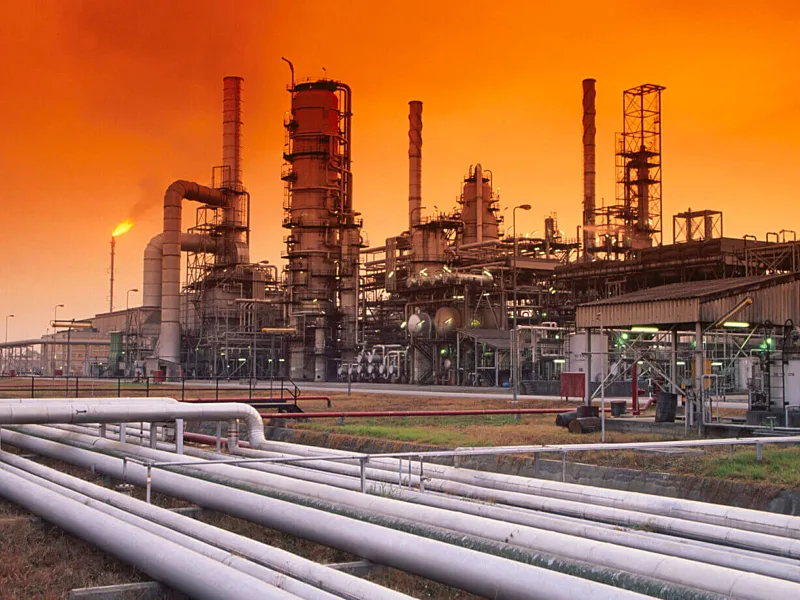
The report describes Africa as primarily supplying raw or partly processed minerals while much downstream activity occurs elsewhere.
- This limits opportunities for learning, specialist employment and supplier development.
- The constraint is industrial organisation as well as access to resources.
A processing plant needs reliable energy, suitable feedstock, technical expertise and a market for its output.
- Building it close to a mine may reduce one transport cost while creating other costs if power or logistics are unreliable.
- A national beneficiation target therefore needs a credible feasibility assessment and coordinated support.
The authors also examine foreign control of upstream activities and its influence on processing decisions.
- Long-term purchasing agreements and financing can shape where minerals move.
- African governments need to understand those commercial relationships when negotiating commitments on technology, supply chains and domestic participation.
Regional coordination can combine dispersed strengths.
- The report proposes linking mineral-producing areas with processing hubs and manufacturing capabilities.
- This does not mean that every country gains through the same activity.
- A smaller producer could participate through supplies, logistics or specialised services if the regional arrangements make that participation commercially workable.
Shared Production Can Broaden Development Benefits
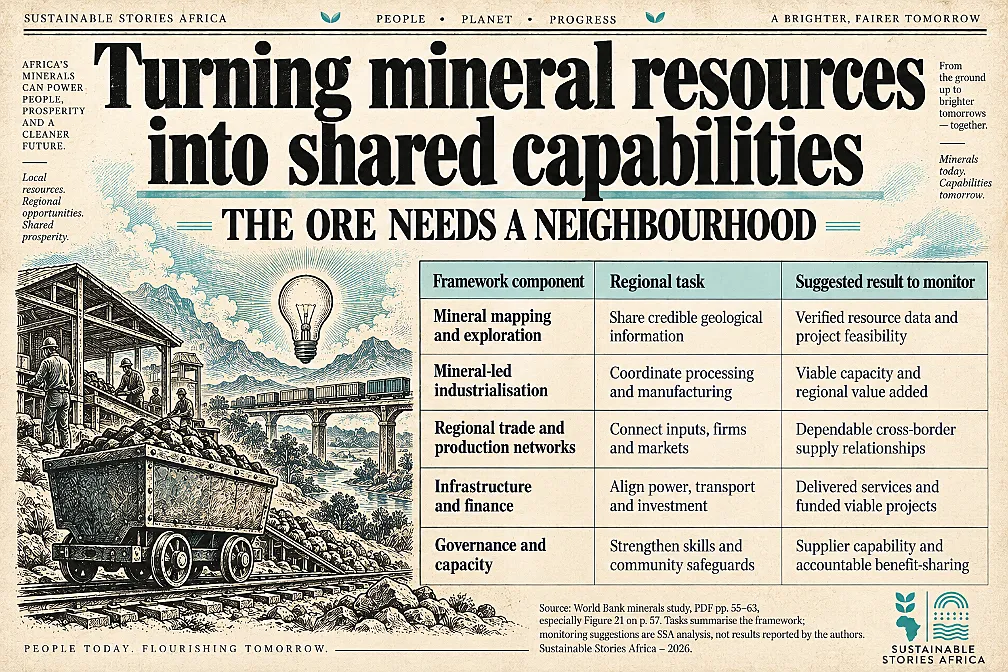
The report's multilayer framework begins with mineral mapping, exploration and extraction.
- Industrialisation and regional integration are the main drivers that link this resource base with structural transformation.
- Finance, infrastructure, security, skills and governance enable those relationships.
For African economies, the opportunity is to use mineral demand to develop capabilities that remain useful beyond a particular deposit.
- Technical maintenance, engineering, quality assurance and transport services can serve wider industries.
- These linkages require deliberate purchasing and training decisions rather than an assumption that growth in extraction automatically benefits nearby firms.
Regional projects can also reduce duplication.
- Two countries may obtain greater value from a viable shared facility than from separate plants operating below efficient scale.
- The trade-off is political: participants need confidence that costs, revenue and employment opportunities will be distributed through credible arrangements.
Environmental and social performance should be part of the industrial case.
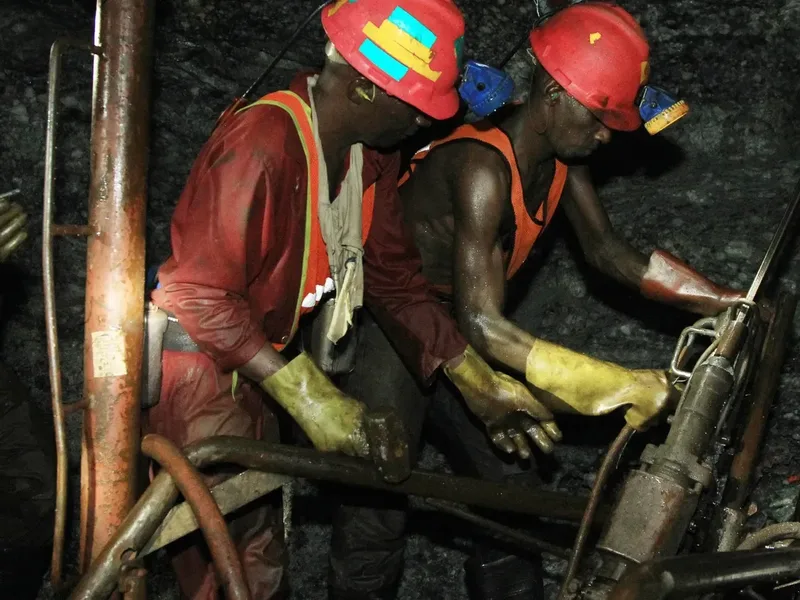
- A technology used in the green transition can still carry substantial local impacts through mining, water use and waste.
- Communities need meaningful participation, transparent benefit arrangements and protection of livelihoods.
- Calling a mineral “green” does not establish that its extraction is sustainable.
Coordinate Projects Before Imposing Industrial Targets
Governments should begin by matching mineral opportunities with industrial capabilities and realistic demand.
- Shared geological information can improve the quality of that assessment.
- Public support should prioritise projects whose costs, input supply and market assumptions withstand scrutiny, including changes in mineral prices and technology demand.
Regional institutions can help align transport arrangements, investment conditions and technical standards.
- They should also clarify how participating countries share benefits and resolve disputes.
- A memorandum on cooperation provides a starting point; operating agreements and accountable institutions make it dependable for investors and citizens.
Evaluate export restrictions and local-content requirements alongside the capacity they intend to develop.
- The report discusses such measures but also identifies weak infrastructure and fragmented implementation.
- Restricting raw exports without viable processing, financing and market access can create a bottleneck rather than a competitive industry.
Mining companies and financiers should disclose how procurement and technology transfer contribute to productive capacity.
- Training should link to identifiable technical roles, and supplier programmes should track manufacturing or service capability rather than domestic registration alone.
Community safeguards need clear responsibilities throughout project development.
- Baseline environmental information, water-use planning and credible grievance mechanisms support both public trust and project durability.
The report's regional strategy will be strongest when the distribution of value is visible, rather than expressed only as a continental ambition.
Path Forward – Through Regional Mineral Cooperation
African mineral policy should connect verified resource opportunities with shared infrastructure, industrial capabilities and regional markets.
Governments need feasible projects and enforceable cooperation, supported by finance and technical skills.
The next step is to identify complementary capabilities and agree transparent delivery and benefit-sharing arrangements.
Success should be measured through viable production, local supplier development and community outcomes, alongside credible environmental performance across the mineral value chain.