Nigeria's September power-sector developments combine distribution investment rules, a N728.9 billion bond issuance, state-market implementation and a $300 million renewable-energy fund.
The common test is delivery.
Debt settlement and dedicated investment mechanisms can address financial constraints, but households and businesses benefit only when they produce reliable service, workable regulation and affordable electricity access.
Power Reforms Face A Delivery Test
Nigeria's power-sector reforms are addressing several financing and governance constraints at once.
The September 2026 update from Udo Udoma & Belo-Osagie describes revised distribution investment rules, a second power-sector bond issuance, implementation of Edo's electricity market and the commercial launch of a distributed renewable-energy fund.
Its principal announcements occurred during September, including NERC's revised order on September 4 and the renewable-energy fund launch on September 22.
Relevant primary announcements confirm the NERC order, bond close and fund launch.
The stakes extend from generation companies to neighbourhood businesses.
- Clearing historical receivables can support liquidity, while ring-fenced network funds and renewable projects can address infrastructure needs.
- These measures operate at different points in the electricity system.
Their combined significance depends on whether financial progress reaches consumers through more dependable and accessible supply.
Dedicated Revenues Must Produce Better Networks
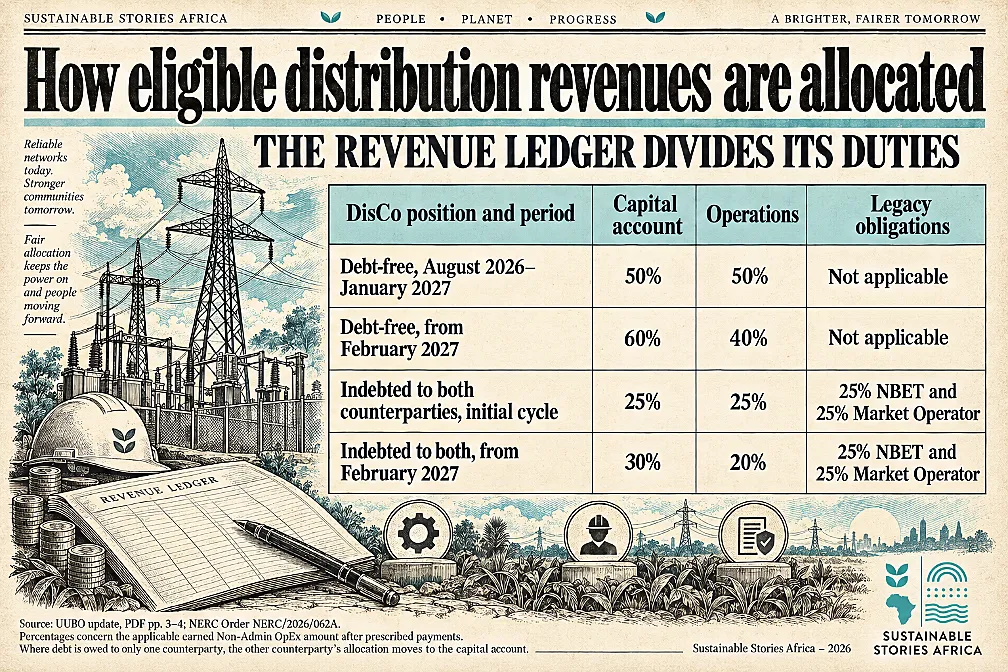
NERC's revised Order No. NERC/2026/062A introduces a dedicated capital-expenditure provision account for successor distribution companies.
- The order links earned non-administrative revenue allowances with eligible network investment, after applicable upstream invoices and administrative operating costs are paid.
The terminology needs care.
- For this instrument, non-administrative operating expenditure includes specified tariff building blocks beyond ordinary operating expenses, including depreciation and returns on investment.
- The prescribed percentages apply to the relevant earned amount under the order, not to every naira of gross customer collections.
For companies without outstanding market obligations;
- 50% is allocated to capital expenditure during the August 2026 – January 2027 market cycle, rising to 60% from February 2027.
- Indebted companies divide the initial amount across NBET, the Market Operator, capital investment and operations.
This structure attempts to balance network needs with debt settlement and ongoing service delivery.
Financial Restructuring Addresses Distinct Sector Constraints
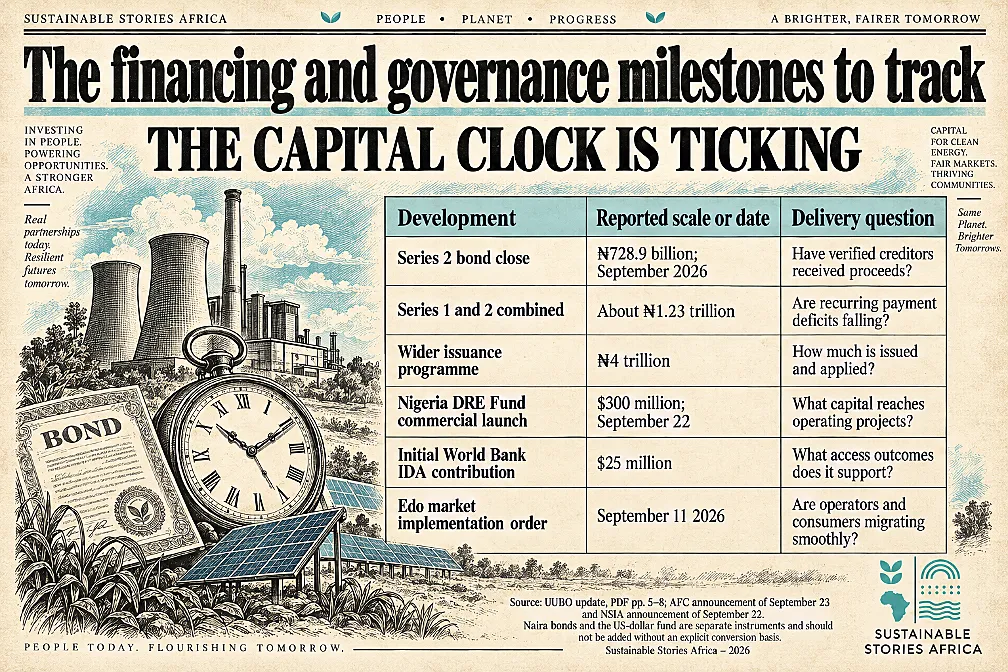
The federal government's N728.9 billion Series 2 bond issuance follows the N501 billion Series 1 transaction completed in January 2026.
- Together they total N1.2299 trillion, conventionally rounded to approximately N1.23 trillion, within a N4 trillion multi-instrument programme.
- The transactions seek to settle verified unpaid generation-company receivables for electricity supplied between February 2015 and March 2025.
The update reports that 11 generation companies participated in Series 2, compared with eight in Series 1.
- The relevant receivables amount to approximately 5,398 MW of generation capacity and 290,644.84 GWh of electricity billed during the historical period.
Neither figure represents new capacity installed or new electricity delivered by the bond.
- They describe the scope of historical obligations.
- Issuance also should not be confused with evidence that every creditor has received its full settlement.
The policy benefit depends on the use of proceeds and subsequent payment flows.
- Separately, the $300 million Nigeria Distributed Renewable Energy Fund entered its commercial-launch phase on September 22.
- Co-managed by NSIA and Africa50, it supports mini-grids and standalone solar systems, with an initial $25 million IDA contribution announced by the World Bank.
The launch establishes an investment platform; it does not establish that the full announced amount has been deployed.
Decentralisation Can Support More Responsive Electricity Markets
Edo's operational framework illustrates the governance side of reform.
- The update describes ESERC Order No. ESERC/ORDER/2026/001 and a process for existing NERC licensees to regularise, revalidate and obtain state instruments within 30 days, subject to the stated transitional arrangements.
The update also explains that existing tariffs, technical codes and consumer-protection instruments continue until ESERC changes or replaces them.
- The objective is continuity while the state develops its own operating framework.
- The change in regulator should therefore be assessed through licensing readiness and consumer service, rather than assumed to produce an immediate tariff or reliability improvement.
For businesses, the opportunity lies in clearer responsibility for local supply and investment.
- Distributed renewable-energy projects can complement grid improvements where traditional infrastructure has not met demand.
- A productive-use installation serving a market or workshop cluster may support economic activity if service and payment arrangements remain viable.
That example is an analytical application, not a completed project documented by the update. Affordability, maintenance and demand all influence whether an investment sustains useful service.
Network upgrades and renewable finance also need to link with customer protection so that improved infrastructure translates into a dependable relationship with users.
Connect Financial Progress With Consumer Outcomes
Regulators should publish the distribution of ring-fenced funds alongside project approvals, implementation and service outcomes.
- Eligible projects require oversight at specified stages, including a no-objection process and approval before contract award, while distribution companies must provide quarterly implementation reports.
That reporting can link expenditure with completed feeders, substations or other approved network work. Maintenance capacity also deserves attention as operational allocations decrease.
- A larger capital budget may be ineffective if companies cannot sustain equipment or respond to faults.
Debt-reform institutions should show how settlement improves payment discipline across generation and gas supply.
- Clearing an old stock of receivables can help, but new unpaid invoices would reproduce the liquidity problem.
- Public accountability should therefore track both historical settlement and the flow of new obligations.
DRE fund managers should report disbursement, commissioned assets, active connections and service reliability.
- Tariffs and productive uses belong alongside financial deployment figures.
- State regulators should maintain transparent licensing and complaint processes, with practical information for consumers during transition.
These measures give investors and citizens a common basis for judging progress.
The reform announcements identify tools; operational evidence must show whether those tools improve electricity access and the economic activity that depends on it.
Path Forward – For Reliable Affordable Electricity
Nigeria should link debt settlement, network investment and renewable finance with measurable service improvements.
Transparent project reporting and stronger payment discipline are essential to sustaining the reforms.
Federal and state institutions should protect continuity during market transition, while fund managers report deployed capital and functioning connections.
The most meaningful result will be reliable electricity that households and businesses can afford and use productively.