Latin American fintechs are connecting stablecoins with domestic payment systems to support remittances, business payouts and local-currency settlement.
Polygon's corridor report describes substantial activity, though its figures are ecosystem and company claims.
For Africa, the practical question is whether cheaper settlement reaches the customer after conversion, compliance and withdrawal costs.
Faster infrastructure still needs trustworthy institutions and usable local payment connections.
Payment Infrastructure Meets Everyday Financial Needs
Cross-border payments are becoming a practical application for stablecoins in Latin America.
Polygon's What LATAM Cross-Border Payments Look Like in 2026:
- Stablecoin Rails Are Upgrading Infrastructure Across the Region's Largest Corridors describes companies connecting blockchain settlement with local bank transfers and payment systems.
It profiles payment providers and wallets across Brazil, Mexico, Argentina and Colombia, presenting transaction volumes and business milestones alongside a commercial case for Polygon's network.
For African and emerging markets, the report offers infrastructure lessons rather than an investment recommendation.
- Stablecoins aim to maintain value relative to a reference asset, often a currency, but reliability depends on their structure, reserves and redemption arrangements.
The relevant development question is whether a payment can reach its recipient affordably and predictably and with a workable route for resolving problems.
Large Volumes Need Careful Comparable Definitions
The report says;
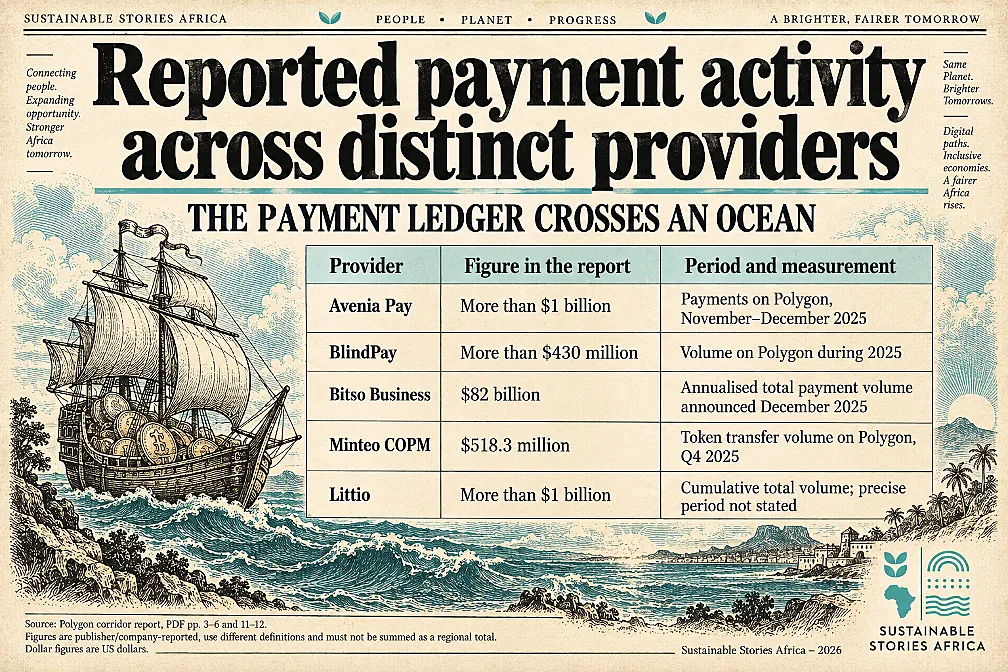
- Bitso Business announced $82 billion in annualised total payment volume in December 2025 and served 1,900 institutional clients.
- It also reports more than $430 million of BlindPay volume on Polygon during 2025.
These figures suggest business use beyond speculative trading, but they measure different things.
- Annualised volume projects a rate of activity over a year.
- It is not the same as payments actually completed during that calendar year.
- Blockchain transfer volume can also include operational movements between accounts rather than unique customer purchases or remittances.
Adding those figures together would be an unsupported market-size estimate.
Avenia illustrates the importance of linking local systems.
- Its infrastructure links settlement with Brazil's Pix and Mexico's SPEI
- Its BRLA token references the Brazilian real.
- A recipient's ability to use local money is central to the service: a fast transfer has limited value if conversion or withdrawal remains difficult.
Settlement Savings Differ From Customer Savings
The report makes a striking cost comparison:
- Paxos processed $1.3 billion on Polygon with less than $700 in total blockchain gas fees, against an estimated $32.5 million of traditional card interchange.
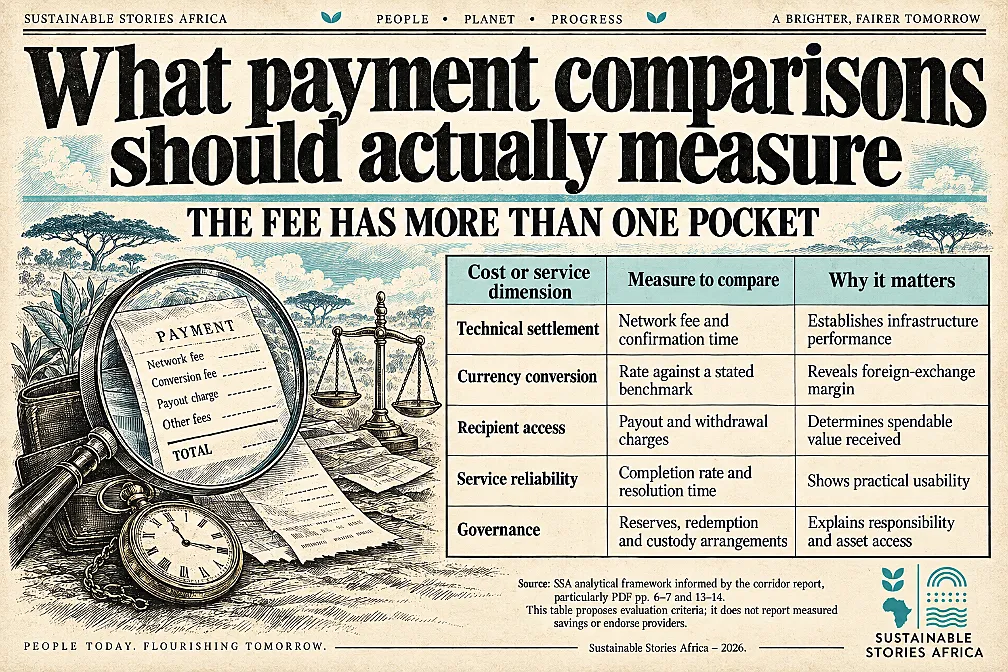
- The comparison supports a claim about cheap technical settlement, but it does not establish a like-for-like reduction in the full cost of providing a payment service.
Gas fees pay for a blockchain transaction.
- Interchange supports a different payment arrangement, and a customer's final price may also include foreign-exchange margins, platform charges, compliance costs and access to cash or a bank account.
- The report's claimed 99.998% saving should therefore not become a headline promising that level of household savings.
Its own examples demonstrate the difference.
- Belo is described as charging approximately 2%, even when network transaction costs are fractions of a cent.
- The platform's fee, rather than the underlying network fee alone, is the relevant starting point for someone receiving international income.
The same care applies to remittances.
- The report contrasts sub-1% stablecoin fees in the US – Mexico corridor with a 6.49% traditional remittance benchmark attributed to World Bank data.
- The benchmark is not established there as a matched service in the same corridor.
- A credible consumer comparison must specify the amount, currencies, payout method and exchange rate on both sides.
Local Connections Can Make Inclusion Practical
African payment providers can reduce friction in ordinary transactions.
- A small exporter may need confirmation that a customer has paid before shipping.
- A remote worker may need proceeds in a spendable local currency.
- A family receiving support may need a reliable cash-out option, not a new digital balance alone.
These are illustrative African applications, not outcomes measured in the Latin American report.
- They show why the local payment links matter as much as international settlement.
- Access to accounts, clear pricing, and dependable customer support determine whether faster infrastructure becomes useful financial access.
Local-currency stablecoins offer another approach.
- The report describes Colombian peso and Brazilian real tokens alongside dollar-linked products.
- A currency reference can reduce one kind of conversion need, but does not remove liquidity, reserve, custody or exchange-rate risk elsewhere in the transaction.
The social and governance dimensions should guide the assessment.
- Financial inclusion improves when recipients understand the service and can recover from errors
- A network's low fee is only a single component of that experience.
- Promised yields and tokenised investment products also involve different risks from a straightforward payment and should not be presented as equivalent services.
Test Payment Corridors With Transparent Governance
Regulators and providers should start with clearly defined use cases and applicable authorisation requirements.
- A supervised pilot can compare identical payment amounts and payout methods with existing services.
- It should disclose the final local-currency amount received, every fee and the time between initiation and usable funds.
Reserve and redemption arrangements need equal attention.
- Users should know the issuing entity, how assets are held, who controls access and what happens if a provider fails.
- Operational safeguards should address mistaken transfers, fraud and interruptions, with responsibilities explained before a customer commits money.
Business customers should also assess whether a service can handle reporting, reconciliation and compliance obligations.
- Faster settlement may improve liquidity, but weak records can create another administrative burden.
- Integration with familiar accounts and clear transaction histories can matter more than adding a technically sophisticated feature.
Development institutions can support comparative evidence that is independent of network promotion.
- Useful results would distinguish cost reductions attributable to settlement from those arising through scale, pricing or local partnerships.
- The Latin American report demonstrates commercial interest; African implementation still requires local evidence on affordability, access and trust.
Path Forward – Through Affordable Trusted Payments
African payment innovation should be judged by the usable value delivered to customers.
Lower settlement fees are promising when enabled with fair conversion, dependable payouts and clear rights.
Providers and regulators should publish comparable corridor evidence and address reserves, redemption and service failures.
Latin America's experience offers design lessons, while local testing must establish whether the infrastructure improves affordability and access for African businesses and households.