The World Economic Forum argues that climate and nature finance needs actors who can build investable markets and fund projects.
Its catalysts combine patient money with expertise, networks and institutional support.
For Africa, the opportunity lies in addressing the specific barriers that keep useful solutions from scaling.
Assessing financial mobilisation sits alongside functioning services, credible environmental outcomes and fair treatment of communities.
Climate Finance Requires More Than Capital
Closing climate and nature investment gaps requires institutions that can make viable solutions easier to finance and sustain.
The World Economic Forum's The Catalysts: Unlocking Markets for a Sustainable Economy examines how foundations, family offices, impact investors, and selected institutional investors can support that process.
An August 2026 white paper. It presents 8 catalytic roles and 11 cases across ocean, forest and energy systems, arguing for more deliberate combinations of financial and non-financial support.
For African and emerging markets, the relevant question is what prevents a solution from becoming dependable and investable.
- An energy business may need early risk capital, including capable managers, credible operating data and a workable regulatory environment.
The report's central insight is that different constraints require different interventions, and a funding deal alone may leave essential parts of the system unresolved.
Global Investment Needs Exceed Existing Financial Flows
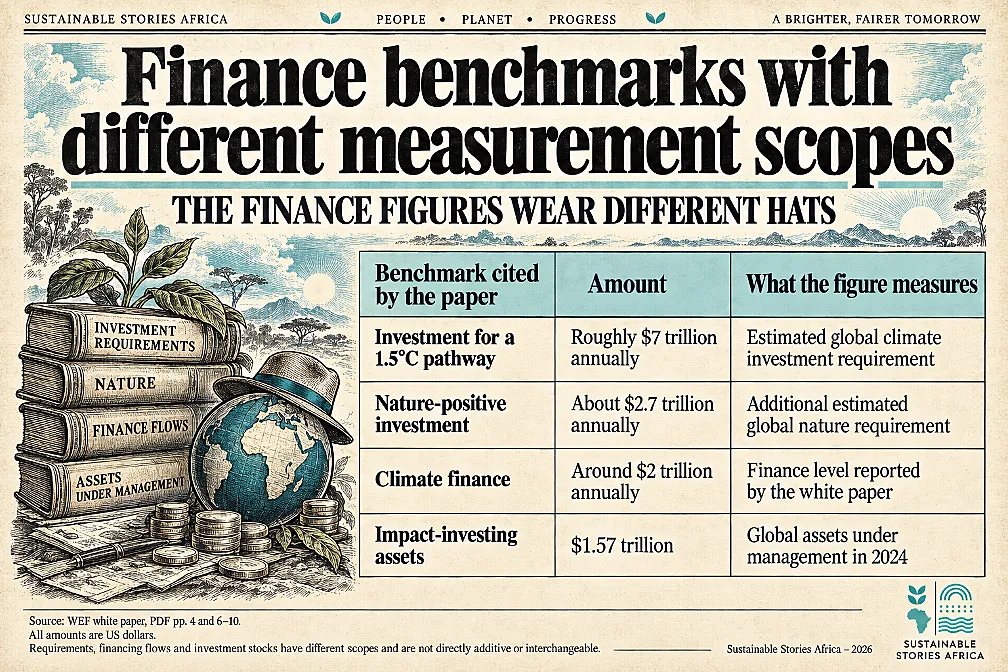
The white paper estimates annual investment needs of roughly $7 trillion for a 1.5°C climate pathway and another $2.7 trillion for a nature-positive economy.
- It reports climate finance of around $2 trillion a year.
These figures are broad estimates with different scopes and should not be combined into a precise single funding-gap calculation without examining the underlying methodologies.
The report also cites $1.57 trillion in impact-investing assets under management in 2024.
- Assets under management are a stock of investments, whereas annual financing is a flow.
- The figure is not fresh money available each year to meet climate needs, nor does it mean all impact assets target climate or nature.
These distinctions sharpen the debate about African financing.
- The challenge is not simply to identify large pools of capital.
- Investors need opportunities with credible delivery, measurable outcomes and arrangements that match their risk and return requirements.
- Catalytic actors can help develop those conditions where commercial finance is reluctant to enter initially.
Catalytic Roles Address Specific Market Bottlenecks
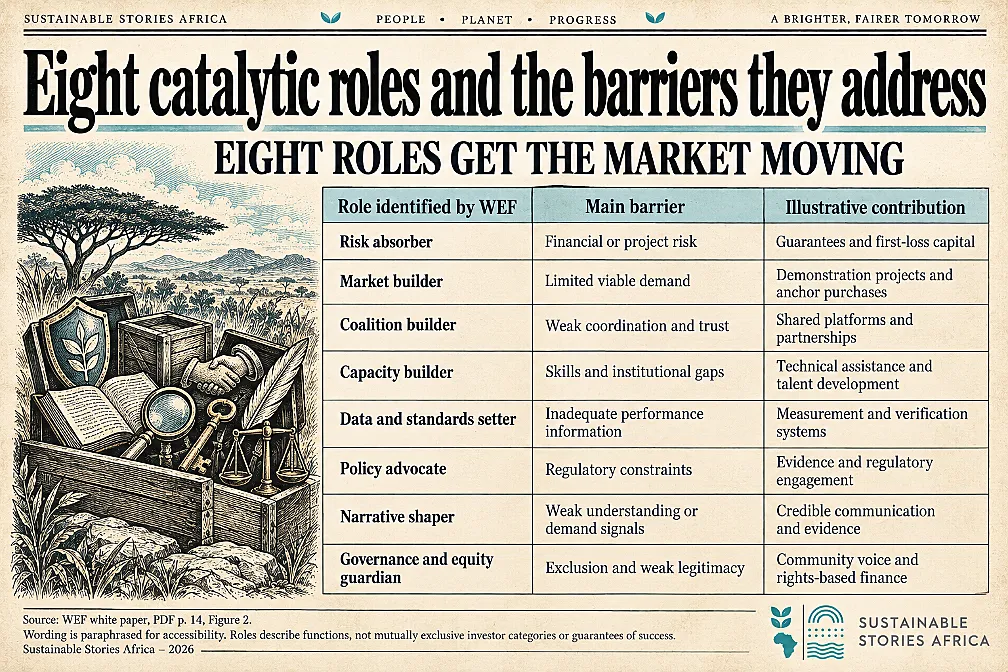
The report identifies 8 roles, ranging from risk absorption and market development to governance and equity protection.
It stresses that the categories overlap: one organisation can perform several roles, and an effective initiative may require several actors working together.
- Risk absorption can involve first-loss finance or guarantees.
- Capacity development can support operational skills and local institutions.
- Data and standards can make performance easier to assess, while coalition-building can coordinate actors whose individual actions would otherwise remain disconnected.
These non-financial contributions matter because a viable technology can struggle in a weak delivery system.
- A financier may understand a project's capital cost and lack reliable evidence about customer demand or operating performance.
- Supporting that evidence can improve decisions across a market rather than only subsidising one transaction.
The report describes the Global Accelerator for Earth Action (GAEA) as a convening platform that connects catalytic actors.
- It is not presented as a fund deploying its own capital.
That distinction should remain clear when discussing available institutional support and which organisations hold the actual financing responsibility.
Patient Support Can Expand Useful Services
The Acumen case illustrates a support sequencing.
- By 2021, its Pioneer Energy Investment Initiative had deployed early-stage equity into twelve companies that reached 1.25 million people and attracted $128 million in follow-on capital, according to the white paper.
- The case links patient investment with technical assistance, sector evidence and partnerships.
These outcomes are case-study claims, not proof that the same financing structure will produce identical results elsewhere.
- Nevertheless, they offer a practical account of how early support can improve a company's ability to attract later finance.
- African off-grid energy enterprises feature within the broader experience discussed by the report.
The Indian Self-Employed Women's Association case highlights another mechanism.
- A 25% first-loss guarantee supported financing for 600 solar pumps, after which Bank of Baroda extended loans for 15,000 additional pumps.
- Training and community-linked financial arrangements accompanied the finance.
The lesson for African productive-use projects is to assess customer livelihoods and delivery capability together, while testing suitability locally.
GEAPP provides a broader partnership example.
- The report says the alliance mobilised more than $1 billion in clean-energy finance, supporting 130 projects across forty countries, alongside livelihoods for more than 600,000 people.
- Livelihood support is not the same metric as jobs created.
- Its account of worker retraining associated with South Africa's Komati transition also illustrates why social support belongs within energy investment planning.
Direct Catalytic Support Towards Verifiable Constraints
African governments, investors and philanthropies should identify the specific barrier before selecting a financing instrument.
- If a developer lacks evidence of demand, a guarantee may not solve the problem.
- If the constraint is regulatory uncertainty or a weak service organisation, technical and institutional support may be needed alongside money.
Partnerships should define responsibilities and an achievable sequence of support.
- Early grants may fund design or capacity development; patient investment may help establish operational performance; commercial finance may enter once evidence and risk arrangements improve.
- This sequence should be adapted to the project rather than presented as a fixed formula.
Fund managers should report both financial mobilisation and delivered outcomes.
- Appropriate measures may include active energy connections, service reliability, verified environmental performance or the distribution of livelihood benefits.
- Announced commitments, funds raised and capital actually deployed are separate stages and should remain separate in reporting.
Community participation needs a concrete role in governance.
- Projects affecting land, livelihoods or public services should disclose how people are consulted, how benefits are distributed and how concerns can be addressed.
- Private returns do not by themselves demonstrate that a transition is fair.
The report's future-facing cases require particular care.
- Plans to mobilise $125 billion through the Tropical Forest Forever Facility are ambitions, not completed fundraising totals.
- Similarly, planned early coal-plant retirement represents a future commitment until closure and replacement arrangements are delivered.
Catalytic finance earns credibility through evidence that supports changed outcomes and leaves stronger institutions.
Path Forward Through Accountable Catalytic Partnerships
African climate and nature investment should match financial and institutional support to clearly identified barriers.
Patient capital is most useful when paired with dependable delivery capabilities.
Governments, philanthropies, and investors should agree on measurable responsibilities and report on deployment, services and community outcomes.
The aim is to develop viable markets that can sustain useful solutions while maintaining financial discipline, environmental integrity and fair participation.