
The World Economic Forum’s September 2026 maker-skills white paper argues that physical capabilities remain essential to AI infrastructure, clean energy, manufacturing and food systems.
Digital technology is changing these occupations rather than removing the need for practical expertise.
For Africa, the opportunity lies in connecting hands-on learning with modern tools, recognised competence and better career progression.
Training systems must also reach workers whose skills were acquired informally.
Physical Skills Underpin The Emerging Economy
Building the future economy requires people who can install, operate, maintain and repair its physical systems. The World Economic Forum’s New Economy Skills: Skills for the Maker Economy, published in September 2026, places these capabilities at the centre of investment and workforce planning.
The paper defines maker skills through three groups of practical capabilities:
- Constructing and installing;
- Operating equipment and machinery;
- Handling and processing material resources.
Its analysis connects these skills with agriculture, manufacturing, logistics, energy and the infrastructure behind digital services.
For African markets, SSA’s analysis is that practical competence should be treated as an investment requirement.
- New equipment creates lasting value only when people can use and maintain it.
- Education, apprenticeship and recognition systems therefore need to evolve alongside plans for infrastructure and industrial development.
Maker Employment Reveals A Large Opportunity
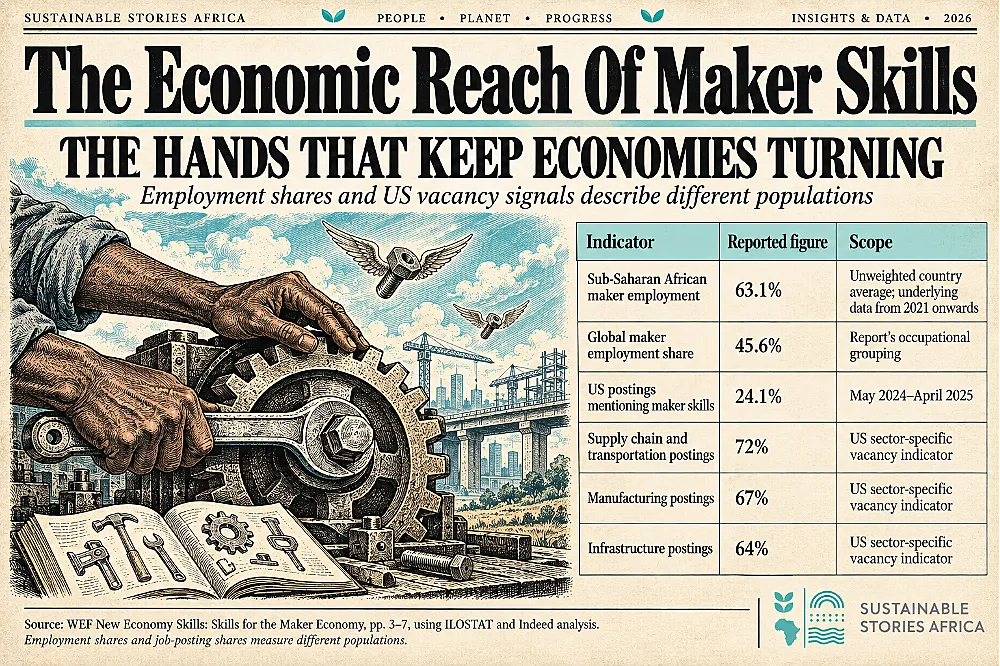
The report finds that maker occupations account for more than 60% of employment on average across countries in Sub-Saharan Africa, Southern Asia and South-East Asia.
- It also reports that these occupations represent 45.6% of global employment.
These findings use the report’s occupational grouping and should not be read as a count of only formally certified tradespeople.
The importance of maker skills is visible in a different dataset: US job postings.
- An Indeed analysis covering May 2024 to April 2025 finds that 24.1% mention maker skills.
- The share rises to 72% in supply chain and transportation;
- 67% in manufacturing;
- 64% in infrastructure.
These are US vacancy indicators, not African hiring rates.
SSA’s inference is that African industrial strategies should ask which capabilities each proposed investment requires locally.
That assessment needs to include maintenance and repair after construction, rather than focus solely on the initial installation phase.
Digital Change Raises Practical Skill Requirements
The paper argues that digitalisation is reshaping physical work.
- Makers increasingly interact with sensors, software, AI and automated equipment.
- Across the countries analysed, 57% report needing stronger AI skills to remain relevant.
That result describes a perceived learning need, rather than demonstrated proficiency or a uniform requirement across every trade.
- An illustrative technician maintaining a solar installation may need practical wiring competence alongside an understanding of monitoring data.
- A worker in food processing may need to operate machinery and interpret digital quality records.
The useful combination depends on the task and the consequences of error.
The report challenges assumptions that physical abilities are uniformly easy to automate.
- It finds lower predicted automation risk among occupations requiring stronger motor and sensory abilities.
- These estimates depend on analytical methods and occupational requirements; they do not establish that any particular job is protected from change.
SSA recommends teaching digital tools through practical applications.
- A generic AI introduction is less useful to a maintenance worker than supervised learning on interpreting equipment information, verifying suggestions and identifying when specialist support is needed.
- Digital competence should reinforce safety and judgement.
The paper also reports associations between skill proficiency and wages in its analysis.
- Such associations do not prove that a course will cause a specified pay increase for an African worker.
- Employment opportunities, employer practices and the local market determine whether improved skills translate into higher earnings.
Inclusive Training Can Expand Skilled Participation
The pipeline faces several constraints.
- Across regions, women represent an average 30% of makers, compared with 49% of other workers.
- Only 13% of boys and 4% of girls in the analysed student data expect to enter maker occupations.
The report presents these patterns as signs that potential talent is being missed.
Ageing is more pronounced in several regions outside Africa.
- The paper reports that workers aged 55 and above account for 20% – 35% of makers in Asia, Europe and Northern America
- Africa is the main exception, with less than 15%.
Africa’s younger workforce does not remove the need for good training and attractive careers.
Inclusion needs practical changes.
- Women entering technical occupations may need safe facilities, suitable equipment and fair recruitment.
- Workers from low-income households may need paid learning opportunities.
- People already working in informal settings need a route to demonstrate competence without being required to restart their careers.
The paper notes that informal apprenticeships account for substantial shares of surveyed apprentices in countries including Nigeria, Lesotho and Tanzania.
- It argues that useful skills acquired through practice often lack portable recognition.
Recognising prior learning can help employers assess ability and workers pursue better opportunities.
Employers And Educators Must Share Responsibility
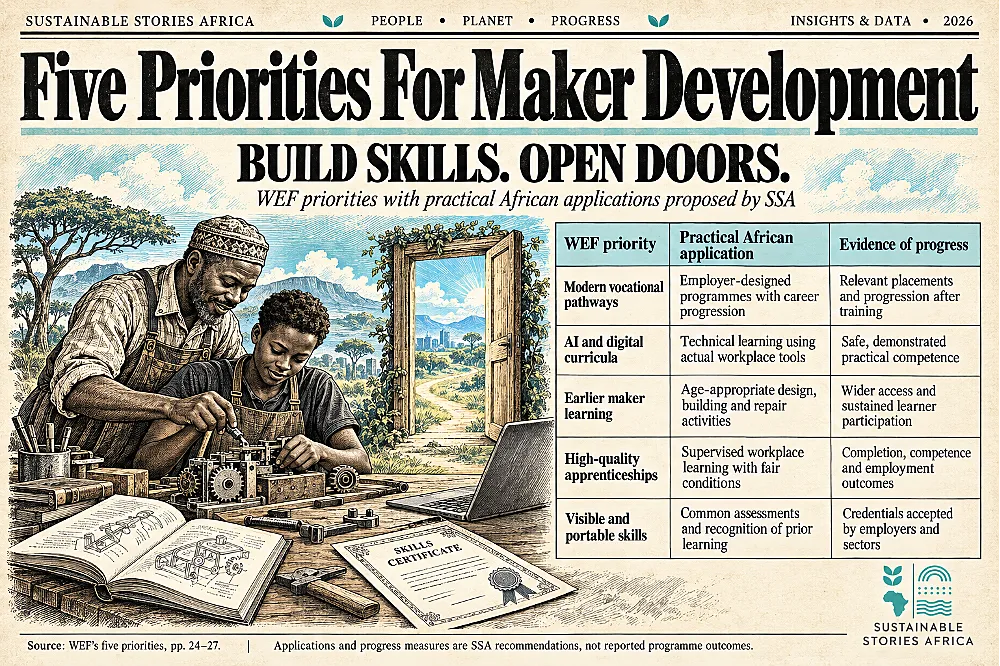
The report calls for employers, educators and governments to improve vocational pathways, integrate digital skills, start practical learning earlier, expand high-quality apprenticeships and make skills visible and portable.
- It emphasises equipment, instructors and institutional links with industry.
SSA recommends beginning with the skills required by actual projects and local businesses.
- Employers should identify recurring technical needs and participate in assessment.
- Training providers should use equipment relevant to the workplace and support instructors in maintaining current expertise.
- Smaller enterprises may need sector associations to represent their requirements.
Apprenticeship quality should be judged through supervision, learning content, safety and fair conditions.
- A worker spending time at a site has not necessarily received structured training.
- Programmes need explicit competencies and assessments that show what a learner can do without unsafe shortcuts.
Recognition systems should value existing experience while verifying it.
- Practical assessments can help skilled workers demonstrate competence, with additional training where gaps are identified.
- Credentials should describe capabilities clearly enough for employers to use them in recruitment, progression and pay decisions.
Governments can connect these priorities with infrastructure and procurement planning.
- Projects should identify workforce requirements early and support training routes that continue beyond a single contract.
- Outcome reporting should examine employment, earnings and progression where feasible, alongside the number of people enrolled.
Path Forward – For African Maker Capabilities
African economies should connect investment plans with practical training, digital competence and recognised skills.
Employers and educators need shared standards, modern equipment and supervised learning routes.
Accessible apprenticeships and recognition of prior learning can widen participation.
The objective is a workforce able to build, maintain and improve essential systems, with safer work and credible opportunities for progression as the physical economy changes.