
Telesat’s Africa telecom guide presents carrier-grade low Earth orbit networks as a way to extend terrestrial services into difficult-to-reach locations.
Its argument centres on integration, service control and measurable performance.
For African operators and communities, the test is broader than satellite coverage.
A viable deployment must also account for affordability, reliable power, national permissions and the quality of service that people can actually use.
Africa Connectivity Expansion Needs Operational Integration
Satellite links could help African telecom operators reach places where extending fibre or microwave networks is difficult.
The 2026 guide from Telesat argues that carrier-grade low Earth orbit, or LEO, connectivity should work within operators’ existing service and management systems.
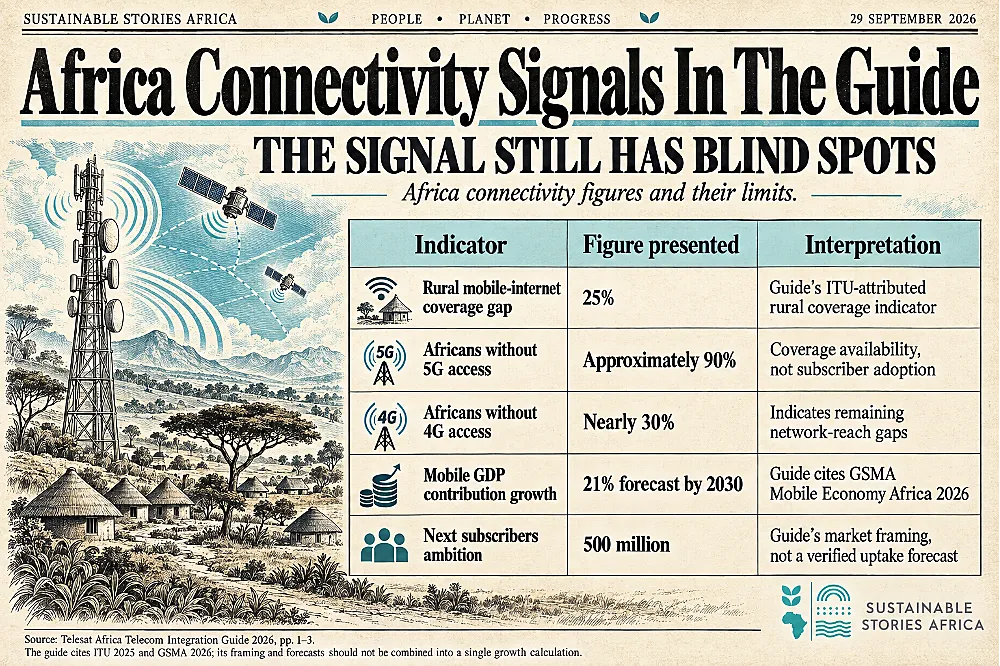
The guide’s ambition to reach Africa’s next 500 million subscribers frames the potential market, rather than a documented forecast of additional subscriptions or a commitment that one network will deliver them.
It is also a vendor publication promoting Telesat Lightspeed, so its capability claims require attribution and independent evaluation.
SSA’s analysis is that the development opportunity depends on delivery at ground level.
- A satellite connection must translate into dependable, affordable service for households, businesses and public institutions.
- That requires terrestrial infrastructure, trained operators and a viable operating model alongside capacity in space.
Coverage Gaps Explain The Expansion Opportunity
The guide reports that roughly 90% of Africans lack 5G access and nearly 30% lack 4G access, attributing those figures to the International Telecommunication Union’s 2025 Africa regional assessment.
- It also presents a rural mobile-internet coverage gap of 25%.
- These are coverage indicators cited by the vendor, not measurements of everyone’s actual internet use.
The distinction is important.
- Extending coverage can make a service technically available, but people may still face device costs, data prices, unreliable electricity or a lack of relevant services.
- An operator’s business case should therefore assess demand and affordability alongside engineering feasibility.
LEO satellites operate closer to Earth than traditional geostationary satellites.
- The guide focuses on their potential use for mobile backhaul, enterprise connectivity and resilient network extensions.
- Backhaul is the connection linking a local access site to the operator’s wider network; it is different from selling a satellite terminal directly to every household.
Network Architecture Determines What Customers Experience
The guide describes carrier-grade satellite service as an extension of familiar network operations.
- It emphasises standards-based interoperability, management interfaces and the ability to provision and monitor services across terrestrial and non-terrestrial resources.
- Its reference points include Mplify Alliance MEF 3.0 Carrier Ethernet and lifecycle service-orchestration interfaces.
An illustrative rural health facility may need a stable connection for records, consultations and supplies.
- Its needs differ from a mining operation transferring large files or a mobile site carrying several communities’ traffic.
- An operator should define the required service and peak demand before selecting a network solution.
Latency, throughput, packet loss and jitter matter in different combinations.
- A high advertised download rate does not establish reliability for an interactive application.
- Service-level commitments, monitoring and support arrangements should specify what performance is being contracted, where it is measured and how failures are remedied.
Operational control also matters.
- The vendor argues that operators should be able to manage capacity pools, support different service classes and use standardised interfaces.
- These are capabilities to test during procurement and integration, rather than benefits that should be assumed from the LEO label.
Telesat states that Lightspeed is intended for operators, service providers and governments, rather than direct consumer retail, and offers a network emulator for evaluation before full operations.
- The guide does not establish that its complete commercial network was already operational in Africa.
SSA’s inference is that laboratory testing should lead to field evaluation of the whole service.
- Terminals, site power, ground connectivity, support procedures and user demand all affect the outcome.
- A well-performing link cannot compensate for a base station that lacks reliable electricity or an operating budget.
Meaningful Access Can Improve Local Services
Better connections could support commerce, education, public services and operational continuity in remote locations.
- The benefits depend on the relevant institutions having the equipment, staff and recurring funds to use the service.
- Coverage alone does not demonstrate that learning, health or income outcomes improve.
For small businesses, reliable connectivity can make digital payments and customer communication more practical.
For operators, backhaul satellite could provide an additional option where terrestrial expansion is uneconomic or temporarily disrupted.
- Neither proposition eliminates the need to compare costs with available alternatives.
Environmental assessment should also be specific.
- Site energy, equipment life, maintenance and the wider resource footprint belong within the comparison.
- A deployment should be judged against the service it replaces or enables, with clear boundaries, rather than described as sustainable simply because it avoids one form of construction.
The strongest public-interest case connects technical performance with access.
- Contracts and monitoring can identify whether service is dependable, whether prices are workable and whether smaller institutions receive support to participate.
Operators Must Test Claims Before Commitment
SSA recommends evaluating total operating cost over the intended service life.
- This includes equipment, installation, bandwidth, power, licensing, integration, maintenance and support.
- Costs should be compared using consistent capacity and reliability assumptions across satellite and terrestrial options.
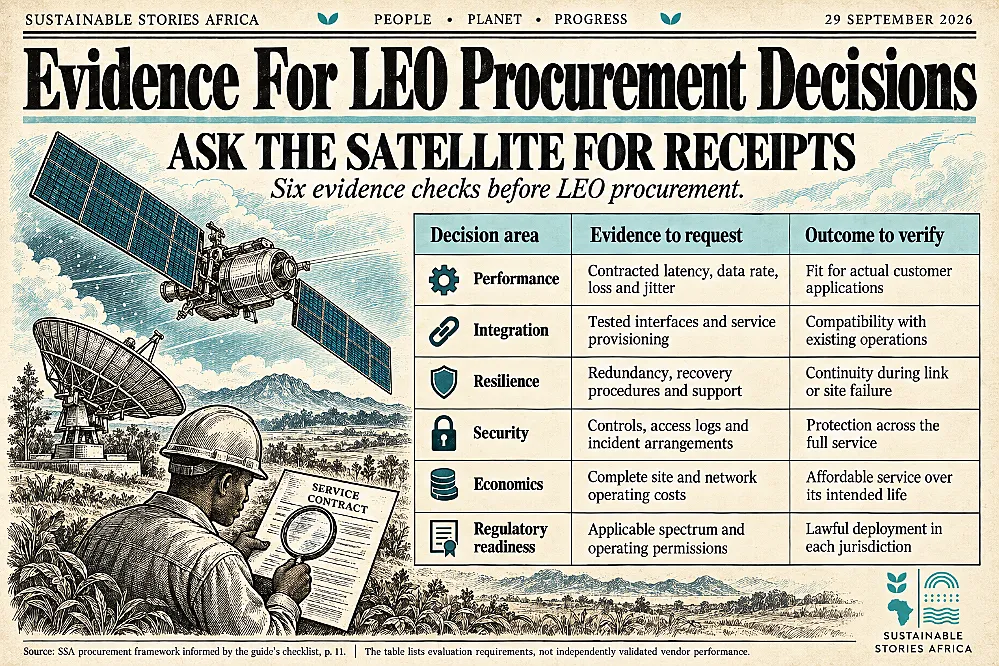
Operators should test with representative traffic and clear acceptance criteria.
- Procurement should define responsibility for failures across satellite and terrestrial components, rather than leaving customers to navigate separate suppliers.
- Cybersecurity reviews should cover terminals, management access and the handling of customer information.
Public authorities can support responsible expansion through transparent permissions and infrastructure planning.
- Where public funding is involved, proposals should identify intended beneficiaries, affordability assumptions and how outcomes will be measured.
- Communities and service institutions should inform demand assessments so that investment responds to real use.
Path Forward – For Meaningful African Connectivity
African operators should test carrier-grade LEO services against defined needs, complete costs and practical integration requirements.
Deployment plans must account for power, permissions and customer affordability.
Satellite capacity can become one part of a more resilient network.
Its development value will be demonstrated through dependable service and useful access, with transparent evidence distinguishing vendor promises from delivered performance.