Most surveyed chief sustainability officers expect sustainability progress to hold or improve over the next year, even as geopolitics and short-term costs constrain action.
Their emphasis is shifting towards delivery through business operations.
The World Economic Forum’s September 2026 outlook suggests African firms will need credible plans for adaptation, technology use, and financing, not just broad commitments.
Corporate Confidence Persists Through Global Uncertainty
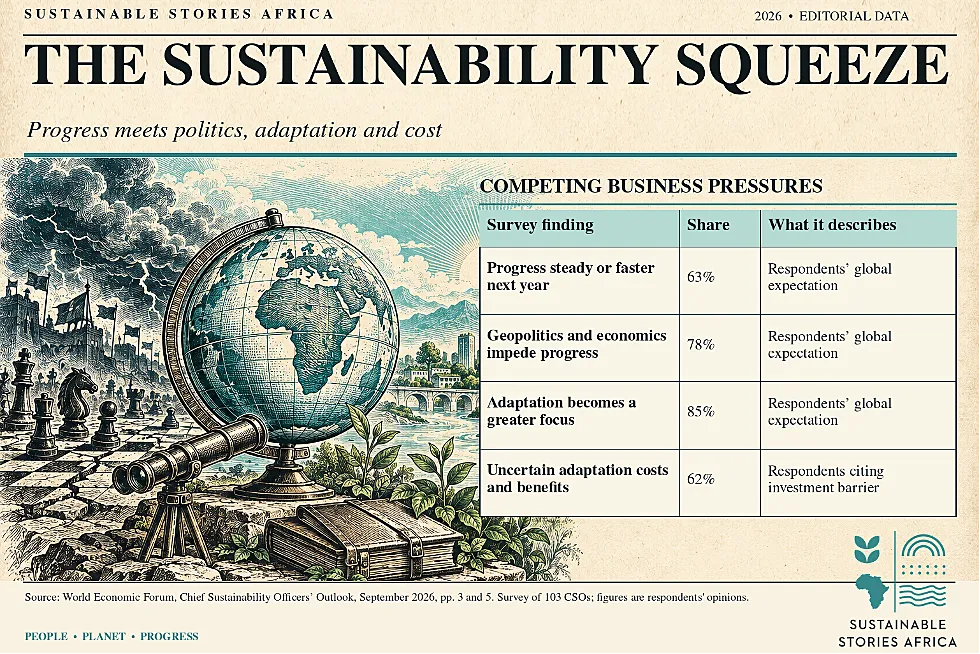
Nearly two-thirds of chief sustainability officers surveyed by the World Economic Forum expect global sustainability progress to remain steady or accelerate over the next year.
Its inaugural Chief Sustainability Officers’ Outlook finds 63% hold that view, while about three-quarters expect their companies’ transition-related investment to stay level or increase over the following 12 months.
That optimism has limits.
- Some 78% expect geopolitical and macroeconomic conditions to hold back progress.
The report hinges on 103 anonymised responses gathered from 10 February to 18 March 2026 from 189 sustainability leaders at large companies.
It presents a view of those respondents, not a survey of all businesses or a regional forecast for Africa.
Commercial Logic Begins To Shape Delivery
The respondents place business economics at the centre of the next phase.
- Looking three years ahead, 64% of respondents identify a clear business case as an accelerator of sustainability measures;
- 56% point to cheaper and more available technologies.
- At the same time, 68% identify policy uncertainty as a force that could slow progress,
- 61% cite short-term performance pressure
- 54% highlight international tensions.
About two-thirds say senior executives still primarily approach sustainability as a compliance issue.
However, the report describes a growing focus on competitiveness, resilience and operational choices.
- The shift matters when a company has to decide whether a cleaner process reduces input costs, whether an alternative supplier lowers disruption risk, or whether its infrastructure can operate through extreme heat and flooding.
The survey period itself illustrates the uncertainty behind these judgements.
- Responses were collected during a period of geopolitical escalation, though the Forum notes that most had been submitted before the late-February events it discusses.
- Responses span five continents but are not broken down by region.
The percentages therefore describe a group of large-company sustainability officers and should not be applied mechanically to small enterprises, governments or African markets as a separate estimate.
Artificial Intelligence Creates An Execution Tradeoff
Nearly three-quarters of surveyed officers expect artificial intelligence and other digital tools to support sustainability progress over the next year.
- They identify uses in risk modelling, efficiency, measurement and reporting.
- At the same time, 77% point to the energy and resource demands of AI infrastructure as its most significant negative effect.
That is a practical issue for markets where electricity and water are already constrained.
- A company may use digital tools to locate waste or track a supplier, but it should account for the power, equipment and data needed to operate them.
- The outlook does not claim that every use of AI reduces emissions.
It calls for judgement about where the operational gains justify the resource cost.
Adaptation Investment Needs A Credible Return
Physical climate impacts receive stronger attention:
- 85% expect adaptation to become a greater global focus.
- 77% agree that private-sector investment will be decisive.
However, 62% cite uncertainty about costs and benefits as a constraint.
- A resilience project often prevents a future loss rather than producing a simple new sales line; that makes its financial case harder to present.
- For African businesses, such choices can include heat-resistant facilities, reliable cooling, water security or stronger logistics links.
These examples illustrate the commercial decisions implied by the global survey;
- The report does not provide separate Africa-only survey percentages.
- To attract funding, businesses can estimate disruption costs, show who benefits, and identify cash flows or risk-sharing arrangements that support repayment.
The case for adaptation may differ sharply by sector.
- A port operator can quantify interruption days from flooding;
- An agricultural processor may need to model water availability over several harvests;
- A hospital may value dependable cooling during heatwaves.
Each needs a baseline, an estimate of possible losses and a way to measure whether an intervention works.
The Forum argues that risk-sharing mechanisms and clearer revenue or repayment models can help turn these avoided costs into projects financiers can assess, especially when the benefits are spread across several parties.
Public procurement can also reward resilience where its benefits extend beyond a single company.
Path Forward – Connects Resilience With Capital
Boards should test sustainability proposals against operational savings, avoided disruption and measurable risk reduction.
Investment plans should specify costs, accountability and the evidence used to update decisions.
Financiers and policymakers can help translate adaptation benefits into investable projects, while tracking the resource demands of new technologies.
The survey points to sustained action, but its expectations remain forecasts rather than delivered results.