
AI competition is changing how companies choose technology, move data and serve customers.
West Monroe argues that national policy, infrastructure and workplace expectations increasingly shape distinct AI markets.
African companies need to assess these differences to improve and develop their own capabilities.
The opportunity is to combine access to global innovation with local accountability, relevant skills and technology choices that can adapt when operating conditions change.
AI Competition Reaches African Business Strategy
An African company expanding abroad may discover that an AI tool approved at headquarters requires different controls in another market.
- Questions about customer information, model availability and the use of automated recommendations now belong in market-entry planning, rather than being left until deployment.
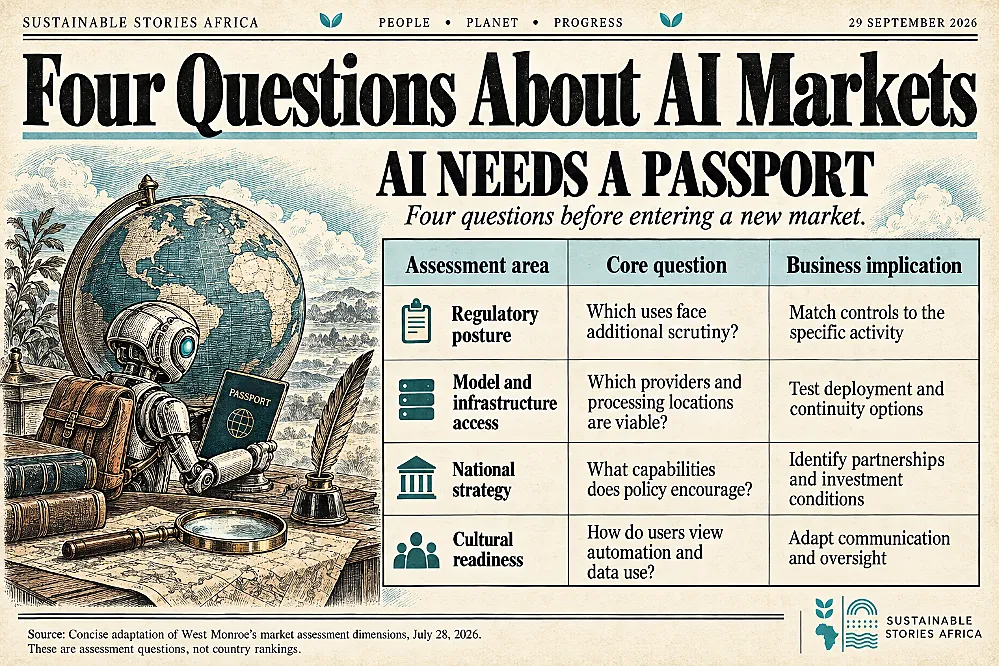
West Monroe’s July 28, 2026 analysis describes increasingly distinct AI ecosystems shaped by national regulation, infrastructure, industrial strategy and cultural expectations.
- It recommends treating changing market conditions as a leadership issue and assessing the ability to substitute models
The implications extend beyond multinational corporations.
- Exporters, banks, technology firms and outsourced service providers may inherit requirements from customers or partners overseas.
As of September 29, 2026, SSA’s analysis is that competitiveness depends partly on understanding these operating conditions and demonstrating that technology can be used responsibly across them.
National Choices Create Different Operating Conditions
The European Commission describes the EU AI Act as a risk-based framework applying to developers and deployers in relation to specific AI uses.
- The implication for a company is that a general statement about using AI says little about the obligations surrounding a particular activity.
- The intended use and the organisation’s role matter.
African policy also has its own development purpose.
- The African Union’s Continental Artificial Intelligence Strategy calls for coordinated national approaches and cooperation, linking AI with inclusive and responsible development.
- Its agenda includes human capital, research capacity and an enabling institutional environment.
- It is a continental strategic framework, not a single law replacing national requirements.
These approaches illustrate why market assessments need specificity.
- An organisation should identify the product, the affected people, the information being processed and the institutions that govern the activity.
- It should distinguish enacted rules from policy ambitions and procurement preferences.
SSA’s inference is that a supposedly cheaper technology choice can become expensive if it requires a late redesign, interrupts customer service or cannot support the evidence an overseas buyer needs.
Assessing those constraints early can improve the quality of investment decisions.
Compliance Depends On Actual Business Activities
Consider an illustrative African outsourcing company preparing customer-support summaries for several international clients.
- Its employees may handle different categories of information under different contracts.
- A single public chatbot account cannot, by itself, resolve whether those records may be processed by a particular service or retained in a particular location.
The company would need an inventory of applications and information flows.
- It should document who supplies data, what employees enter, where processing occurs, which parties can access outputs and how records are deleted or retained.
- Contractual and legal permissions should both be established; one does not automatically provide the other.
The UNESCO Recommendation on the Ethics of Artificial Intelligence places human rights, fairness, transparency and human oversight at the centre of responsible development.
- These principles allow a useful reference for examining the effect of a system on people, while national and sector rules determine specific obligations.
Practical evaluation should include local performance.
- A system handling agricultural claims, public-service enquiries or regional trade documents may need vocabulary and context that differ from its original benchmarks.
- An output can be fluent while still misinterpreting a person’s situation.
Organisations should test realistic cases with competent reviewers and retain a route for correction.
Infrastructure choices also involve trade-offs.
- Locally hosted systems can offer control over deployment, but they require engineering, security and maintenance capacity.
- Managed services may simplify operations while creating supplier dependencies.
Neither model removes responsibility for the information processed or decisions supported.
Local Capability Can Strengthen Market Participation
The business opportunity is to develop services that clients can trust across jurisdictions.
- Companies that can show their data controls, evaluate local performance and adapt deployments may be better positioned to compete for work that requires verifiable oversight.
- This is an analytical proposition, not a forecast of guaranteed revenue.
Skills investment is central.
- The Future of Jobs Report 2025 finds that 86% of surveyed employers expect AI and information-processing technology to transform their operations by 2030.
- It also identifies AI and big data among the fastest-growing skill areas.
These are expectations from a global employer survey, not evidence that every African business needs the same technical workforce.
An effective team needs people who understand the service and the technology.
- Customer staff can identify recurring misunderstandings, domain specialists can test outputs, and engineers can assess reliability.
- Managers need to recognise where an automated recommendation creates a decision requiring explanation or review.
Africa’s contribution need not be confined to importing tools.
- Relevant datasets, locally grounded evaluation, technical maintenance and applications addressing specific business problems can create value.
Such work requires clear arrangements for data rights and investment in the people who maintain the service after launch.
Leaders Need A Practical Adaptation Plan
NIST’s AI Risk Management Framework offers voluntary guidance for incorporating trustworthiness considerations into AI design, development, use and evaluation.
Its guidance and generative AI profile can inform internal practices, but they do not substitute for applicable law.
SSA recommends using a common internal standard for documentation, testing and accountability, with additional controls where a market or customer relationship requires them.
- The standard should identify who approves applications, how incidents are reported and when a material change triggers renewed assessment.
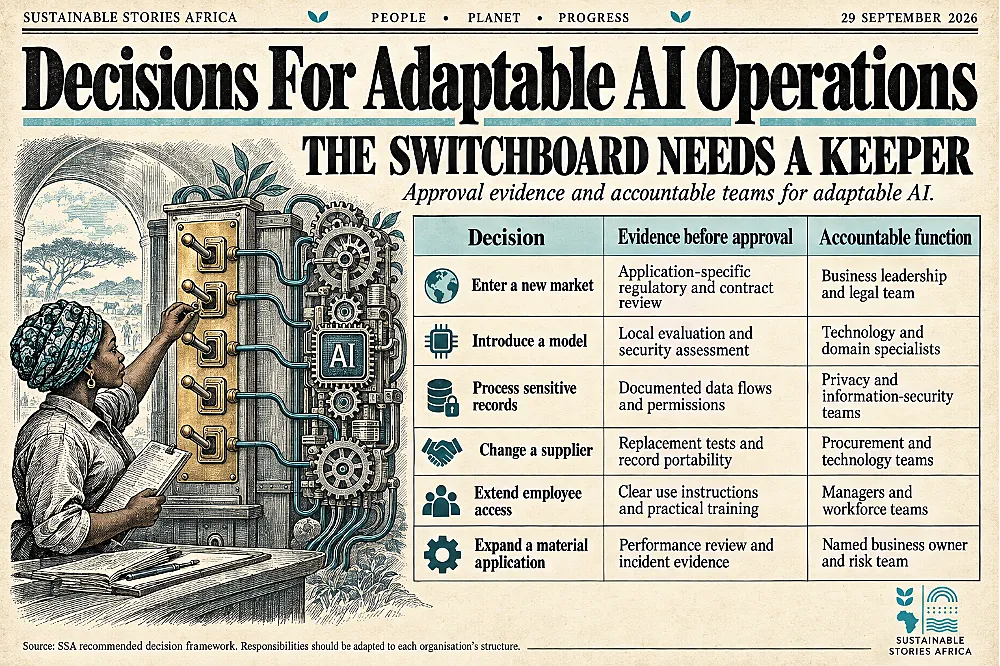
Procurement teams should ask whether a provider can supply documentation, notify customers of meaningful changes and support migration.
- A replacement plan should include the cost of retesting and the effect on employees. Portability is useful only if an alternative can perform the required work safely.
Governments can improve the operating environment through clearer coordination, workforce development and public procurement that rewards evidence of competent delivery.
Businesses should maintain a dated record of requirements and assumptions to identify changes before they interrupt operations.
Path Forward – For African AI Competitiveness
African firms should map their actual AI activities, establish common operating controls and review market-specific requirements before expansion.
Technology decisions should account for local performance, data rights and practical supplier replacement.
Public policy can support participation through skills, research and dependable institutions.
The objective is greater capacity to develop and use AI that serves African needs while meeting the expectations of customers and partners elsewhere.