Sub-Saharan Africa has closed 68.8% of its measured gender gap, according to the World Economic Forum’s 2026 report.
Namibia ranks fourth globally, while Chad is last among the 145 economies covered.
The contrast shows why progress assessment in education, work and political power should be country-specific, not inferred from a single regional average.
Africa Records Gains Alongside Wide Disparities
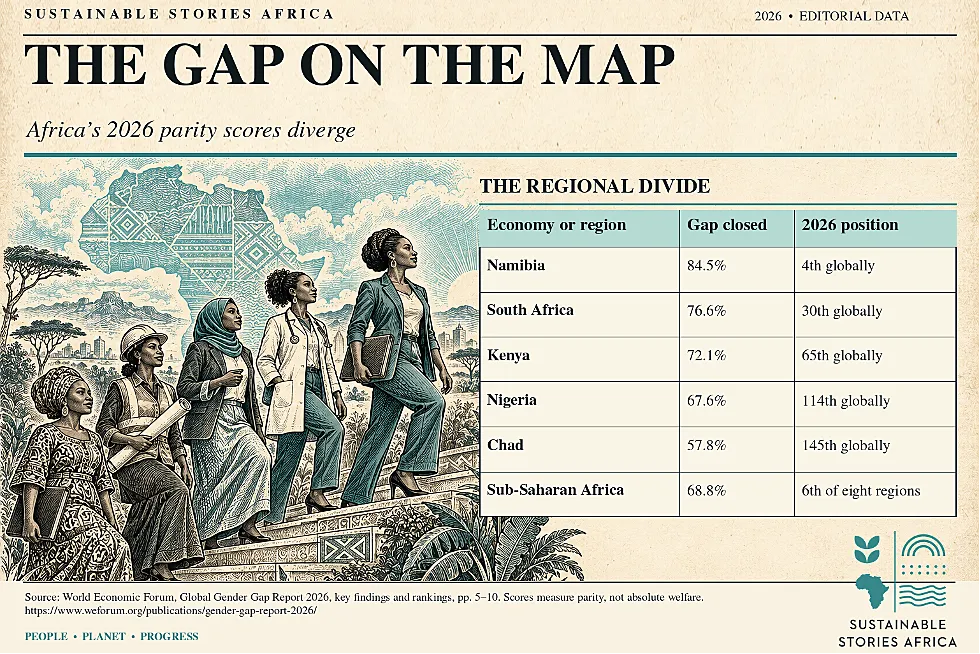
Sub-Saharan Africa has closed an average of 68.8% of its measured gender gap, placing sixth among the eight regions in the World Economic Forum’s Global Gender Gap Report 2026.
The region has gained 6.0 percentage points since 2006, but performance varies more widely between its economies than in any other region.
- Namibia ranks fourth worldwide with 84.5% of its gap closed.
- Chad stands at 57.8%, ranking 145th of the 145 economies in this year’s index.
- South Africa scores 76.6% and ranks 30th;
- Kenya scores 72.1% and ranks 65th;
- Nigeria scores 67.6% and ranks 114th.
The index measures relative gaps between women and men across four dimensions.
A higher score does not by itself mean living standards or service quality are high.
Work And Leadership Drive Regional Progress
The region’s greatest long-run improvements have come in economic participation and opportunity, up 8.0 percentage points since 2006.
- Within that dimension, the report records gains in parity among legislators, senior officials and managers, labour-force participation and estimated earned income.
- These indicators point to more women entering paid work and positions of authority relative to men, although the gains are far from uniform.
Educational attainment has improved across indicators; however, Sub-Saharan Africa remains the lowest-ranked region on that dimension, with more than ten percentage points of its gender gap still to close.
Political empowerment has advanced by 6.0 percentage points since 2006, supported particularly by stronger parliamentary representation.
- These measures do not show that every girl completes school or that every woman can obtain a secure job; they show changes in measured parity.
The rankings also require care when used in public debate.
- Kenya gained 33 places from the previous edition, according to the report, but rank movements can reflect changes among other economies as well as domestic progress.
- Its index score, 72.1%, provides a more direct snapshot of measured parity in 2026.
For comparisons over time, we apply the same methodology consistently to indicators within the same countries; that is why the Forum uses a constant 97-economy sample for its long-run estimate.
Global Averages Conceal The Slowest Dimensions
Globally, the report finds 69.2% of the gender gap closed in 2026.
- Health and survival is at 96.2%
- Educational attainment at 96.9%
- Economic participation and opportunity stands at 61.7%
- Political empowerment at just 22.1%.
The 2026 edition covers 145 economies, but its estimate that parity is 120 years away draws on the trend for a constant group of 97 economies included since 2006.
It is a projection at the observed pace, not a promised date.
The African comparison complicates a simple income story.
- Namibia reaches the global top five while many higher-income economies score lower.
- Regional results also mask local barriers to financing, childcare, safe travel, digital access and promotion.
- Policies can be more effective when they address the bottleneck shown by a country’s own economic, educational and political indicators.
Targeted Policy Can Convert Parity Into Opportunity
- Employers can examine recruitment, pay and advancement by gender, then correct barriers that keep qualified women from senior roles.
- Governments can use education and labour data to focus on school retention and pathways into formal work.
- Political institutions can track whether candidate selection and representation improve over time.
These are practical implications of the index, not interventions evaluated by this report.
No economy in the 2026 edition has achieved full measured parity.
- This fact, alongside large differences within Africa, cautions against treating a rising regional score as completion.
- Sustained gains will depend on whether measurable access to education leads to better earnings, leadership and public decision-making.
The global evidence shows where the hardest work lies.
- The report estimates 129 years to close the economic participation gap and 194 years to close the political empowerment gap at the current pace, compared with eight years for educational attainment.
- These are trend-based estimates and can change with policy or economic conditions.
For a company or public agency, tracking women’s progress from entry into training to hiring, pay and leadership can show where a broad commitment stops producing results.
Path Forward – Requires Country-Level Measures
Policymakers should track each of the four index dimensions alongside local evidence on school completion, employment quality and representation.
Employers and investors can publish gender-disaggregated outcomes and act where gaps persist.
The next test is whether regional progress reduces the disparities between economies and turns formal access into economic and political influence for women.